Overview
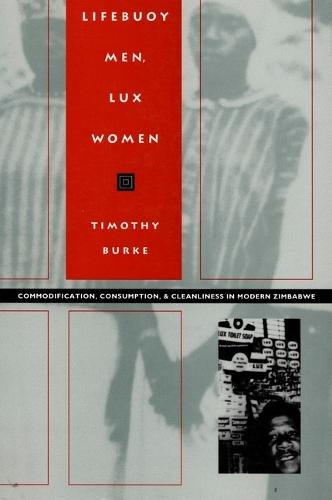
How do people come to need products they never even knew they wanted? How, for example, did indigenous Zimbabweans of the 1940s begin to believe that they required Lifebuoy soap? Offering a glimpse into the intimate workings of modern colonialism and global capitalism, Timothy Burke takes up these questions in Lifebuoy Men, Lux Women, a study of post-World War II commodity culture in Zimbabwe. With particular attention to cosmetic products and the contrast between colonial and pre-colonial ideas of cleanliness, Burke examines the role played by commodity culture, changing patterns of consumption, and the spread of advertising in the making of modern Zimbabwe. His work combines history, anthropology, and political economy to show how the development of commodification in the region relates to the social history of hygiene. Within this framework, and drawing on a wide variety of historical sources, Burke explores dense interactions between commodity culture and embodied aspects of race, gender, sexuality, domesticity, health, and aesthetics in a colonial society. Rather than viewing the production of needs simply as an imposition from above, Lifebuoy Men, Lux Women shows what heterogeneous and complex processes, involving the aims and histories of both colonizers and colonized, produced these changes in Zimbabwean society. Integrating political economy, cultural studies, and a wide range of the social sciences, Lifebuoy Men, Lux Women will find readers among scholars of colonialism, African history, and ethnography as well those for whom the problem of commodification is a significant theoretical issue.
Full Product Details
Author: Timothy Burke
Publisher: Duke University Press
Imprint: Duke University Press
Dimensions:
Width: 16.50cm
, Height: 3.20cm
, Length: 24.80cm
Weight: 0.703kg
ISBN: 9780822317531
ISBN 10: 0822317532
Pages: 312
Publication Date: 09 May 1996
Audience:
College/higher education
,
General/trade
,
Postgraduate, Research & Scholarly
,
General
Format: Hardback
Publisher's Status: Active
Availability: In Print 
This item will be ordered in for you from one of our suppliers. Upon receipt, we will promptly dispatch it out to you. For in store availability, please contact us.
Table of Contents
Acknowledgments vii Introduction 1 1. Cleanliness and Civilization : Hygiene and Colonialism in Southern Africa 17 2. Education, Domesticity, and Bodily Discipline 35 3. Buckets, Boxes, and Bonsella : Precolonial Exchange, the Kaffir Truck Trade, and African Needs 63 4. Manufacturing, the African Market, and the Postwar Boom 91 5. The New Mission: Advertising and Market Research in Zimbabwe, 1945-1979 125 6. Bodies and Things: Toiletries and Commodity Culture in Postwar Zimbabwe 166 Appendix: Budgetary Charts, 1957-1970 217 Notes 229 Bibliography 271 Index 293
Reviews
“Well researched, highly intelligent, well written, and markedly original—there is nothing like it in the literature of East, Central, and Southern Africa.”—Terence Ranger, Oxford University
An exciting and original contribution to a number of areas of study: the history of Africa, the history of the body, and the history of commodification. It is clearly the result of painstakingly thorough research combined with considerable analytical skill and historical imagination. It is one of the few pieces of African historical writing I have read recently which successfully combines empirical research with a real grasp of theory. -Megan Anne Vaughan, Oxford University Well researched, highly intelligent, well written, and markedly original-there is nothing like it in the literature of East, Central, and Southern Africa. -Terence Ranger, Oxford University
Burke's overall project is successful in combining trends in current cultural studies and history to delineate changes in individual appropriations of toiletries within a social historical context of African and European interaction in colonial Zimbabwe. In this respect the work will serve well to break from the one-dimensional body of literature that exists in much of the social history covering this period and region. <br>--Timothy Scarnecchia, International Journal of African Historical Studies
Author Information
Timothy Burke is Associate Professor of History at Swarthmore College.
Tab Content 6
Author Website:
Countries Available
All regions
|