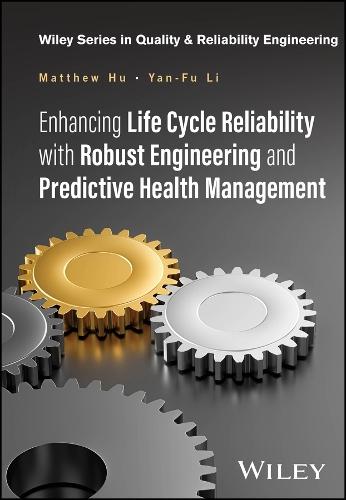
Enhancing Life Cycle Reliability with Robust Engineering and Predictive Health Management

Author:   Matthew Hu (University of Houston, TX, USA) ,  Yan-Fu Li (Tsinghua University, China) ,  Andre V. Kleyner (Aptiv, USA)
Publisher:   John Wiley & Sons Inc
ISBN:  

9781394182381


Pages:   304
Publication Date:   04 June 2026
Format:   Hardback
Availability:   Awaiting stock   Availability explained


Our Price $228.95 Quantity:  
Pre-Order

Share |

Enhancing Life Cycle Reliability with Robust Engineering and Predictive Health Management


Overview

Enhancing Life Cycle Reliability with Robust Engineering and Predictive Health Management Complete process for ensuring product performance through robust concept design, robust optimization, selection, and verification in an uncontrollable user environment Enhancing Life Cycle Reliability with Robust Engineering and Predictive Health Management enables readers to build a robustness-thinking-based approach for robust design for reliability and prognostic health management (PHM), explaining best practices from early product design through the entire product lifecycle, leading to lower costs and shorter development cycles. The text integrates key tools and emerging reliability management systems into a comprehensive program for developing more robust and reliable technology-based products. The text provides value-added strategies for robustness development in new products and health management with three main types of robustness development and reliability growth case studies: intrinsic, instrumental, and collective. Readers can harness multiple forms of engineering knowledge to inform decision-making within reliability contexts. To ensure customer satisfaction, the text helps readers consciously consider noise factors (environmental variation during the product’s usage, manufacturing variation, and component deterioration) and cost of failure in the field for the Robust Design method. Written by two highly qualified authors, this book includes information on: Effective reliability efforts in an integrated product development environment, failure mode avoidance, and reliability analysis using the physics-of-failure process Essentials of robustness and robust design in reliability improvement, covering design-in reliability up front, eliminating failures prior to testing, and increasing fielded reliability Rapid, cost-effective deployment of health and usage monitoring systems and improving diagnostic and prognostic techniques and processes ROI analyses for PHM, selecting and deploying sensors, setting up data transmission channels, and developing data collection and data pre-processing functions Comprehensive in scope, this book is an essential resource on the subject for all individuals responsible for product development and design, increasing life-cycle product reliability, process quality, or reducing costs in a design, development, manufacturing, and maintenance.

Full Product Details

Author:   Matthew Hu (University of Houston, TX, USA) ,  Yan-Fu Li (Tsinghua University, China) ,  Andre V. Kleyner (Aptiv, USA)
Publisher:   John Wiley & Sons Inc
Imprint:   John Wiley & Sons Inc
ISBN:  

9781394182381


ISBN 10:   1394182384
Pages:   304
Publication Date:   04 June 2026
Audience:   Professional and scholarly ,  Professional & Vocational
Format:   Hardback
Publisher's Status:   Forthcoming
Availability:   Awaiting stock   Availability explained

Table of Contents

I.       Scope                                                                                               1.1.       Purpose       1.2.       Essential of Robustness and Robust Design in Reliability Improvement 1.3.       Effective Reliability efforts in an Integrated Product Development   Environment 1.4.       Enhancing Reliability Integration into the Product Development Process 1.5.       Physics of Failures: Reliability Analysis Using the Physics-of-Failure Process 1.6.       Failure Mode Avoidance 1.7.       Design for Six Sigma 1.8.       Robust Design for Reliability 1.9.       Prognostic Health Management 1.10.   The importance of digital quality in Life Cycle Reliability through Robustness Development and Prognostics & Health Management             II.      Robustness Thinking and Strategies for Reliability Development 2.1     Introduction 2.2     What Is Robustness Thinking? 2.3     Why Robust Design? 2.4     The Concept of ""Flow"" in Robust Design 2.5     Robustness Development Strategy 2.6     Three Phases of Robust Design 2.7     Robustness Measurement: Measurement of Function using S/N ratio. 2.7.1  Static S/N Ratio 2.7.2  Dynamic S/N Ratio     III.     Chapter 3:  Robust Design Principles, Tactics and Primary Tools   3.1     Introduction 3.2     Ideal Function: Ideal Transformation System Input and output relationship 3.3     Ideal Function and Quality Problems 3.4     Identification and Classification of Design Parameters: P-Diagram 3.5     Robustness Measurement: Measurement of Function using S/N Ratio 3.6     S/N Ratio Improvement and Variation Reduction 3.7     S/N Ratio, the Additive Model and the Conservative Laws of Physics 3.8     Opportunity for Robustness Development:  Interactions between Control and   Noise Factors 3.9     Two-step Optimization 3.10   Robust Parameter Design Strategy and Steps 3.11   Quality Measurement: Loss Function     IV.     Chapter 4:  Robust Design for Reliability (RDfR) A Comprehensive Approach to Product Excellence    4.1     Introduction 4.2     A Comprehensive Approach to Product Excellence 4.2.1 Building a Strong RDfR Team 4.2.2 Concurrent Engineering in RDfR 4.2.3 Implementation Readiness for RDfR 4.2.4 Preventing Failure Modes Through Vigilance 4.2.5 Supply Chain Integration in RDfR 4.2.6 Regulatory Compliance in RDfR 4.2.7 Digital Quality in RDfR 4.3     Roadmap for Robust Design for Reliability Execution           4.3.1 Identify Phase 4.3.1.1 Identify Phase Purposes 4.3.1.2 Identify Phase Activities 4.3.1.3 Identify Phase Deliverables           4.3.2 Design Phase  4.3.2.1 Design Phase Purposes 4.3.2.2 Design Phase Activities 4.3.2.3 Design Phase Deliverables           4.3.3 Optimize Phase 4.3.3.1 Optimize Phase Purpose 4.3.3.2 Robustness ""Rules of Engagement"" 4.3.3.3 Optimize Phase Activities 4.3.3.4 Optimize Phase Deliverables           4.3.4 Verify Phase 4.3.4.1 Verify Phase Purpose 4.3.4.2 Verify Phase Activities 4.3.4.3 Verify Phase Deliverables 4.4     Robust Design for Reliability Principles for Prognostics & Health Management (PHM) 4.5     Scorecard for Robust Design for Reliability Implementation 4.6     Digital quality through Robust Design for Reliability 4.7     Critical Parameter Development and Management (CPD&M) Process and Phases     V.      Prognostics & Health Management   CHAPTER 5: 5.1.1. Justification for Prognostic Health Management (PHM) in Robust System Design 5.2.1 PHM System Architecture 5.3.1. System Components and their Functions 5.3.2. Integration with Existing Maintenance Operations 5.3.3. Scalability and Adaptability in PHM Design   CHAPTER 6: Failure Signatures and Imperfect Data treatment 6.1. Characterizing Failure Signatures 6.1.1. Identifying Degradation Patterns 6.1.2. Signature Analysis for Different System Components 6.1.3. The Role of Signatures in Failure Prediction 6.1.4. Data Collection for Signature Development 6.1.5. Data Envelopment Analysis (DEA) for Signature Refinement 6.2. Advanced Signature Analysis Techniques 6.2.1. Machine Learning for Signature Recognition 6.2.2. Multivariate Analysis of Complex Signatures 6.2.3. Signature Synthesis for Enhanced Prognostic Accuracy 6.2.4. Heuristic Principles in CBD Modeling 6.3. Impact of Imperfect Data on PHM 6.3.1. Sources and Types of Imperfect Data 6.3.2. Effects of Data Quality on Prognostic Accuracy 6.3.3. Data Preprocessing for PHM 6.3.4. Advanced Data Conditioning Methods   CHAPTER 7: Guidelines for PHM system implementation 7.1. Enabling Technologies for PHM 7.1.1. Sensor Technology Selection and Integration 7.1.2. Developing Robust Sensor Technology and Integration Strategy for PHM 7.1.2.1. Sensor Technology Development for PHM 7.1.2.2. Conducting Robustness Assessment of Sensors 7.1.3. Advanced Computing Platforms for PHM Analytics 7.1.4. Evaluation Metrics for PHM Systems 7.1.5. Economic Justification for PHM Implementation 7.2. Identifying and Selecting Robust Sensors for PHM 7.2.1. Modular Architecture for PHM Systems 7.2.2. Redundancy and Fault Tolerance in System Design 7.2.3. User-Centric Design for Ease of Integration 7.2.4. Prototype/Test-Bench Development for PHM System Validation 7.2.5. Verification Against Real-World Failure Data 7.2.6. Continuous System Evaluation Post-Deployment 7.3. Integration and Validation for PHM-Ready Systems 7.4. Hardware-Level Integration 7.5. Validation, Calibration, and Fault Tolerance 7.6. Advanced Computing Platforms for PHM Analytics 7.6.1. Edge Computing 7.6.2. Cloud Computing 7.6.3. Fog Computing 7.6.4. Distributed Computing Frameworks 7.6.5. High-Performance Computing (HPC) 7.7. AI-Accelerated Hardware 7.8. Evaluation Metrics for PHM Systems 7.9. Robust PHM System 7.9.1.  Modular Architecture for PHM Systems 7.9.2. Robustness, Redundancy, and Fault Tolerance in PHM System Design 7.9.2.1. Redundancy in PHM Architecture 7.9.2.2. Fault Tolerance Mechanisms 7.9.2.3. Building for Long-Term Reliability and Cost Effectiveness 7.9.3. User-Centric Design for Ease of Integration 7.9.4. Implementation Measures of User-Centric Design in PHM 7.10. Robust Prototype and Test-Bench Development for PHM System Validation 7.10.1. System-Level Requirements with Robustness in Mind 7.11. Modular, Robust PHM Prototype Architecture 7.12. Test-Bench Design for Robustness Validation 7.13. Embedding Robustness into PHM Prototyping 7.13.1. Modular Prototype Architecture 7.14.  Verification Against Real-World Failure Data 7.14.1 Why Real-World Data Validation Matters 7.14.2. Types and Sources of Real-World Failure Data 7.14.3. Public Benchmark Datasets 7.14.4. Structured Methods for Real-World Verification 7.14.5. Continuous System Evaluation Post-Deployment 7.14.6. Rationale for Continuous Evaluation 7.14.7. Key Components of a Post-Deployment Evaluation Framework 7.15. Organizational Integration and Governance 7.15.1. Strategic Implementation of PHM 7.15.2. Future-Proofing PHM Systems for Technological Advancements 7.16 Case Study of PHM System Development:     CHAPTER 8: Case Study for Robust Design for Reliability (RDfR) 8.1 RDfR Case Study: Detonator Power Supply Module (DPSM) 8.1.1. Overview 8.1.2. RDfR Team Building 8.1.3. Why DPSM Was Chosen 8.1.4. RDfR Scorecard as a Framework 8.1.5. Key Elements of the RDfR Case Study 8.1.6. RDfR Phases in DPSM Case Study 8.1.7. Summary of Benefits for the Robust Design for Reliability (RDfR) Case Study on           the Detonator Power Supply Module (DPSM)

Reviews

Author Information

Matthew Hu, Senior Vice President, Engineering and Quality, Haylion Technologies, and Adjunct Professor, University of Houston, USA. Dr. Hu is a Certified Robust Design Expert using Taguchi Method, a Certified LSS Master Black Belt, and a certified DFSS Master Black Belt. Yan-Fu Li, Professor, Tsinghua University, China. He is the Principal Investigator (PI) of several government projects including the key project funded by National Natural Science Foundation of China.

Tab Content 6

Author Website:  

Countries Available

All regions
Latest Reading Guide

April RG 26_2


Shopping Cart
Your cart is empty
Shopping cart
Mailing List