Overview
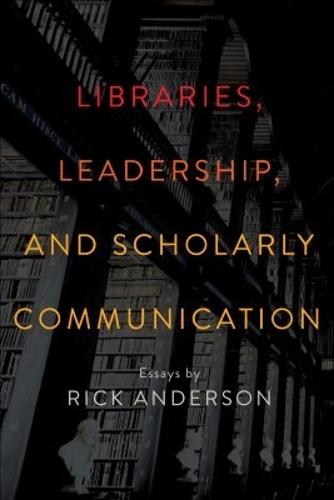
A creative thinker on topics related to library collections and scholarly publishing, Rick Anderson does not back away from controversy. “Whenever we, as members of an organization like a library, are forced to choose between good things, we may start by trying to figure out some way to have both things,” he writes in the preface. “But in many cases, that will turn out to be impossible and we’ll have to decide which good thing is going to take priority over the other. We can’t make that decision without invoking values, and the moment we start invoking values is when the conversation can take a really difficult and interesting turn.” When it’s time for your organization to make choices and set priorities, this collection of essays, articles, white papers, and blog posts will provide conversation starters for your strategic discussions. Anderson offers engaging, persuasive arguments on a range of timely topics, such as: the decline of print; patron-driven acquisitions; Open Access (OA); blacklisting publishers and relations with publishers’ sales reps; patron privacy; symptoms of zealotry; unintended consequences of the print-on-demand model; and how to define library value . Ideal for browsing, the ideas in this collection will kickstart your brainstorming sessions and spur your organization to confront choices head on.
Full Product Details
Author: Rick Anderson
Publisher: American Library Association
Imprint: ALA Editions
Dimensions:
Width: 15.10cm
, Height: 1.20cm
, Length: 22.90cm
Weight: 0.328kg
ISBN: 9780838914335
ISBN 10: 0838914330
Pages: 240
Publication Date: 30 June 2016
Audience:
Professional and scholarly
,
Professional & Vocational
Format: Paperback
Publisher's Status: Active
Availability: In Print 
This item will be ordered in for you from one of our suppliers. Upon receipt, we will promptly dispatch it out to you. For in store availability, please contact us.
Table of Contents
Preface Section I: Libraries and Their Collections, Now and in the Future 1: Being Essential Is Not Enough 2 : My Name Is Ozymandias, King of Kings 3: The Crisis in Research Librarianship 4: The Portal Problem: The Twin Plights of the Encyclopaedia Britannica and the Library Collection 5: On Necessity, Virtue, and Digging Holes with Hammers 6: Can, Should, and Will 7: How Sacred Are Our Patrons’ Privacy Rights? Answer Carefully 8: Crazy Idea #274: Just Stop Collecting 9: Local and Global, Now and Forever: A Matrix Model of “Depth Perception” in Library Work 10: A Quiet Culture War in Research Libraries—and What It Means for Librarians, Researchers, and Publishers 11: Interrogating the American Library Association’s “Core Values” Statement 12: Asserting Rights We Don’t Have: Libraries and “Permission to Publish” 13: Frenemies: The Perfect and the Good, the Noisy and the Important 14: What Patron-Driven Acquisition Does and Doesn’t Mean: An FAQ 15: Reference Services, Scalability, and the Starfish Problem 16: Kitten in a Beer Mug: The Myth of the Free Gift 17: You Might Be a Zealot If . . . 18: It’s Not about the Workflow: Patron-Centered Practices for Twenty-First-Century Serialists 19: Can’t Buy Us Love: The Declining Importance of Library Books and the Rising Importance of Special Collections 20: On Knowing the Value of Everything and the Price of Nothing 21: Preservation, Yes—but What Shall We Preserve? 22: The Struggle for Library Space Section II Scholarly Communication and Library-Publisher Relations 23: On Advocacy, Analysis, and the Vital Importance of Knowing the Difference 24: Signal Distortion: Why the Scholarly Communication Economy Is So Weird 25: Six Mistakes Your Sales Reps Are Making—and Six That Librarians Are Making 26: Prices, Models, and Fairness: A (Partly) Imaginary Phone Conversation 27: Print-on-Demand and the Law of Unintended Consequences 28: Quality and Relevance: A Matrix Model for Thinking about Scholarly Books and Libraries 29: No Such Thing as a Bad Book? Rethinking “Quality” in the Research Library 30: No, You May Not Come Train My Staff 31: On the Likelihood of Academia “Taking Back” Scholarly Publishing 32: Is a Rational Discussion of Open Access Possible? 33: CC BY, Copyright, and Stolen Advocacy 34: Open-Access Rhetoric, Economics, and the Definition of “Research” 35: CC BY and Its Discontents: A Growing Problem for Open Access 36: Deceptive Publishing: Why We Need a Blacklist, and Some Suggestions on How to Do It Right 37: The NPR Model and the Financing of Scholarly Communication Index.
Reviews
Author Information
Rick Anderson is associate dean for collections and scholarly communication in the J. Willard Marriott Library at the University of Utah. He has worked previously as a bibliographer for YBP, Inc.; as head acquisitions librarian for the University of North Carolina Greensboro; and as director of resource acquisition at the University of Nevada, Reno. He serves on numerous editorial and advisory boards, is a regular contributor to The Scholarly Kitchen, and has been a regular contributor to Library Journal’s Academic Newswire. His book Buying and Contracting for Resources and Services: A How-to-Do-It Manual for Librarians was published in 2004 by Neal-Schuman. In 2005, he was identified by Library Journal as a “Mover &Shaker”—one of the “50 people shaping the future of libraries.” In 2008, he was elected president of the North American Serials Interest Group, and he was named an ARL Research Library Leadership Fellow for 2009–2010. In 2013, he was the recipient of the HARRASSOWITZ Leadership in Library Acquisitions Award and was invited to give the Gould Distinguished Lecture on Technology and the Quality of Life at the University of Utah. In 2015, he was elected president of the Society for Scholarly Publishing. He is a popular speaker on subjects related to the future of scholarly communication and research libraries.
Tab Content 6
Author Website:
Countries Available
All regions
|