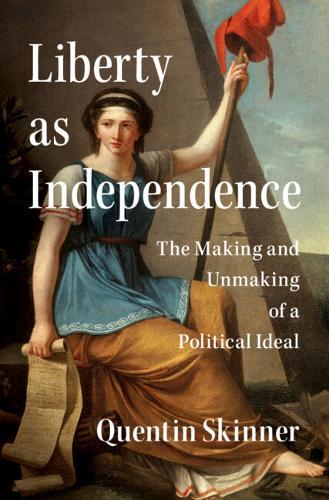
Full Product Details
Author: Quentin Skinner (Queen Mary, University of London)
Publisher: Cambridge University Press
Imprint: Cambridge University Press
Dimensions:
Width: 16.00cm
, Height: 2.20cm
, Length: 23.70cm
Weight: 0.590kg
ISBN: 9781107027732
ISBN 10: 110702773
Pages: 332
Publication Date: 06 February 2025
Audience:
College/higher education
,
Postgraduate, Research & Scholarly
Format: Hardback
Publisher's Status: Active
Availability: Manufactured on demand

We will order this item for you from a manufactured on demand supplier.
Reviews
'The ideal of liberty as independence from arbitrary power was hegemonic from the Roman Republic to the Age of Revolutions until it was rapidly, and seemingly irreversibly, replaced by the reigning notion of liberty as the absence of restraint. No one has done more to excavate the genealogies of these two concepts of liberty than Quentin Skinner. Liberty as Independence draws on decades of research and reflection to present a magisterial account of the anti-democratic and counter-revolutionary displacement of liberty as self-rule and of the prospects for recovering independence as a critical political value.' David Armitage, Harvard University 'In this spectacular book, Skinner takes his story of neo-Roman freedom into the Enlightenment, showing why one view of freedom overturned another, and what was lost in that displacement. Skinner casts a chilling shadow over our current liberal dispensation, opening up an alternative vision of democratic freedom – one that has the power to transform the lives of all those who are subject to the arbitrary will of another.' Hannah Dawson, King's College London 'In this rich and masterly excavation of liberty in political thought, Quentin Skinner shows how liberty understood as independence was vanquished in the liberal era. With brilliant clarity and unmatched attention to the powerplay behind intellectual discourse, he unveils the liberal victory as the loss of an egalitarian and democratic ideal.' Lena Halldenius, Lund University 'Quentin Skinner extends his powerful account of liberty as independence, from classical roots into the eighteenth century's sermons and novels as well as pamphlets and treatises, and in the hands of abolitionists among others. Skinner argues that the ideal was ultimately overturned by opponents of the radical movements it inspired.' Melissa Lane, Princeton University 'We live in the midst of democratic crisis but these tend also to be times when purposive change becomes possible. This is why Liberty as Independence is such a significant book that urgently needs to be engaged with. There is no better guide to liberty and its history in free states than Quentin Skinner. He remains the most lucid of writers and the most brilliant of intellectual historians.' Richard Whatmore, University of St Andrews
'The ideal of liberty as independence from arbitrary power was hegemonic from the Roman Republic to the Age of Revolutions until it was rapidly, and seemingly irreversibly, replaced by the reigning notion of liberty as the absence of restraint. No one has done more to excavate the genealogies of these two concepts of liberty than Quentin Skinner. Liberty as Independence draws on decades of research and reflection to present a magisterial account of the anti-democratic and counter-revolutionary displacement of liberty as self-rule and of the prospects for recovering independence as a critical political value.' David Armitage, Harvard University 'In this spectacular book, Skinner takes his story of neo-Roman freedom into the Enlightenment, showing why one view of freedom overturned another, and what was lost in that displacement. Skinner casts a chilling shadow over our current liberal dispensation, opening up an alternative vision of democratic freedom – one that has the power to transform the lives of all those who are subject to the arbitrary will of another.' Hannah Dawson, King's College London 'In this rich and masterly excavation of liberty in political thought, Quentin Skinner shows how liberty understood as independence was vanquished in the liberal era. With brilliant clarity and unmatched attention to the powerplay behind intellectual discourse, he unveils the liberal victory as the loss of an egalitarian and democratic ideal.' Lena Halldenius, Lund University 'Quentin Skinner extends his powerful account of liberty as independence, from classical roots into the eighteenth century's sermons and novels as well as pamphlets and treatises, and in the hands of abolitionists among others. Skinner argues that the ideal was ultimately overturned by opponents of the radical movements it inspired.' Melissa Lane, Princeton University 'We live in the midst of democratic crisis but these tend also to be times when purposive change becomes possible. This is why Liberty as Independence is such a significant book that urgently needs to be engaged with. There is no better guide to liberty and its history in free states than Quentin Skinner. He remains the most lucid of writers and the most brilliant of intellectual historians.' Richard Whatmore, University of St Andrews 'Skinner's argument is timely and welcome' Jonathan Clark, Times Literary Supplement 'a book of fantastic depth and breadth, full of good learning and effortless erudition, which is sure to become an instant classic.' Yuan Yi Zhu, The Critic 'remarkable … the book's extraordinary scope is matched by a bold thesis' Richard Bourke, Literary Review 'Brilliant.' Indira Ghose, Times of India
Author Information
Quentin Skinner is Emeritus Professor of Humanities at Queen Mary University of London. He was at the Institute for Advanced Study at Princeton between 1974 and 1979, and was Regius Professor of History at the University of Cambridge between 1996 and 2008. He is the author and editor of numerous books on Renaissance and Modern Intellectual History, and the recipient of many awards including the Wolfson Prize for History and a Balzan Prize. Previous publications include the two-volume study, The Foundations of Modern Political Thought (Cambridge, 1978), Liberty before Liberalism (Cambridge, 1998) and, most recently, From Humanism to Hobbes: Studies in Rhetoric and Politics (Cambridge, 2018).