|
|
|||
|
||||
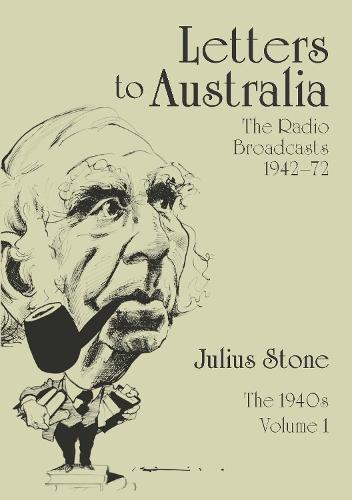
OverviewLetters to Australia is a collection of Julius Stone's radio talks, originally broadcast by the ABC between 1942 and 1972. Recently discovered in the nation's archives, they take the reader back to the mid-20th century, bringing to life the people, events and the sweep of affairs during World War II and its turbulent aftermath, the hopes and fears of individuals and nations. They tell much of Australia's role in that world and that era. More than anyone else at that time, Julius Stone gave Australians a sense that they were part of the world and could, and should, seek to influence these events. Full Product DetailsAuthor: Professor Julius StonePublisher: Sydney University Press Imprint: Sydney University Press Dimensions: Width: 17.60cm , Height: 1.90cm , Length: 25.00cm Weight: 0.400kg ISBN: 9781743323908ISBN 10: 1743323905 Pages: 298 Publication Date: 03 June 2014 Audience: Professional and scholarly , Professional & Vocational Format: Paperback Publisher's Status: Active Availability: Available To Order We have confirmation that this item is in stock with the supplier. It will be ordered in for you and dispatched immediately. Table of ContentsForewords Preface Dedication Part 1: the needs of the hour – wartime broadcasts Editor’s note The common cause American democracy’s New Deal Fighting faith no. one: faith in our cause Fighting faith no. two: need we be confused? Fighting faith no. three: the fascist challenge Fighting faith no. four: democracy’s answer A government of laws and not of men America at our side China at our side A heritage that lives Constitution and liberty in Soviet Russia Appeasement’s defeat These peoples will prevail Part 2: the birth of the United Nations The San Francisco Charter San Francisco Charter – disarmament The American senate and the New World Charter UNO and veto The Soviet-Persian issue in the Security Council Light and shade at UNO World planning in reverse – any progress to world security? Part 3: political aftermath of war, and reconstruction Two state trials of today Cavalcade of conferences – Atlantic Charter to Potsdam Theories for defeat Blocs and cordons sanitaires and the failure of London Out of war, or into one? Truman’s 12 points Cards on the table – face upwards Nationalism and liberation Foreign secretaries to meet in Moscow International stocktaking 1945 Foreign secretaries in Moscow – agreements on procedures for peace Moscow and after – the outlook for 1946 Four-power plan for Japanese disarmament Peace conference: plus ça change … Open diplomacy at the Paris Conference Soviets demand revision of Turkish Straits Treaty This reparations business Evatt and Molotov tussle over terms of peace Moscow Conference III wraps up Part 4: economic aftermath of war, and reconstruction The freedoms of the air Anglo-Soviet relations and the Black Sea Straits Lend-lease and markets Moves to free trade Food and peace Lines of credit and lines of policy Freedom of the air The economic aftermath of the war Wool over their eyes American aid and ideologies of trade The World Trade Charter Peace and plenty By the banks of the Danube (conference on the navigation of the river) Part 5: criminal aftermath of war War crimes and diplomacy The men of Belsen War crimes trial opens in Nuremburg Japanese war criminals on trial Part 6: disarmament and the control of nuclear weapons Disarmament without fears The way of man with the atom Part 7: UK relations with US, USSR, and the Commonwealth The Prime Ministers’ conference and British-American relations When is an ally not an ally? – the future of the Anglo-Soviet Alliance From American aid towards world depression Attlee’s dream The need for reform in the UK-Commonwealth relations American bread upon the waters – complexities of the Marshall Plan The British Commonwealth and European Union Part 8: the evolution of the Cold War Peace, Potsdam, and the atomic bomb Atom politics and the atomic age Nuclear capabilities; spy hunt in Canada Russian aims and the Russian walk-out Mr Byrnes gets tough Planning for the atomic age Soviet American relations and the Canadian arctic Atoms and the man – recent developments on the atomic front State socialism and Anglo-Soviet relations Warring words and words of war – a commentary on the big speeches of the big three Armies at home and abroad The Spitsbergen question America’s perimeter of defence Regionalism and the Western Bloc International police and international politics Checkmate or stalemate? Why Russia sticks to UNO, and how The diplomacy of attraction Atomic bombast The outlook for the fifth Council of Foreign Ministers The might dollar in a matey world And then there were two (great powers) Truth by nationality – aftermath of a collision Yugoslavia on the international frontier Air lift over Berlin Berlin crisis – a trigger for war? Berlin – crisis of war or of negotiation? Part 9: the press and democracy The press and the peace IndexReviewsAuthor InformationJulius Stone (19071985) was Challis professor of jurisprudence and international law at the University of Sydney from 1942 to 1972, then adjunct professor at the University of New South Wales, until his death. Tab Content 6Author Website:Countries AvailableAll regions |
||||