Overview
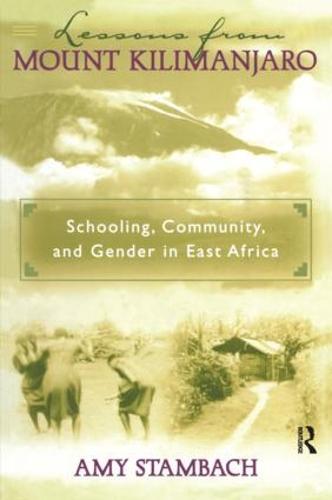
An ethnographic study of a school and community in East Africa focusing on the role school plays in the development of the children's identity and relationships to their parents and community, as well as in the development of the region.
Full Product Details
Author: Amy Stambach
Publisher: Taylor & Francis Ltd
Imprint: Routledge
Dimensions:
Width: 15.20cm
, Height: 1.50cm
, Length: 22.90cm
Weight: 0.374kg
ISBN: 9780415925839
ISBN 10: 0415925835
Pages: 224
Publication Date: 20 April 2000
Audience:
College/higher education
,
General/trade
,
Tertiary & Higher Education
,
General
Format: Paperback
Publisher's Status: Active
Availability: In Print

This item will be ordered in for you from one of our suppliers. Upon receipt, we will promptly dispatch it out to you. For in store availability, please contact us.
Reviews
... [A] welcome contribution to the field of gender and education in Africa...important for those interested in gender issues and concerned about education as a tool to empower women. -Comparative Education Review The strengths of this book lie in its detailed imagery and personal portraits. I appreciated the illustrations and the location map, images to augment the dialogue in the text. The author poses many useful questions. How can such divergent views of schooling be reconciled in a community? How do community members remain loyal to national principles and curriculum even in the face of questions about the direct relevance of the curriculum? The author's honesty about her roles as researchers is refreshing, telling us how she operated both as a participant and as observer, and how she was received as an outsider, with the admonition that a person living in a foreign place should not question everything she sees, but upon returning to her natal household, may comment all she wants.. - Anthropology & Education Quarterly, December 2001 [A] welcome contribution to the field of gender and education in Africa...offers insight into the dynamics that yield differentials in the processes, outcomes, and socioeconomic effects of education...important for those interested in gender issuesand concerned about education as a tool to empower women. -Comparative Education Review May 2002
"""...[A] welcome contribution to the field of gender and education in Africa...important for those interested in gender issues and concerned about education as a tool to empower women."" -- Comparative Education Review ""The strengths of this book lie in its detailed imagery and personal portraits. I appreciated the illustrations and the location map, images to augment the dialogue in the text. The author poses many useful questions. How can such divergent views of schooling be reconciled in a community? How do community members remain loyal to national principles and curriculum even in the face of questions about the direct relevance of the curriculum? The author's honesty about her roles as researchers is refreshing, telling us how she operated both as a participant and as observer, and how she was received as an outsider, with the admonition that ""a person living in a foreign place should not question everything she sees, but upon returning to her natal household, may comment all she wants."" -- Anthropology & Education Quarterly, December 2001 ""[A] welcome contribution to the field of gender and education in Africa...offers insight into the dynamics that yield differentials in the processes, outcomes, and socioeconomic effects of education...important for those interested in gender issuesand concerned about education as a tool to empower women."" -- Comparative Education Review May 2002"
... [A] welcome contribution to the field of gender and education in Africa...important for those interested in gender issues and concerned about education as a tool to empower women. <br>-Comparative Education Review <br> The strengths of this book lie in its detailed imagery and personal portraits. I appreciated the illustrations and the location map, images to augment the dialogue in the text. The author poses many useful questions. How can such divergent views of schooling be reconciled in a community? How do community members remain loyal to national principles and curriculum even in the face of questions about the direct relevance of the curriculum? The author's honesty about her roles as researchers is refreshing, telling us how she operated both as a participant and as observer, and how she was received as an outsider, with the admonition that a person living in a foreign place should not question everything she sees, but upon returning to her natal household, may comment all she wants.. <br>- Anthropology & Education Quarterly, December 2001 <br> [A] welcome contribution to the field of gender and education in Africa...offers insight into the dynamics that yield differentials in the processes, outcomes, and socioeconomic effects of education...important for those interested in gender issuesand concerned about education as a tool to empower women. <br>-Comparative Education Review May 2002 <br>
... [A] welcome contribution to the field of gender and education in Africa...important for those interested in gender issues and concerned about education as a tool to empower women. -Comparative Education Review The strengths of this book lie in its detailed imagery and personal portraits. I appreciated the illustrations and the location map, images to augment the dialogue in the text. The author poses many useful questions. How can such divergent views of schooling be reconciled in a community? How do community members remain loyal to national principles and curriculum even in the face of questions about the direct relevance of the curriculum? The author's honesty about her roles as researchers is refreshing, telling us how she operated both as a participant and as observer, and how she was received as an outsider, with the admonition that a person living in a foreign place should not question everything she sees, but upon returning to her natal household, may comment all she wants.. - Anthropology & Education Quarterly, December 2001 [A] welcome contribution to the field of gender and education in Africa...offers insight into the dynamics that yield differentials in the processes, outcomes, and socioeconomic effects of education...important for those interested in gender issuesand concerned about education as a tool to empower women. -Comparative Education Review May 2002