Overview
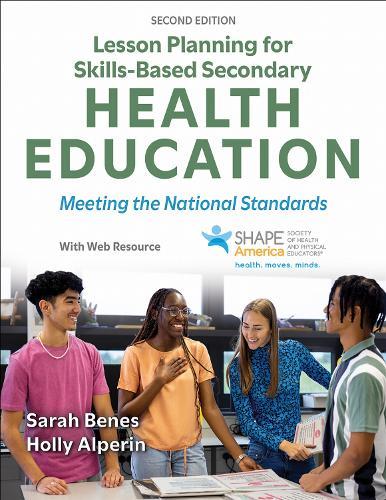
Implement a skills-based approach in health education. A practical resource for middle school and high school health educators, Lesson Planning for Skills-Based Secondary Health Education, Second Edition With Web Resource, offers field-tested ways to implement a skills-based approach to health education. Renowned authors Sarah Benes and Holly Alperin, together with leading health educators, present the rationale and foundation for a skills-based approach while offering practical examples, tools, resources, assessments, and strategies to support teachers. This text can serve as a blueprint for creating an entirely new curriculum or as a supplement to existing programs, helping educators make a seamless shift from a content-based approach to a skills-based one. The second edition features updates such as these: New units organized by health skills, with 70 new lessons to choose from and use in your class right away Alignment with the 2024 SHAPE America National Health Education Standards Reproducible student worksheets that are modifiable and available in both English and Spanish The online web resource contains downloadable, editable supplemental materials and includes all the lessons and materials from the first edition for an additional 64 lesson plans. Online content can be accessed through a QR code found in the front of the book. This text is an ideal companion to The Essentials of Teaching Health Education, Third Edition, a foundational text by Benes and Alperin that presents teaching and assessment strategies for planning and implementing a skills-based approach to teaching health education. Together, these two books can help educators effectively teach skills-based health education from day one. Lesson Planning for Skills-Based Secondary Health Education provides educators with everything they need to put a skills-based approach into practice: the solid foundational information that explains the concepts as well as the resources, tools, and strategies to help implement lesson plans and activities that will aid students in developing proficiency in the skills emphasized in the national standards. Human Kinetics is proud to publish this book in association with SHAPE America, the national organization that defines excellence for school-based health and physical education professionals across the United States.
Full Product Details
Author: Sarah Benes ,
Holly Alperin
Publisher: Human Kinetics Publishers
Imprint: Human Kinetics
Edition: Second Edition
ISBN: 9781718235465
ISBN 10: 1718235461
Pages: 384
Publication Date: 02 March 2026
Audience:
Professional and scholarly
,
Professional & Vocational
Format: Paperback
Publisher's Status: Forthcoming
Availability: Not yet available

This item is yet to be released. You can pre-order this item and we will dispatch it to you upon its release.
Author Information
Sarah Benes, EdD, MPH, CHES, is an assistant professor and the coordinator of the school health education program at Southern Connecticut State University. She earned a BS in athletic training at University of Connecticut, an EdM in human movement from Boston University in 2006, and an EdD in curriculum and teaching from Boston University in 2010. In 2021, she also completed a master's degree in public health. She worked as a graduate assistant athletic trainer and an assistant athletic trainer at Boston University before transitioning to teaching full time and running the physical and health education programs for six years. Benes then held a position as an associate clinical professor in the School of Health Sciences at Merrimack College. Benes' research and scholarship interests include skills-based health education, equity and justice in health education, physical activity in the classroom, and enhancing school-based physical and health education programming. She is a past president of SHAPE America, after serving on the board for three years and serving as chair of the Health Education Council. She has done curriculum development with many districts in Massachusetts, has conducted skills-based health education professional development in multiple states across the country and internationally, and has written more than a dozen health education presentations and publications. She currently lives in Natick, Massachusetts, with her husband and two daughters. She enjoys yoga and meditation, reading, hiking, and going on adventures with her family. Holly Alperin, EdM, MCHES, is a clinical associate professor at the University of New Hampshire (UNH) with over 20 years' experience in both public health and education. As a faculty member and program coordinator of the department of kinesiology's health and physical education teacher preparation program, she focuses on preparing preservice educators to teach using a skills-based approach. Prior to UNH, she worked at the Massachusetts Department of Elementary and Secondary Education in a variety of roles that supported schools in their efforts to strengthen policies and increase capacity around school health education and programs, school nutrition programs, and professional learning experiences for educators. Through her work at the local, state, national, and international levels, Alperin provides guidance to schools as they create a culture of health and well-being for each student—both in the health education classroom and throughout the school. In addition to other volunteer roles, she is the past vice president of health education for New Hampshire Association for Health, Physical Education, Recreation and Dance; served on the task force to revise the National Health Education Standards; and is the past chair of the Health Education Council for SHAPE America. Alperin received her master's in education in policy, planning, and administration from Boston University and her bachelor's degree in health education and health promotion from Central Michigan University. She holds the Master Certified Health Education Specialist (MCHES) credential. She lives in New Hampshire with her husband and two daughters. In her free time, you can likely find her in the mountains or at the beach enjoying the best New England has to offer.