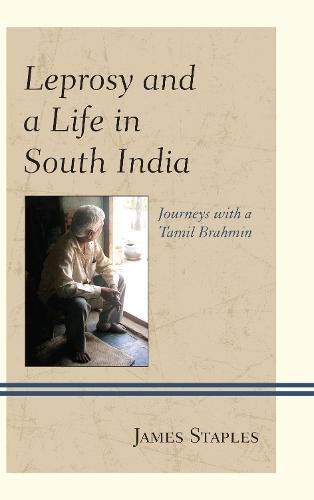
Full Product Details
Author: James Staples
Publisher: Bloomsbury Publishing Plc
Imprint: Lexington Books
Dimensions:
Width: 16.80cm
, Height: 1.90cm
, Length: 23.60cm
Weight: 0.440kg
ISBN: 9780739187340
ISBN 10: 0739187341
Pages: 204
Publication Date: 05 June 2014
Audience:
Professional and scholarly
,
Professional & Vocational
Format: Hardback
Publisher's Status: Active
Availability: In Print

This item will be ordered in for you from one of our suppliers. Upon receipt, we will promptly dispatch it out to you. For in store availability, please contact us.
Reviews
James Staples's book takes us through a most exciting narrative journey...[The book] dislodges any reductionist primacy ascribed to religion, caste, intimacy, or disease. Journal Of The Royal Anthropological Institute Leprosy and a Life in South India is a vividly told and skillfully presented anthropological life history, bringing poignant texture to the lived experience of disease, caste, poverty, migration, conversion, and more in contemporary South India. -- Kirin Narayan, Australian National University, author of Alive in the Writing This is a rich, thickly textured and deeply intimate meditation on the story of a remarkable man who seems to embody the triumphs and tragedies of life in the margins of modern India. The author has found that point of fine balance between deep empathy and critical understanding, just as Das himself seems to be able to articulate the story of his own life in terms that capture the inherent tension between intimacy and objective dispassion. Fundamentally, this is a beautifully written story about the precarity of human existence. -- Joseph S. Alter, University of Pittsburgh
James Staples's book takes us through a most exciting narrative journey...[The book] dislodges any reductionist primacy ascribed to religion, caste, intimacy, or disease. Journal Of The Royal Anthropological Institute Staples's methodology ... provides an interesting framework for organizing the individual anecdotes within the broader story of Das's lived experience...Leprosy and a Life in South India is a recommended read for those interested in the life history genre, the ways in which cultural constructions of disease play out in real lives and depictions of the human condition in South Asia. American Ethnologist Leprosy and a Life (not leprosy and life) is a thrilling book, written almost like a novel, in the first person with a hero and several other characters and a number of plots and subplots. The book differs from a novel, or for that matter from any literary work, because Staples makes no attempt to create an illusory or a magical effect through fictions in the mind of the reader... These thickly described chapters form the core of the book, which is the painstaking result of anthropological fieldwork by the author over three decades in India. The method adopted by the author toward the construction of his self-reflective ethnography is life history, which in recent years has emerged as a potentially rich technique with immense future possibilities... Putting a research assistant in the foreground of a multisited ethnographic narrative and using his lens to view postcolonial India are definitely novel. Staples has opened new windows not only for anthropology but also for social science research in South Asia in general, wherein big themes like globalization, marginality, and the subaltern consciousness still predominate... I believe that this book will help bridge the proverbial gap between the self and the other, the observer and the observed, and the objective and the subjective in ethnographic representations of the changing nature of caste in India. American Anthropologist Leprosy and a Life in South India is a vividly told and skillfully presented anthropological life history, bringing poignant texture to the lived experience of disease, caste, poverty, migration, conversion, and more in contemporary South India. -- Kirin Narayan, Australian National University, author of Alive in the Writing This is a rich, thickly textured and deeply intimate meditation on the story of a remarkable man who seems to embody the triumphs and tragedies of life in the margins of modern India. The author has found that point of fine balance between deep empathy and critical understanding, just as Das himself seems to be able to articulate the story of his own life in terms that capture the inherent tension between intimacy and objective dispassion. Fundamentally, this is a beautifully written story about the precarity of human existence. -- Joseph S. Alter, University of Pittsburgh
Leprosy in South India is a vividly told and skillfully presented anthropological life history, bringing poignant texture to the lived experience of disease, caste, poverty, migration, conversion, and more in contemporary South India. -- Kirin Narayan, Australian National University, author of Alive in the Writing This is a rich, thickly textured and deeply intimate meditation on the story of a remarkable man who seems to embody the triumphs and tragedies of life in the margins of modern India. The author has found that point of fine balance between deep empathy and critical understanding, just as Das himself seems to be able to articulate the story of his own life in terms that capture the inherent tension between intimacy and objective dispassion. Fundamentally, this is a beautifully written story about the precarity of human existence. -- Joseph S. Alter, University of Pittsburgh
Leprosy in South India is a vividly told and skillfully presented anthropological life history, bringing poignant texture to the lived experience of disease, caste, poverty, migration, conversion, and more in contemporary South India. -- Kirin Narayan, Australian National University, author of Alive in the Writing
Author Information
James Staples is senior lecturer in anthropology at Brunel University, London.