Overview
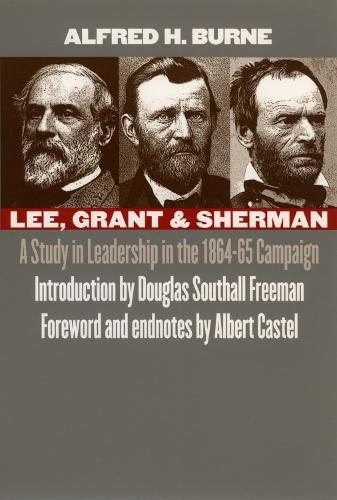
Had Lee enjoyed the manpower or materiel advantages of Grant, would the South have triumphed? Had Hood possessed strength superior to Sherman's, would he still have lost their encounters in Georgia? Popular sentiment has long bowed to the military leadership of the Civil War's victorious generals--a view that has been disputed by modern scholarship. Many might be startled to learn that a British army officer also called these opinions into question long ago. Out of print for more than fifty years, Lee, Grant and Sherman is an unrecognized classic of Civil War history that presaged current scholarship by decades. Alfred H. Burne assesses the military leadership of Grant, Lee, Sherman, Hood, Johnston, Early, and Sheridan from mid-1864 to Appomattox, contradicting prevailing perceptions of the generals and even proposing that Grant's military capabilities were inferior to Lee's. Burne sought to challenge the orthodox views of other historians--J. F. C. Fuller on Grant and Basil Liddell Hart on Sherman--but his assessments were so unorthodox that even with the endorsement of preeminent Civil War historian Douglas Southall Freeman, his book received scant attention in its day. He sees Sherman as more concerned with the geographical objective of capturing Atlanta than the military goal of smashing the Confederate army, lacking Grant's understanding that the principal object of war is to conquer and destroy the enemy's armed forces. Yet he asserts that ""Grant in his heart of hearts feared Lee"" and also suggests that Jubal Early's Valley campaign might have been the most brilliant of the whole war. In his analysis of the Georgia campaign, Burne views Sherman as a general who avoided risk and was too obsessed with raiding to wage an all-out offensive battle. Refusing to dismiss Hood as incompetent, as many historians have done, Burne points to his brilliance in military planning and claims that most of his defeats were merely the result of inadequate resources. Burne's book was ahead of its time, anticipating later shifts in historical evaluations of Civil War leadership. Now available in a corrected edition, with Freeman's original introduction and a new foreword and endnotes by Albert Castel, it is a rich source of insight for scholars--and for anyone willing to reconsider traditional views of these generals.
Full Product Details
Author: Alfred H. Burne ,
Douglas Southall Freeman ,
Albert Castel
Publisher: University Press of Kansas
Imprint: University Press of Kansas
Edition: New edition
Dimensions:
Width: 16.00cm
, Height: 2.50cm
, Length: 23.40cm
Weight: 0.586kg
ISBN: 9780700610723
ISBN 10: 0700610723
Pages: 280
Publication Date: 18 December 2000
Audience:
College/higher education
,
Professional and scholarly
,
Undergraduate
,
Postgraduate, Research & Scholarly
Format: Hardback
Publisher's Status: Active
Availability: Temporarily unavailable

The supplier advises that this item is temporarily unavailable. It will be ordered for you and placed on backorder. Once it does come back in stock, we will ship it out to you.
Reviews
-Burne's book glows with a prophetic light. . . . His unorthodox judgments . . . anticipated a major shift, starting in the 1960s, in historical evaluations of military leadership during the Civil War. . . . [These views have] gained so many converts and promise to gain so many more that [they] might well be on the way to becoming the new orthodoxy.---from the Foreword by Albert Castel
Burne's book glows with a prophetic light. . . . His unorthodox judgments . . . anticipated a major shift, starting in the 1960s, in historical evaluations of military leadership during the Civil War. . . . [These views have] gained so many converts and promise to gain so many more that [they] might well be on the way to becoming the new orthodoxy. --from the Foreword by Albert Castel Embodies the best features of military history written by a former officer: firm tactical grasp, common sense about what is and what is not practicable in the deployment of armies, shrews judgment in regard to debates over the merits of commanders, and a provocative edge. The whole is composed in a sinewy, readable style. --Journal of Military History An overlooked book that can now be read in a different light and perhaps will encourage Civil War historians to reexamine Burne's ideas. --Civil War News
A British army officer analyzes the three main campaigns of the Civil War and their generals:- Grant and Lee in the Wilderness, the Cold Harbor and the Spottsylvania campaign; Sherman vs Johnston and Hood before Atlanta, the Battle of Nashville and the March to the Sea; Sheridan's raid through the Shenandoah Valley. Detailed study of day by day moves, of the strategy used by each general, etc. Specially drawn maps illustrated each day's events. Value definitely for students of strategem and military tactics. Limited in appeal. (Kirkus Reviews)
Burne's book glows with a prophetic light. . . . His unorthodox judgments . . . anticipated a major shift, starting in the 1960s, in historical evaluations of military leadership during the Civil War. . . . [These views have] gained so many converts and promise to gain so many more that [they] might well be on the way to becoming the new orthodoxy. --from the Foreword by <b>Albert Castel</b>