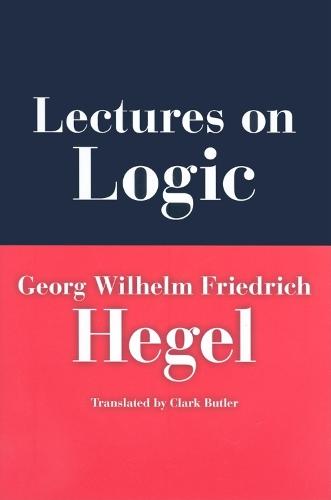
Lectures on Logic

Author:   Georg W. F. Hegel ,  Clark Butler ,  Clark Butler
Publisher:   Indiana University Press
ISBN:  

9780253351678


Pages:   264
Publication Date:   02 July 2008
Format:   Hardback
Availability:   In Print   Availability explained
This item will be ordered in for you from one of our suppliers. Upon receipt, we will promptly dispatch it out to you. For in store availability, please contact us.

Our Price $65.95 Quantity:  
Add to Cart

Share |

Lectures on Logic


Overview

Georg Wilhelm Friedrich Hegel gave many lectures in logic at Berlin University between 1818 and his untimely death in 1831. Edited posthumously by Hegel's son, Karl, these lectures were published in German in 2001 and now appear in English for the first time. Because they were delivered orally, Lectures on Logic is more approachable and colloquial than much of Hegel's formal philosophy. The lectures provide important insight into Hegel's science of logic, dialectical method, and symbolic logic. Clark Butler's smooth translation helps readers understand the rationality of Hegel's often dark and difficult thought. Readers at all levels will find a mature and particularly clear presentation of Hegel's systematic philosophical vision.

Full Product Details

Author:   Georg W. F. Hegel ,  Clark Butler ,  Clark Butler
Publisher:   Indiana University Press
Imprint:   Indiana University Press
Dimensions:   Width: 15.60cm , Height: 2.30cm , Length: 23.50cm
Weight:   0.508kg
ISBN:  

9780253351678


ISBN 10:   0253351677
Pages:   264
Publication Date:   02 July 2008
Audience:   Professional and scholarly ,  Professional & Vocational
Format:   Hardback
Publisher's Status:   Active
Availability:   In Print   Availability explained
This item will be ordered in for you from one of our suppliers. Upon receipt, we will promptly dispatch it out to you. For in store availability, please contact us.

Table of Contents

Translator's Introduction Introduction to the Lectures on Logic Preliminary General Concept of Our Subject Matter A. The First Position [of Thought] Toward Objectivity B. The Second Position of Thought Toward Objectivity B.I. Empiricism B.II. The Critical Philosophy [B.II.]a. The theoretical faculty [B.II.b.] Practical reason [B.II.c. The reflective power of judgment] C. The Third Position [of Thought] Toward Objectivity [More Exact Concept and] Division of the [Science of] Logic [I. Being] II. [Essence] III. The Self-Concept BEING I. Being I.A. Quality I.A.a. Being I.A.b. Determinate Being [Dasein] I.A.c. Being for Itself I.B. Quantity I.C. Measure ESSENCE II. Essence II.A. Essence as the Ground of Existence II.A.a. The Show of the Essence of Being II.A.a. Identity II.A.a. Difference II.A.a. Ground II.A.b. Existence II.A.c. The Thing II.B. Appearance [II.B.a.] The World of Appearance [II.B.b. Form and Content] [II.B.c. Correlation] [1.] The whole and its parts [2. Force and its expression] [3. The inner and the outer] II.C. Actuality [Moments of Actuality as an Efficacious Process: Contingency and Mere Possibility versus the Real Possibility, Pre-Conditions, and Necessity of a Matter at Hand] [II.C.a. The Matter at Hand] [II.C.b. The Moments of Necessity] [1.] Conditions [2.] The matter at hand 3. The activity [of a matter at hand actualizing itself] [II.C.c. The Forms of Necessity] [1. The correlation of substantiality] [2. The correlation of causality] [3. The correlation of reciprocal interaction] THE SELF-CONCEPT III. The Self-Concept Subdivisions [of the Logic of the Self-Concept] III.A. The Subjective Self-Concept III.A.1. The Self-Concept as Such III.A.2. Judgment [III.A.2. Qualitative judgment] III.A.2. Reflective judgment III.A.2. Necessary judgment III.A.2. Conceptual judgment III.A.3. The Syllogisms III.A.3.The qualitative syllogism III.A.3.The reflective syllogism III.A.3.The necessary syllogism III.B. The Object III.B.a. Mechanism III.B.b. Chemism III.B.c. Teleology III.C. The Idea III.C.a. Life [III.C.a.1. The soul] [III.C.a.2. The bodily organism] [III.C.a.3. The species] III.C.b. Recognizance [Erkennen] III.C.b.1. Recognizance as such [The analytical method] [The synthetic method] [Definition] [Classification] [Proof] III.C.b.2. The will III.C.c. The Absolute Idea

Reviews

Butler has translated for clarity and flow, and has produced a text that reads very easily and smoothly, without sacrifice of accuracy. -John Russon, University of Guelph


Butler has translated for clarity and flow, and has produced a text that reads very easily and smoothly, without sacrifice of accuracy. John Russon, University of Guelph


""Butler has translated for clarity and flow, and has produced a text that reads very easily and smoothly, without sacrifice of accuracy."" John Russon, University of Guelph


Author Information

Clark Butler is Director of the Institute for Human Rights at Indiana University–Purdue University, Ft. Wayne. He is translator (with Christiane Seiler) of Hegel: The Letters (IUP, 1984) and author of Hegel's Logic: Between Dialectic and History.

Tab Content 6

Author Website:  

Countries Available

All regions
Latest Reading Guide

NOV RG 20252


Shopping Cart
Your cart is empty
Shopping cart
Mailing List