|
|
|||
|
||||
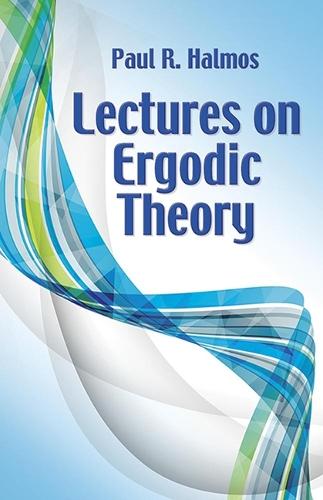
OverviewThis concise classic by Paul R. Halmos, a well-known master of mathematical exposition, has served as a basic introduction to aspects of ergodic theory since its first publication in 1956. ""The book is written in the pleasant, relaxed, and clear style usually associated with the author,"" noted the Bulletin of the American Mathematical Society, adding, ""The material is organized very well and painlessly presented."" Suitable for advanced undergraduates and graduate students in mathematics, the treatment covers recurrence, mean and pointwise convergence, ergodic theorem, measure algebras, and automorphisms of compact groups. Additional topics include weak topology and approximation, uniform topology and approximation, invariant measures, unsolved problems, and other subjects. AUTHOR: Hungarian-born Paul R. Halmos (19162006) is widely regarded as a top-notch expositor of mathematics. He taught at the University of Chicago and the University of Michigan as well as other universities and made significant contributions to several areas of mathematics including mathematical logic, probability theory, ergodic theory, and functional analysis. Full Product DetailsAuthor: Paul R. HalmosPublisher: Dover Publications Inc. Imprint: Dover Publications Inc. Dimensions: Width: 14.00cm , Height: 0.50cm , Length: 21.60cm Weight: 0.145kg ISBN: 9780486814896ISBN 10: 0486814890 Pages: 112 Publication Date: 26 January 2018 Audience: General/trade , Professional and scholarly , General , Professional & Vocational Format: Paperback Publisher's Status: Active Availability: In Print This item will be ordered in for you from one of our suppliers. Upon receipt, we will promptly dispatch it out to you. For in store availability, please contact us. Table of ContentsReviewsAuthor InformationHungarian-born Paul R. Halmos (1916-2006) is widely regarded as a top-notch expositor of mathematics. He taught at the University of Chicago and the University of Michigan as well as other universities and made significant contributions to several areas of mathematics including mathematical logic, probability theory, ergodic theory, and functional analysis. Tab Content 6Author Website:Countries AvailableAll regions |
||||