Overview
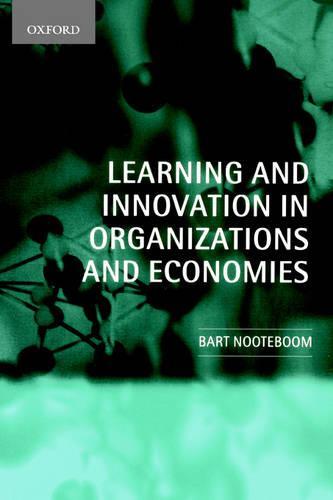
This book develops a general 'logic', or heuristic of discovery, to explain the emergence of novelty in individual thought, organizations, industries, and economies. It draws on a variety of literatures, discussing theories of organizational learning, evolutionary and institutional economics, knowledge and language. It brings these together in a unifying framework, and applies that for an analysis of innovation systems and the management of learning.Unification is based on the resource or competence-based view in economics, in combination with a theory of learning by interaction. The central theme of the book is the relation between stability and change. In business literature this theme appears in the relation between exploitation and exploration. In evolutionary economics it appears in the relation between selection and adaptation. The general heuristic shows how exploitation can provide the basis for exploration. The analysis is illustrated with many phenomena and empirical results from the different literatures.
Full Product Details
Author: Bart Nooteboom (, Professor of Organization, Rotterdam School of Management, Erasmus University)
Publisher: Oxford University Press
Imprint: Oxford University Press
Dimensions:
Width: 15.70cm
, Height: 2.00cm
, Length: 23.40cm
Weight: 0.499kg
ISBN: 9780199241002
ISBN 10: 0199241007
Pages: 358
Publication Date: 23 August 2001
Audience:
Professional and scholarly
,
Professional & Vocational
Format: Paperback
Publisher's Status: Active
Availability: To order

Stock availability from the supplier is unknown. We will order it for you and ship this item to you once it is received by us.
Reviews
Review of previous edition: Bart Nooteboom has written a remarkable and valuable book. In it he draws from and weaves together conceptions and empirical research findings from a wide range of fields. The scholarship is a model of what interdisciplinary work should be. Nooteboom is concerned with knowledge, learning, and innovation, at a number of different levels - the individual, the firm, and society as a whole - and his work sheds a penetrating light on all of these. A reader interested in any or all of these subjects is bound to come away from this book with important new insights and understandings. --Richard R. Nelson, Columbia University<br>
`In his inspiring and thoughtful book Learning and Innovation in Organisations and Economies, Bart Nooteboom looks at innovation the other way round: He tries to find common logic behind the processes of exploration, of searching for radical innovations and drawing on the economic and technical possibilities that these innovations open up. I strongly recommend this book to anyone who is concerned with the fundamental mechanisms driving innovative processes.' Kyklos Vol 55, 1 `Review from previous edition Bart Nooteboom has written a remarkable and valuable book. In it he draws from and weaves together conceptions and empirical research findings from a wide range of fields. The scholarship is a model of what interdisciplinary work should be. Nooteboom is concerned with knowledge, learning, and innovation, at a number of different levels - the individual, the firm, and society as a whole - and his work sheds a penetrating light on all of these. A reader interested in any or all of these subjects is bound to come away from this book with important new insights and understandings.' Richard R. Nelson, Columbia University
<br>Review of previous edition: Bart Nooteboom has written a remarkable and valuable book. In it he draws from and weaves together conceptions and empirical research findings from a wide range of fields. The scholarship is a model of what interdisciplinary work should be. Nooteboom is concerned with knowledge, learning, and innovation, at a number of different levels - the individual, the firm, and society as a whole - and his work sheds a penetrating light on all of these. A reader interested in any or all of these subjects is bound to come away from this book with important new insights and understandings. --Richard R. Nelson, Columbia University<br>
Author Information
Bart Nooteboom studied mathematics and econometrics. He worked in industry, was appointed Professor of Industrial Organization at Groningen University in 1987, and is now Professor of Organization at Erasmus University, Rotterdam. He has published widely in the areas of entrepreneurship and small business; industry and technology policy; innovation and diffusion; transaction costs; trust; inter-firm relations; organizational learning; and philosophy of economics and management.