Overview
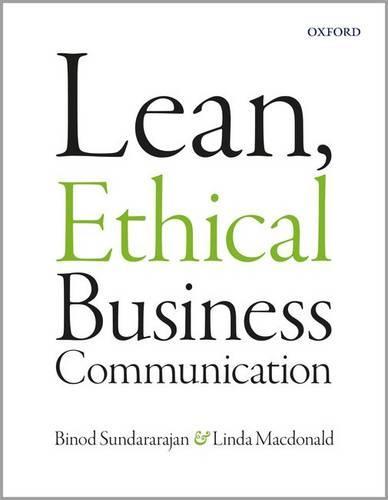
Lean, Ethical Business Communication focuses on five key elements of business communication - strategy, content, outcome, presentation, and ethics (""S.C.O.P.E.""). Through a series of case studies, students learn to apply this five-point focus to the complex communication challenges that they are likely to encounter in their future careers, including applying for a job, sending routine business messages, creating formal reports and presentations, and managing corporate identities online.
Full Product Details
Author: Binod Sundararajan (Associate professor of management, Associate professor of management, Rowe School of Business, Dalhousie University) , Linda Macdonald (Assistant professor, Assistant professor, Rowe School of Business, Dalhousie University)
Publisher: Oxford University Press, Canada
Imprint: Oxford University Press, Canada
Dimensions:
Width: 17.90cm
, Height: 1.30cm
, Length: 22.80cm
Weight: 0.418kg
ISBN: 9780199011216
ISBN 10: 0199011214
Pages: 256
Publication Date: 02 March 2017
Audience:
Professional and scholarly
,
Professional & Vocational
Format: Paperback
Publisher's Status: Active
Availability: To order 
Stock availability from the supplier is unknown. We will order it for you and ship this item to you once it is received by us.
Table of Contents
Note: Each chapter includes - Learning objectives - The Story So Far - Introduction - Case studies - Applying S.C.O.P.E. - Summary - Discussion questions - Good Advice or Bad? - Exercises - Strategic Language - Additional resources Introduction S.C.O.P.E.: Strategy, Content, Outcome, Presentation, and Ethics APPFORMS the Organization Exercises PART ONE: THE JOB SEARCH PROCESS - Creating and Maintaining Individual Identity 1. The Career Portfolio: Résumés, Cover Letters and the Elevator Pitch Résumés and Cover Letters - Case of Sean MacNeil - Identifying and Understanding Stakeholders - Choices and Alternatives - Selecting Material - Decision and Application - Case of Lara Leveaux - Identifying and Understanding Stakeholders - Choices and Alternatives - Selecting Material - Decision and Application - Case of Maya chen - Identifying and Understanding Stakeholders - Choices and Alternatives - Selecting Material - Decision and Application The Elevator Pitch - Case of James Patel - Identifying and Understanding Stakeholders - Choices and Alternatives - Selecting Material - Data, Evidence - Style, Arrangement, Design - Tone, Voice, Pace, Inflections - Decision and Application 2. Networking, Job Interviews and Follow Up Networking Identifying and Understanding Stakeholders - Definition of Networking - Purpose of Networking - Case of James Patel - Formal Networking - How to Network - Choices and Alternatives - Research, Research, Research -- Decision and Application Interviewing and Follow Up - The Interviewer's Perspective -- Selecting the Candidates -- Selecting the Questions - The Interview Case of James Patel - Identifying and Understanding Stakeholders - Choices and Alternatives - Face-to-Face Interview - Decision and Application Bibliography PART TWO: INFORMATION, ANALYSIS AND ARGUMENTATION, PERSUASION 3. Internal Informative Messaging Email Case of Sean MacNeill - Identifying and Understanding Stakeholders - Choice and Alternatives - Determining What Needs To Be Said - Positive, Neutral, Negative - Effective Presentation Techniques - Data, Evidence, Grammar - Decision and Application Case of Lara Leveaux - Identifying and Understanding Stakeholders - Choice and Alternatives - Determining What Needs To Be Said - Positive, Neutral, Negative - Effective Presentation Techniques - Data, Evidence, Grammar - Decision and Application Memos Case of Sean MacNeill - Identifying and Understanding Stakeholders - Choice and Alternatives - Determining What Needs To Be Said - Positive, Neutral, Negative - Selecting Effective Presentation Techniques - Data, Evidence, Visuals, Grammar - Decision and Application Case of Maya Chen - Identifying and Understanding Stakeholders - Choice and Alternatives - Determining What Needs To Be Said - Positive, Neutral, Negative - Selecting Effective Presentation Techniques - Data, Evidence, Visuals, Grammar - Decision and Application 4. Analysis and Argumentation Analysis and Synthesis Case of Carrie du Plessis - Reducing to Elemental Parts - Understanding the Issue/Problem - Thinking Critically and Evaluating with a Critical Mind - Choices and Alternatives - Coming Up with an Optimal Solution - Synthesis - Decision and Application Argumentation Case of James Patel - Reducing to Elemental Parts - Understanding the Issue/Problem - Thinking Critically and Evaluating with a Critical Mind - Choices and Alternatives - Writing to an Audience - Decision and Application 5. Maintaining External Relationships with Business Letters Case of Gary Chambers - Construction of Letter - Choices and Alternatives - Decision and Application Case of Hamish Iosepho - Construction of Letter - Choices and Alternatives - Decision and Application Case of Abdul Hamza - Construction of Letter - Choices and Alternatives - Decision and Application Case of Glenda Goodwin - Construction of Letter - Choices and Alternatives - Decision and Application PART THREE: REPORTS AND PRESENTATIONS 6. Persuasive Techniques for Short Reports Reports Form, Content, and Everything in Between Case of Bahram Fonseca - Identifying and Understanding Stakeholders - Choice and Alternatives - Determining What Needs To Be Said - Positive, Neutral, Negative - Selecting Effective Presentation Techniques - Data, Evidence, Visuals, Grammar - Decision and Application Case of Kirsten Hamed - Identifying and Understanding Stakeholders - Choice and Alternatives - Determining What Needs To Be Said - Positive, Neutral, Negative - Selecting Effective Presentation Techniques - Data, Evidence, Visuals, Grammar - Decision and Application Case of Dharini Gagnon - Identifying and Understanding Stakeholders - Choice and Alternatives - Determining What Needs To Be Said - Positive, Neutral, Negative - Selecting Effective Presentation Techniques - Data, Evidence, Visuals, Grammar - Decision and Application 7. Persuasive Techniques for Long Reports Reports Case of Carrie du Plessis - Revisited - Reducing to Elemental Parts - Understanding the Issue/Problem - Thinking Critically and Evaluating with a Critical Mind - Choices and Alternatives - Coming Up with an Optimal Solution - Synthesis - Decision and Application Case of James Patel - Revisited - Reducing to Elemental Parts - Understanding the Issue/Problem - Thinking Critically and Evaluating with a Critical Mind - Choices and Alternatives - Coming Up With an Optimal Solution - Synthesis - Decision and Application 8. Persuasive Techniques for Short and Long Presentations Form, Content of Presentations, and Everything in Between - Form of a Presentation - Design Elements in a Presentation - Content in a Presentation - Style and Delivery in a Presentation Short Presentations Case of Carrie du Plessis - Identifying and Understanding Stakeholders - Choice and Alternatives - Determining What Needs To Be Said - Positive, Neutral, Negative - Selecting Effective Presentation Techniques - Data, Evidence, Visuals, Grammar - Style, Arrangement, Design - Tone, Voice, Pace, Inflections - Decision and Application Long Presentations Example Sean MacNeill - Identifying and Understanding Stakeholders - Choice and Alternatives - Determining What Needs To Be Said - Positive, Neutral, Negative - Selecting Effective Presentation Techniques - Data, Evidence, Visuals, Grammar - Style, Arrangement, Design - Tone, Voice, Pace, Inflections - Decision and Application PART FOUR: THE INDIVIDUAL, THE ORGANIZATION, AND SOCIAL MEDIA 9. Maintaining Corporate Identity and Managing Social Media Maintaining Individual Identity on Social Media Case of Kailee Pereira - Snapchat and Twitter - Identifying and Understanding Stakeholders - Choice and Alternatives - Determining What Needs To Be Said - Positive, Neutral, Negative - Decision and Application Managing Corporate Identity on Social Media Case of James Patel - Blog - Identifying and Understanding Stakeholders - Choice and Alternatives - Understanding the Channel - Determining What Needs To Be Said - Positive, Neutral, Negative - Selecting Effective Presentation Techniques - Style, Arrangement, Design - Decision and Application References Glossary Index
Reviews
The use of continuing characters and situations creates a story that students can follow. . . . This allows students to gain a deeper understanding of the various topics in the textbook. --Brenda Lang, Bissett School of Business, Mount Royal University The case-based approach makes it easier for students to relate to the material and understand it. I particularly value the inclusion of technology as an integral part of the communication process. --Iman El Meniawy, Edwards School of Business, University of Saskatchewan
The use of continuing characters and situations creates a story that students can follow. . . . This allows students to gain a deeper understanding of the various topics in the textbook. --Brenda Lang, Bissett School of Business, Mount Royal University The case-based approach makes it easier for students to relate to the material and understand it. I particularly value the inclusion of technology as an integral part of the communication process. --Iman El Meniawy, Edwards School of Business, University of Saskatchewan
The use of continuing characters and situations creates a story that students can follow. . . . This allows students to gain a deeper understanding of the various topics in the textbook. --Brenda Lang, Bissett School of Business, Mount Royal University The case-based approach makes it easier for students to relate to the material and understand it. I particularly value the inclusion of technology as an integral part of the communication process. --Iman El Meniawy, Edwards School of Business, University of Saskatchewan
Author Information
Binod Sundararajan is an associate professor of management at the Rowe School of Business, Dalhousie University Linda Macdonald is an assistant professor and director of the International Student Success Program at the Rowe School of Business, Dalhousie University.
Tab Content 6
Author Website:
Countries Available
All regions
|