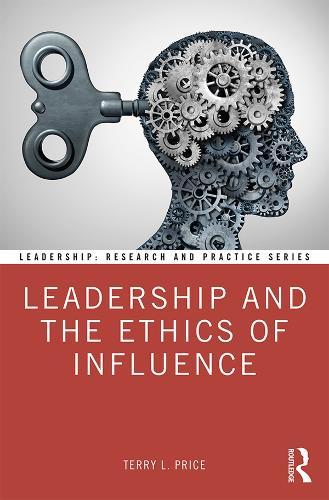
Full Product Details
Author: Terry L. Price (University of Richmond, USA)
Publisher: Taylor & Francis Ltd
Imprint: Routledge
Weight: 0.276kg
ISBN: 9781138327658
ISBN 10: 1138327654
Pages: 184
Publication Date: 12 March 2020
Audience:
College/higher education
,
Professional and scholarly
,
Postgraduate, Research & Scholarly
,
Professional & Vocational
Format: Paperback
Publisher's Status: Active
Availability: In Print

This item will be ordered in for you from one of our suppliers. Upon receipt, we will promptly dispatch it out to you. For in store availability, please contact us.
Reviews
"""Price, one of the best scholars in leadership ethics, breaks new ground in this exploration of the ethics of influence. The book tackles the primary task of leadership—how to get followers to work towards a common goal. Price reminds us that when it comes to influence, bad leaders have more in common with good leaders than most of us are willing to accept. He deftly shows how agency that respects the autonomy of followers forms the middle ground between making and letting people do something. This eloquently written book is a ‘must read’ for leadership scholars and anyone who has attempted to lead."" —Joanne B. Ciulla, Professor and Director of the Institute for Ethical Leadership, Rutgers Business School, USA ""In this timely, yet timeless, philosophical inquiry into the ethics of leadership influence, Terry Price elegantly (and ethically) ‘gets’ the reader to confront and transcend the familiar but unhelpful divisions between good versus bad leaders; hard versus soft influence tactics; means versus ends; and realism versus idealism in ethical leadership. In the process, he has created the ethical leadership book that I and many other leadership practitioners/scholars have long been seeking. I am pleased to report, having read this fine book, that leadership is still our best hope for autonomy."" —Brad Jackson, Professor of Social Innovation, Griffith University, Australia"
Price, one of the best scholars in leadership ethics, breaks new ground in this exploration of the ethics of influence. The book tackles the primary task of leadership--how to get followers to work towards a common goal. Price reminds us that when it comes to influence, bad leaders have more in common with good leaders than most of us are willing to accept. He deftly shows how agency that respects the autonomy of followers forms the middle ground between making and letting people do something. This eloquently written book is a 'must read' for leadership scholars and anyone who has attempted to lead. --Joanne B. Ciulla, Professor and Director of the Institute for Ethical Leadership, Rutgers Business School, USA In this timely, yet timeless, philosophical inquiry into the ethics of leadership influence, Terry Price elegantly (and ethically) 'gets' the reader to confront and transcend the familiar but unhelpful divisions between good versus bad leaders; hard versus soft influence tactics; means versus ends; and realism versus idealism in ethical leadership. In the process, he has created the ethical leadership book that I and many other leadership practitioners/scholars have long been seeking. I am pleased to report, having read this fine book, that leadership is still our best hope for autonomy. --Brad Jackson, Professor of Social Innovation, Griffith University, Australia
Price, one of the best scholars in leadership ethics, breaks new ground in this exploration of the ethics of influence. The book tackles the primary task of leadership-how to get followers to work towards a common goal. Price reminds us that when it comes to influence, bad leaders have more in common with good leaders than most of us are willing to accept. He deftly shows how agency that respects the autonomy of followers forms the middle ground between making and letting people do something. This eloquently written book is a 'must read' for leadership scholars and anyone who has attempted to lead. -Joanne B. Ciulla, Professor and Director of the Institute for Ethical Leadership, Rutgers Business School, USA In this timely, yet timeless, philosophical inquiry into the ethics of leadership influence, Terry Price elegantly (and ethically) 'gets' the reader to confront and transcend the familiar but unhelpful divisions between good versus bad leaders; hard versus soft influence tactics; means versus ends; and realism versus idealism in ethical leadership. In the process, he has created the ethical leadership book that I and many other leadership practitioners/scholars have long been seeking. I am pleased to report, having read this fine book, that leadership is still our best hope for autonomy. -Brad Jackson, Professor of Social Innovation, Griffith University, Australia
""Price, one of the best scholars in leadership ethics, breaks new ground in this exploration of the ethics of influence. The book tackles the primary task of leadership—how to get followers to work towards a common goal. Price reminds us that when it comes to influence, bad leaders have more in common with good leaders than most of us are willing to accept. He deftly shows how agency that respects the autonomy of followers forms the middle ground between making and letting people do something. This eloquently written book is a ‘must read’ for leadership scholars and anyone who has attempted to lead."" —Joanne B. Ciulla, Professor and Director of the Institute for Ethical Leadership, Rutgers Business School, USA ""In this timely, yet timeless, philosophical inquiry into the ethics of leadership influence, Terry Price elegantly (and ethically) ‘gets’ the reader to confront and transcend the familiar but unhelpful divisions between good versus bad leaders; hard versus soft influence tactics; means versus ends; and realism versus idealism in ethical leadership. In the process, he has created the ethical leadership book that I and many other leadership practitioners/scholars have long been seeking. I am pleased to report, having read this fine book, that leadership is still our best hope for autonomy."" —Brad Jackson, Professor of Social Innovation, Griffith University, Australia
Author Information
Terry L. Price is Professor and Coston Family Chair in Leadership and Ethics at the Jepson School of Leadership Studies, University of Richmond, USA.