Overview
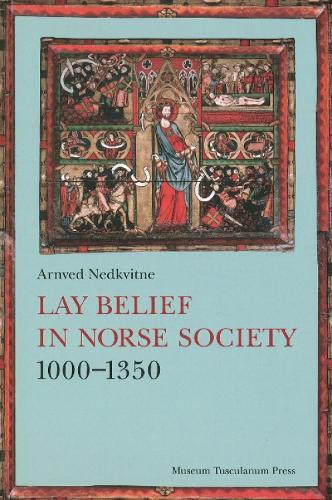
With insightful readings of his source material – which includes Norse sagas, Eddic literature and church homilies – Arnved Nedkvitne sheds light on the complex and diversified nature of lay belief in medieval Norse society. One of the study’s main claims suggests that laypeople had a firm belief in life after death – with all central rituals and beliefs seen as a means to this end. Yet, laypeople also had greater latitude in choosing between a sacred or secular understanding of their everyday lives than is often assumed: while religion was a fundamental source of norms, values and concepts at the time, laypeople also had to relate to state laws, codes of honour upheld by the local community and their own material interests. Lay Belief in Norse Society 1000–1350 offers a comprehensive treatment of the diffusion of strains related to the subject at hand: from orthodox rituals to remnants of pagan religion, from Christian ethics to secular honour. Combining a powerful and lucid exploration of his material with astute methodological awareness, Arnved Nedkvitne paints a vivid picture of the religious and cultural landscape of medieval Norse society.
Full Product Details
Author: Arnved Nedkvitne
Publisher: Museum Tusculanum Press
Imprint: Museum Tusculanum Press
Dimensions:
Width: 1.60cm
, Height: 0.30cm
, Length: 2.40cm
Weight: 0.907kg
ISBN: 9788763507868
ISBN 10: 8763507862
Pages: 401
Publication Date: 18 June 2009
Audience:
General/trade
,
General
Format: Hardback
Publisher's Status: Active
Availability: In Print

This item will be ordered in for you from one of our suppliers. Upon receipt, we will promptly dispatch it out to you. For in store availability, please contact us.
Reviews
""The author successfully uses primary sources such as Norse sagas and church homilies to reconstruct and explore not only the changing church, but also the lay community's changing understanding of the church. ... Nedkvitne attempts to illustrate an incredibly complex and often overlooked aspect of medieval religious understanding. This important work, clearly written for experts in the field of religious history with a firm understanding of the source material and time period, successfully advances research and understanding of lay belief in Norse society. Summing Up: Highly recommended. Graduate students, faculty, specialists."" - A A Leykam, CHOICE, June 2010 Volume 47 No. 10. ""Three meaty chapters on ritual, ethics, and supernatural intervention in Norway and Iceland form the trunk of the book. There is abundant useful material here: a tabulation of biblical, Latin, and local saints' feast days, a clear and concise typology af last rites, an illuminating comparison between medieval and modern Norwegians' annual vacations (90 and 136 days, respectively), and more. Nedkvitne controls Norway's sparse sources as expertly as the better-known Icelandic ones. And unlike Anglophone Nordicists, whose sensibilities generally run literary, he traces his lineage to social history, fuelling some radical departures from accepted wisdom (e.g., pp. 221-22). This is the stuff constructive controversy is made of ... The book is handsomely produced, with stunning color photographs of many sites and artefacts."" -- Oren Falk, Speculum, 85/3 - 2010
The author successfully uses primary sources such as Norse sagas and church homilies to reconstruct and explore not only the changing church, but also the lay community's changing understanding of the church. ... Nedkvitne attempts to illustrate an incredibly complex and often overlooked aspect of medieval religious understanding. This important work, clearly written for experts in the field of religious history with a firm understanding of the source material and time period, successfully advances research and understanding of lay belief in Norse society. Summing Up: Highly recommended. Graduate students, faculty, specialists. - A A Leykam, CHOICE, June 2010 Volume 47 No. 10. Three meaty chapters on ritual, ethics, and supernatural intervention in Norway and Iceland form the trunk of the book. There is abundant useful material here: a tabulation of biblical, Latin, and local saints' feast days, a clear and concise typology af last rites, an illuminating comparison between medieval and modern Norwegians' annual vacations (90 and 136 days, respectively), and more. Nedkvitne controls Norway's sparse sources as expertly as the better-known Icelandic ones. And unlike Anglophone Nordicists, whose sensibilities generally run literary, he traces his lineage to social history, fuelling some radical departures from accepted wisdom (e.g., pp. 221-22). This is the stuff constructive controversy is made of ... The book is handsomely produced, with stunning color photographs of many sites and artefacts. -- Oren Falk, Speculum, 85/3 - 2010
The author successfully uses primary sources such as Norse sagas and church homilies to reconstruct and explore not only the changing church, but also the lay community's changing understanding of the church. ... Nedkvitne attempts to illustrate an incredibly complex and often overlooked aspect of medieval religious understanding. This important work, clearly written for experts in the field of religious history with a firm understanding of the source material and time period, successfully advances research and understanding of lay belief in Norse society. Summing Up: Highly recommended. Graduate students, faculty, specialists. Chr(45) A A Leykam, CHOICE, June 2010 Volume 47 No. 10. Three meaty chapters on ritual, ethics, and supernatural intervention in Norway and Iceland form the trunk of the book. There is abundant useful material here: a tabulation of biblical, Latin, and local saints' feast days, a clear and concise typology af last rites, an illuminating comparison between medieval and modern Norwegians' annual vacations (90 and 136 days, respectively), and more. Nedkvitne controls Norway's sparse sources as expertly as the better-known Icelandic ones. And unlike Anglophone Nordicists, whose sensibilities generally run literary, he traces his lineage to social history, fuelling some radical departures from accepted wisdom (e.g., pp. 221-22). This is the stuff constructive controversy is made of ... The book is handsomely produced, with stunning color photographs of many sites and artefacts. -- Oren Falk, Speculum, 85/3 - 2010
Author Information
Dr Arnved Nedkvitne is Professor of Medieval history at University of Oslo.