Overview
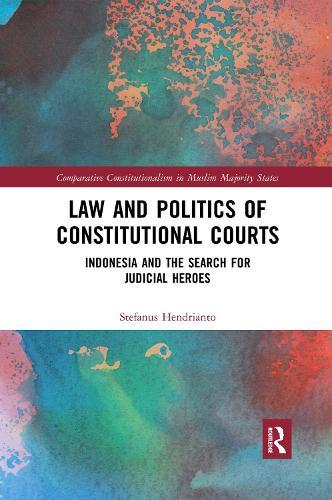
This book critically evaluates different models of judicial leadership in Indonesia to examine the impact that individual chief justices can have on the development of constitutional courts. It explores the importance of this leadership as a factor explaining the dynamic of judicial power. Drawing on an Aristotelean model of heroism and the established idea of judicial heroes to explore the types of leadership that judges can exercise, it illustrates how Indonesia’s recent experience offers a stark contrast between the different models. First, a prudential-minimalist heroic chief justice who knows how to enhance the Court’s authority while fortifying the Court’s status by playing a minimalist role in policy areas. Second, a bold and aggressive heroic chief justice, employing an ambitious constitutional interpretation. The third model is a soldier-type chief justice, who portrays himself as a subordinate of the Executive and Legislature. Contrary perhaps to expectations, the book’s findings show a more cautious initial approach to be the most effective. The experience of Indonesia clearly illustrates the importance of heroic judicial leadership and how the approach chosen by a court can have serious consequences for its success. This book will be a valuable resource for those interested in the law and politics of Indonesia, comparative constitutional law, and comparative judicial politics.
Full Product Details
Author: Stefanus Hendrianto
Publisher: Taylor & Francis Ltd
Imprint: Routledge
Weight: 0.580kg
ISBN: 9780367591748
ISBN 10: 036759174
Pages: 312
Publication Date: 14 August 2020
Audience:
College/higher education
,
Tertiary & Higher Education
Format: Paperback
Publisher's Status: Active
Availability: In Print

This item will be ordered in for you from one of our suppliers. Upon receipt, we will promptly dispatch it out to you. For in store availability, please contact us.
Reviews
'With rare exceptions, such as the courts headed by John Marshall and Earl Warren, it was not common until recently to explain the work-product of constitutional courts by focusing on their leadership. Now, however, a number of writers have begun to emphasize the importance of the chief justice in guiding courts to be bold or cautious, expansive or restrictive, in their constitutional decisions. With his extensive knowledge and with great judiciousness, Stefanus Hendrianto has examined the important role of chief justices of the Constitutional Court of Indonesia. He shows convincingly that leadership can indeed make a major difference in the emergence of constitutional doctrine, as he examines the work of the Court and compares it to similar courts elsewhere. This is an important work of comparative constitutional law and politics that will repay careful study.' Donald L. Horowitz, Duke University, USA and author of Constitutional Change and Democracy in Indonesia 'This book is a major contribution to comparative constitutional studies: it provides a crisp and authoritative account of the early jurisprudence of the Indonesian Constitutional Court, a highly active and creative court operating in one of the world's largest democracies. It also offers a fascinating account of the role of Chief Justice Jimly Assidique, as the leader of that court, and in doing so makes an important contribution to broader debates about the role of constitutional judges - and different styles of constitutional judging - in the consolidation of constitutional democracy.' Rosalind Dixon, UNSW Sydney, Australia 'This fascinating study of the Indonesian Constitutional Court introduces an entirely new concept for understanding judicial power: the judge as a heroic figure. Providing an exhaustive account of the Court's successes and failures, Hendrianto makes a powerful case for the role of judicial
'With rare exceptions, such as the courts headed by John Marshall and Earl Warren, it was not common until recently to explain the work-product of constitutional courts by focusing on their leadership. Now, however, a number of writers have begun to emphasize the importance of the chief justice in guiding courts to be bold or cautious, expansive or restrictive, in their constitutional decisions. With his extensive knowledge and with great judiciousness, Stefanus Hendrianto has examined the important role of chief justices of the Constitutional Court of Indonesia. He shows convincingly that leadership can indeed make a major difference in the emergence of constitutional doctrine, as he examines the work of the Court and compares it to similar courts elsewhere. This is an important work of comparative constitutional law and politics that will repay careful study.' Donald L. Horowitz, Duke University, USA and author of Constitutional Change and Democracy in Indonesia 'This book is a major contribution to comparative constitutional studies: it provides a crisp and authoritative account of the early jurisprudence of the Indonesian Constitutional Court, a highly active and creative court operating in one of the world's largest democracies. It also offers a fascinating account of the role of Chief Justice Jimly Assidique, as the leader of that court, and in doing so makes an important contribution to broader debates about the role of constitutional judges – and different styles of constitutional judging – in the consolidation of constitutional democracy.' Rosalind Dixon, UNSW Sydney, Australia 'This fascinating study of the Indonesian Constitutional Court introduces an entirely new concept for understanding judicial power: the judge as a heroic figure. Providing an exhaustive account of the Court’s successes and failures, Hendrianto makes a powerful case for the role of judicial
'With rare exceptions, such as the courts headed by John Marshall and Earl Warren, it was not common until recently to explain the work-product of constitutional courts by focusing on their leadership. Now, however, a number of writers have begun to emphasize the importance of the chief justice in guiding courts to be bold or cautious, expansive or restrictive, in their constitutional decisions. With his extensive knowledge and with great judiciousness, Stefanus Hendrianto has examined the important role of chief justices of the Constitutional Court of Indonesia. He shows convincingly that leadership can indeed make a major difference in the emergence of constitutional doctrine, as he examines the work of the Court and compares it to similar courts elsewhere. This is an important work of comparative constitutional law and politics that will repay careful study.' Donald L. Horowitz, Duke University, USA and author of Constitutional Change and Democracy in Indonesia 'This book is a major contribution to comparative constitutional studies: it provides a crisp and authoritative account of the early jurisprudence of the Indonesian Constitutional Court, a highly active and creative court operating in one of the world's largest democracies. It also offers a fascinating account of the role of Chief Justice Jimly Assidique, as the leader of that court, and in doing so makes an important contribution to broader debates about the role of constitutional judges - and different styles of constitutional judging - in the consolidation of constitutional democracy.' Rosalind Dixon, UNSW Sydney, Australia 'This fascinating study of the Indonesian Constitutional Court introduces an entirely new concept for understanding judicial power: the judge as a heroic figure. Providing an exhaustive account of the Court's successes and failures, Hendrianto makes a powerful case for the role of judicial
Author Information
Stefanus Hendrianto is a Jesuit and legal scholar. In recent years, he served as a visiting professor at Santa Clara University School of Law and a guest scholar at the Kellogg Institute for International Studies at the University of Notre Dame. Currently, he is a scholar at Boston College, School of Theology and Ministry. He holds a PhD degree from the University of Washington School of Law in Seattle and an LLM from Utrecht University in the Netherlands, in addition to his LLB degree from Gadjah Mada University, Indonesia.