Overview
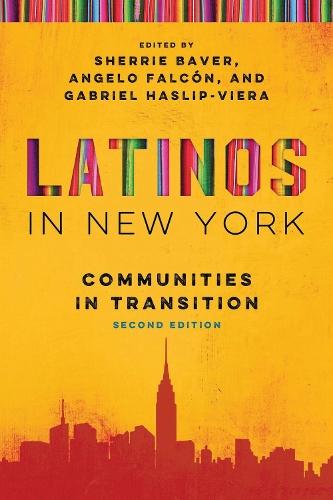
Significant changes in New York City's Latino community have occurred since the first edition of Latinos in New York: Communities in Transition was published in 1996. The Latino population in metropolitan New York has increased from 1.7 million in the 1990s to over 2.4 million, constituting a third of the population spread over five boroughs. Puerto Ricans remain the largest subgroup, followed by Dominicans and Mexicans; however, Puerto Ricans are no longer the majority of New York's Latinos as they were throughout most of the twentieth century. Latinos in New York: Communities in Transition, second edition, is the most comprehensive reader available on the experience of New York City's diverse Latino population. The essays in Part I examine the historical and sociocultural context of Latinos in New York. Part II looks at the diversity comprising Latino New York. Contributors focus on specific national origin groups, including Ecuadorians, Colombians, and Central Americans, and examine the factors that prompted emigration from the country of origin, the socioeconomic status of the emigrants, the extent of transnational ties with the home country, and the immigrants' interaction with other Latino groups in New York. Essays in Part III focus on politics and policy issues affecting New York's Latinos. The book brings together leading social analysts and community advocates on the Latino experience to address issues that have been largely neglected in the literature on New York City. These include the role of race, culture and identity, health, the criminal justice system, the media, and higher education, subjects that require greater attention both from academic as well as policy perspectives. Contributors: Sherrie Baver, Juan Cartagena, Javier Castaño, Ana María Díaz-Stevens, Angelo Falcón, Juan Flores, Gabriel Haslip-Viera, Ramona Hernández, Luz Yadira Herrera, Gilbert Marzán, Ed Morales, Pedro A. Noguera, Rosalía Reyes, Clara E. Rodríguez, José Ramón Sánchez, Walker Simon, Robert Courtney Smith, Andrés Torres, and Silvio Torres-Saillant.
Full Product Details
Author: Sherrie Baver ,
Angelo Falcón ,
Gabriel Haslip-Viera
Publisher: University of Notre Dame Press
Imprint: University of Notre Dame Press
Edition: 2nd Revised edition
Dimensions:
Width: 15.20cm
, Height: 2.70cm
, Length: 22.90cm
ISBN: 9780268101510
ISBN 10: 0268101515
Pages: 482
Publication Date: 30 June 2017
Audience:
Professional and scholarly
,
Professional & Vocational
Format: Paperback
Publisher's Status: Active
Availability: Manufactured on demand

We will order this item for you from a manufactured on demand supplier.
Reviews
Latinos in New York was the first volume to provide a comprehensive view of the wide range of histories, experiences, and conditions of the changing mix of nationalities of the city's Latino/a population. This new edition captures the most significant continuities, discontinuities, and changes of the last two decades in the city's Latino/a population as a whole and among the various national groups, and is as timely and relevant as was the first edition. The essays in this volume offer a plethora of old and recent demographic data and a broad assortment of information to attain a comprehensive and nuanced portrait of New York Latinos/as, the evolving nature of their communities, and the socioeconomic, educational, and political inequalities, discrimination, and segregation that impact their lives in the city. -Edna Acosta-Belen, distinguished professor emerita, University at Albany, SUNY The editors, all keen observers of the Latino communities of New York, have assembled highly knowledgeable and thoughtful analysts to provide thorough and compelling assessments of these increasingly important but still under-studied groups. A must read not only for those interested in the city's diverse communities, but for understanding the dynamics of differentiation within the nation's largest minority population. -John Mollenkopf, Distinguished Professor of Political Science and Sociology, Graduate Center, CUNY Twenty years since the publication of the first pathbreaking edition of Latinos in New York, its editors give us the definitive new resource on the contemporary Latinization of New York. Site of the most diverse Latino/a communities, New York City has been at the forefront of processes of Latinization. Thanks to Baver, Falcon, and Haslip-Viera, we now have a collection of essays by some of the most knowledgeable and experienced scholars, journalists, activists, and educators, who bring us up to speed on the political and cultural issues involved in a changing Latino/a landscape in NYC and beyond. -Arlene Davila, New York University The essays succeed in conveying the diversity of Latino/a communities and experiences through the lenses of settlement patterns, institution building, and policy impact. The collection is a good entry point to the convergence of scholarly literatures on migration, pan-ethnic identities, and local-level studies. -Choice
"""Latinos in New York was the first volume to provide a comprehensive view of the wide range of histories, experiences, and conditions of the changing mix of nationalities of the city's Latino/a population. This new edition captures the most significant continuities, discontinuities, and changes of the last two decades in the city's Latino/a population as a whole and among the various national groups, and is as timely and relevant as was the first edition. The essays in this volume offer a plethora of old and recent demographic data and a broad assortment of information to attain a comprehensive and nuanced portrait of New York Latinos/as, the evolving nature of their communities, and the socioeconomic, educational, and political inequalities, discrimination, and segregation that impact their lives in the city."" —Edna Acosta-Belén, distinguished professor emerita, University at Albany, SUNY ""The editors, all keen observers of the Latino communities of New York, have assembled highly knowledgeable and thoughtful analysts to provide thorough and compelling assessments of these increasingly important but still under-studied groups. A must read not only for those interested in the city’s diverse communities, but for understanding the dynamics of differentiation within the nation’s largest minority population."" —John Mollenkopf, Distinguished Professor of Political Science and Sociology, Graduate Center, CUNY ""Twenty years since the publication of the first pathbreaking edition of Latinos in New York, its editors give us the definitive new resource on the contemporary Latinization of New York. Site of the most diverse Latino/a communities, New York City has been at the forefront of processes of Latinization. Thanks to Baver, Falcón, and Haslip-Viera, we now have a collection of essays by some of the most knowledgeable and experienced scholars, journalists, activists, and educators, who bring us up to speed on the political and cultural issues involved in a changing Latino/a landscape in NYC and beyond."" —Arlene Davila, New York University ""The essays succeed in conveying the diversity of Latino/a communities and experiences through the lenses of settlement patterns, institution building, and policy impact. The collection is a good entry point to the convergence of scholarly literatures on migration, pan-ethnic identities, and local-level studies."" —Choice “Sixteen papers in an expanded and updated second edition examines issues facing the Latino community of New York City, addressing the historical and sociocultural context of Latinos in New York, the diversity constituting the Latino New York, and politics and policy issues affecting New York’s Latinos.” —Journal of Economic Literature"
Every essay in this volume addresses an important historical, sociological, cultural or public policy issue, each one packed with important new resource for the burgeoning field of Ethnic Studies. -- - Evelyn Hu-DeHart, University of Colora A welcome and much-awaited addition to our ethnic and social history. Substantial, informative and comprehensive essays which will forever change our thinking about New York's Latino communities. -- - Virginia Sanchez Korrol, Brooklyn Coll Latinos in New York delivers much more than the title conveys. Beyond the substantive, well-rounded accounts of relative newcomers (especially Dominicans and Mexicans) the volume breaks new ground on several fronts-notably religion, higher education, and the situation of the young-while adding to the growing stock of analyses of political participation, labor processes, cultural diversity, and transnational processes. -- -Frank Bonilla, Hunter College, CUNY Latinos in New York was the first volume to provide a comprehensive view of the wide range of histories, experiences, and conditions of the changing mix of nationalities of the city's Latino/a population. This new edition captures the most significant continuities, discontinuities, and changes of the last two decades in the city's Latino/a population as a whole and among the various national groups, and is as timely and relevant as was the first edition. The essays in this volume offer a plethora of old and recent demographic data and a broad assortment of information to attain a comprehensive and nuanced portrait of New York Latinos/as, the evolving nature of their communities, and the socioeconomic, educational, and political inequalities, discrimination, and segregation that impact their lives in the city. -- Edna Acosta-Belen, University at Albany, SUNY
Latinos in New York was the first volume to provide a comprehensive view of the wide range of histories, experiences, and conditions of the changing mix of nationalities of the city's Latino/a population. This new edition captures the most significant continuities, discontinuities, and changes of the last two decades in the city's Latino/a population as a whole and among the various national groups, and is as timely and relevant as was the first edition. The essays in this volume offer a plethora of old and recent demographic data and a broad assortment of information to attain a comprehensive and nuanced portrait of New York Latinos/as, the evolving nature of their communities, and the socioeconomic, educational, and political inequalities, discrimination, and segregation that impact their lives in the city. - Edna Acosta-Belen, University at Albany, SUNY
Author Information
Sherrie Baver is professor of political science at the City College of New York. Angelo Falcón is president and cofounder of the National Institute for Latino Policy. Gabriel Haslip-Viera is an emeritus social historian in the department of sociology at the City College of New York.