Overview
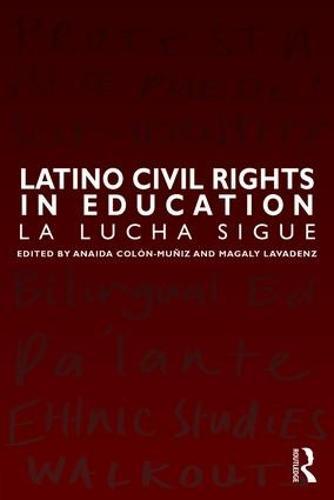
Latino Civil Rights in Education: La Lucha Sigue documents the experiences of historical and contemporary advocates in the movement for civil rights in education of Latinos in the United States. These critical narratives and counternarratives discuss identity, inequality, desegregation, policy, public school, bilingual education, higher education, family engagement, and more, comprising an ongoing effort to improve the conditions of schooling for Latino children. Featuring the perspectives and research of Latino educators, sociologists, historians, attorneys, and academics whose lives were guided by this movement, the book holds broad applications in the study and continuation of social justice and activism today.
Full Product Details
Author: Anaida Colon-Muniz (Chapman University, USA) ,
Magaly Lavadenz (Loyola Marymount University, USA)
Publisher: Taylor & Francis Ltd
Imprint: Routledge
Dimensions:
Width: 15.20cm
, Height: 1.30cm
, Length: 22.90cm
Weight: 0.364kg
ISBN: 9781138943339
ISBN 10: 1138943339
Pages: 228
Publication Date: 19 October 2015
Audience:
College/higher education
,
Tertiary & Higher Education
,
Undergraduate
Format: Paperback
Publisher's Status: Active
Availability: In Print

This item will be ordered in for you from one of our suppliers. Upon receipt, we will promptly dispatch it out to you. For in store availability, please contact us.
Reviews
This groundbreaking book gathers the stories of the struggle for social justice through the voices of Latina/o leaders in education. Offering poignant, moving testimonios and well-researched scholarly essays, this collection covers the significant court cases that ultimately ended the racist educational policies under Jim Crow. -Norma E. Cantu, Professor of Latina/Latino Studies and English at the University of Missouri-Kansas City Latino Civil Rights in Education is a unique and rich compendium of compelling, wonderfully told reflections on activism, agency, and transformative resistance around improving schooling in the US for Chicanos/Mexicanos, Boricuas, and other Latinos. This book is a must-read for educators and scholars in Chicano or Boricua studies and anyone interested in social activism and organizing, qualitative inquiry, and/or indigenous methodologies. -Reynaldo F. Macias, Professor of Chicana/o Studies, Education and Applied Linguistics at the University of California, Los Angeles
This groundbreaking book gathers the stories of the struggle for social justice through the voices of Latina/o leaders in education. Offering poignant, moving testimonios and well-researched scholarly essays, this collection covers the significant court cases that ultimately ended the racist educational policies under Jim Crow. -Norma E. Cantu, Professor of Latina/Latino Studies and English at the University of Missouri-Kansas City Latino Civil Rights in Education is a unique and rich compendium of compelling, wonderfully told reflections on activism, agency, and transformative resistance around improving schooling in the US for Chicanos/Mexicanos, Boricuas, and other Latinos. This book is a must-read for educators and scholars in Chicano or Boricua studies and anyone interested in social activism and organizing, qualitative inquiry, and/or indigenous methodologies. -Reynaldo F. Macias, Professor of Chicana/o Studies, Education and Applied Linguistics at the University of California, Los Angeles
This groundbreaking book gathers the stories of the struggle for social justice through the voices of Latina/o leaders in education. Offering poignant, moving testimonios and well-researched scholarly essays, this collection covers the significant court cases that ultimately ended the racist educational policies under Jim Crow. -Norma E. Cantu, Professor of Latina/Latino Studies and English at the University of Missouri-Kansas City Latino Civil Rights in Education is a unique and rich compendium of compelling, wonderfully told reflections on activism, agency, and transformative resistance around improving schooling in the US for Chicanos/Mexicanos, Boricuas, and other Latinos. This book is a must-read for educators and scholars in Chicano or Boricua studies and anyone interested in social activism and organizing, qualitative inquiry, and/or indigenous methodologies. -Reynaldo F. Macias, Professor of Chicana/o Studies, Education and Applied Linguistics at the University of California, Los Angeles
Author Information
Anaida Colón-Muñiz is Associate Professor in the College of Educational Studies at Chapman University, USA. She teaches in the Multiple Subject, Master of Arts and Doctoral programs and is the Director of Community Education for the college’s community-based bookstore. Magaly Lavadenz is Professor in the Department of Educational Leadership and Founding Director of the Center for Equity for English Learners at Loyola Marymount University, USA.