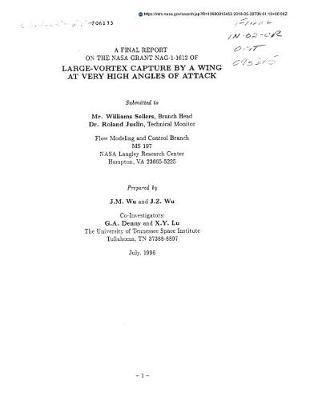
Large-Vortex Capture by a Wing at Very High Angles of Attack

Author:   National Aeronaut Administration (Nasa)
Publisher:   Createspace Independent Publishing Platform
ISBN:  

9781722334413


Pages:   48
Publication Date:   05 July 2018
Format:   Paperback
Availability:   Available To Order   Availability explained
We have confirmation that this item is in stock with the supplier. It will be ordered in for you and dispatched immediately.

Our Price $47.49 Quantity:  
Add to Cart

Share |

Large-Vortex Capture by a Wing at Very High Angles of Attack


Overview

In generating the lift on a wing, the static stall is a severe barrier. As the angle of attack, alpha, increases to the stall angle, alpha(sub stall) the flow separation point on the upper surface of the wing moves to the leading edge, so that on a two-dimensional airfoil or a large-aspect-ratio wing, the lift abruptly drops to a very low level. Therefore, the first generation of aeronautical flow type, i.e., the attached steady flow, has been limited to alpha less than alpha(sub stall). Owing to the obvious importance in applications, therefore, a great effort has been made in the past two decades to enlarge the range of usable angles of attack by various flow controls for a large-aspect-ratio wing. Basically, relevant works fall into two categories. The first category is usually refereed to as separation control, which concentrates on partially separated flow at alpha less than alpha(sub stall). Since the first experimental study of Collins and Zelenevitz, there has been ample literature showing that a partially separated flow can be turned to almost fully attached by flow controls, so that the lift is recovered and the stall is delayed (for a recent work see Seifert et al.). It has been well established that, in this category, unsteady controls are much more effective than steady ones and can be realized at a very low power-input level (Wu et al.; Seifert et al.). The second and more ambitious category of relevant efforts is the post-stall lift enhancement. Its possibility roots at the existence of a second lift peak at a very high angle of attack. In fact, As alpha further increases from alpha(sub stall), the completely separated flow develops and gradually becomes a bluff-body flow. This flow gives a normal force to the airfoil with a lift component, which reaches a peak at a maximum utilizable angle of attack, alpha(sub m) approx.= 40 deg. This second peak is of the same level as the first lift peak at alpha(sub stall). Meanwhile, the drag is also quickly incr...

Full Product Details

Author:   National Aeronaut Administration (Nasa)
Publisher:   Createspace Independent Publishing Platform
Imprint:   Createspace Independent Publishing Platform
Dimensions:   Width: 21.60cm , Height: 0.30cm , Length: 27.90cm
Weight:   0.136kg
ISBN:  

9781722334413


ISBN 10:   172233441
Pages:   48
Publication Date:   05 July 2018
Audience:   General/trade ,  General
Format:   Paperback
Publisher's Status:   Active
Availability:   Available To Order   Availability explained
We have confirmation that this item is in stock with the supplier. It will be ordered in for you and dispatched immediately.

Table of Contents

Reviews

Author Information

Tab Content 6

Author Website:  

Countries Available

All regions
Latest Reading Guide

April RG 26_2


Shopping Cart
Your cart is empty
Shopping cart
Mailing List