Overview
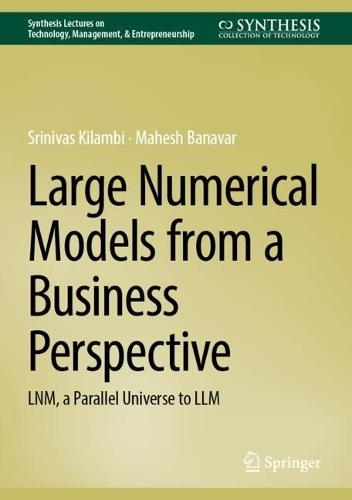
Large Language Models (LLMs) have disruptively changed the world of AI for good and their adoption is near universal. However, how many know that they have a big limitation while processing large numerical quantitative business datasets usually found in ERPs as 1000s of tables. LLMs cannot process 100s of spreadsheets or tables at one time and when they try, they either fail to run or generate inaccurate predictions at best. The authors of this book propose LNMs or Large Numerical Models as a parallel universe to LLMs. LNMs are designed and built for numerical datasets and they offer some significant advantages over LLMs such as very accurate predictions, no hallucinations, improvement in business outcomes and ability to deliver in a ""cold start"" environment. LNMs are vertically curated and can run on a CPU as opposed to energy guzzling GPUs or water consuming cooling systems that LLMs need. This book introduces LNMs, it's underlying structure and SXI. SXI is to LNM as GPT is to LLMs, the underlying core science and technology. The authors also present specific applications of LNMs in healthcare, fintech, wireless, supplychain, marketing campaigns. Finally, the authors introduce their current research area of LLNMs. LLNM combines both LLM and LNM and has significant potential advantages over either LLM or LNMs.
Full Product Details
Author: Srinivas Kilambi ,
Mahesh Banavar
Publisher: Springer Nature Switzerland AG
Imprint: Springer Nature Switzerland AG
ISBN: 9783032148681
ISBN 10: 3032148685
Pages: 112
Publication Date: 06 February 2026
Audience:
General/trade
,
General
Format: Hardback
Publisher's Status: Forthcoming
Availability: Not yet available

This item is yet to be released. You can pre-order this item and we will dispatch it to you upon its release.
Author Information
Dr. Srinivas Kilambi is a passionate technologist at heart with a career spanning over three decades in academics, research, industry/corporates, start-ups across diverse verticals such as chemicals, biomass & renewable energy, clean water, machine-learning & artificial intelligence and education. He is the founder of the Sriya Group. His specialties include: Large Numerical Models (LNM), Large Language and Numerical Models (LLNM), Machine Learning, Green Building Materials, Green Chemicals, Bio-Refineries, Biomass, solar, nanotechnology, biotechnology, and clean water. Dr. Kilambi earned his BS in Chemical Engineering from the Indian Institute of Technology, Chennai, India, and then MS in Environmental Engineering from Clarkson and Johns Hopkins Universities, followed by a PhD in Chemical Engineering from the University of Tennessee-Knoxville. Dr. Kilambi also holds a CFA certification. Dr. Mahesh Banavar is a Professor of Electrical and Computer Engineering at Clarkson University, where he also serves as the Associate Director for Faculty Support at the Institute for STEM Education. He received his BE in Telecommunications Engineering from Visvesvaraya Technological University in India, followed by MS and PhD degrees in Electrical Engineering from Arizona State University. Dr. Banavar’s research spans signal processing, machine learning and artificial intelligence, and STEM education. He leads the Communications, Signal Processing, and Networking (CoSiNe) Lab at Clarkson University, where his work bridges algorithms and applications, with a focus on interdisciplinary and community-engaged research. He is a member of the Tau Beta Pi and Eta Kappa Nu engineering honor societies. Outside academia, Dr. Banavar serves his community as a certified New York State EMT and active volunteer with the Potsdam Volunteer Rescue Squad.