Overview
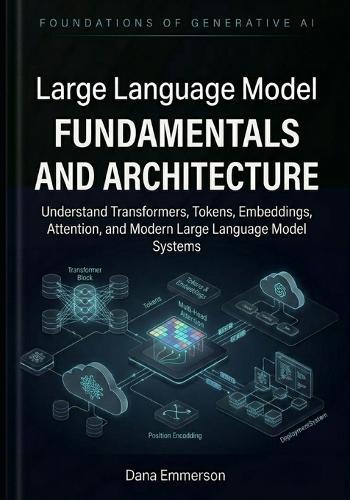
Artificial intelligence has entered a new era driven by Large Language Models (LLMs), transformer architectures, and foundation models capable of generating human-like language, reasoning across complex tasks, and powering intelligent AI systems across industries. As these systems continue to reshape software development, automation, search, communication, and digital experiences, understanding the internal architecture and core principles behind LLMs has become an essential skill for modern developers and AI engineers. LLM Fundamentals and Architecture provides a comprehensive and technically grounded introduction to the foundational concepts, mathematical principles, and architectural components that power modern Large Language Models. Designed for developers, machine learning practitioners, students, and technology professionals, this book explains how transformer-based systems process language, learn contextual representations, generate coherent outputs, and scale into massive foundation models capable of performing sophisticated reasoning and generative tasks. The book begins by exploring the evolution of natural language processing, moving from statistical language models and recurrent neural networks to the transformer revolution that transformed the AI landscape. Readers will develop a deep understanding of the mathematical foundations behind deep learning systems, including tensors, vector spaces, probability, optimization, gradient descent, and representation learning. These concepts are carefully connected to modern transformer architectures and neural language modeling techniques used in today's state-of-the-art LLMs. Throughout the book, readers will examine the internal mechanics of transformers, including self-attention, multi-head attention, positional encoding, feedforward layers, residual connections, and sequence modeling pipelines. The book also provides in-depth coverage of tokenization algorithms, embeddings, semantic vector spaces, training pipelines, fine-tuning methods, inference systems, evaluation strategies, and Retrieval-Augmented Generation (RAG) architectures. Beyond theoretical concepts, the book explores the practical challenges involved in training and scaling large AI systems, including distributed training infrastructure, quantization, inference optimization, hallucination mitigation, AI safety, and model evaluation. Readers will also gain exposure to emerging domains such as multimodal AI systems, AI agents, memory architectures, autonomous reasoning systems, and the future evolution of foundation models. By the end of this book, readers will possess a strong conceptual and technical understanding of how Large Language Models function internally, how modern transformer architectures are designed, and how these systems continue to evolve into increasingly capable AI platforms. This knowledge forms the critical foundation required for building, deploying, and engineering advanced Generative AI systems in real-world environments.
Full Product Details
Author: Dana Emmerson
Publisher: Independently Published
Imprint: Independently Published
Dimensions:
Width: 17.80cm
, Height: 0.90cm
, Length: 25.40cm
Weight: 0.313kg
ISBN: 9798196451133
Pages: 174
Publication Date: 11 May 2026
Audience:
General/trade
,
General
Format: Paperback
Publisher's Status: Active
Availability: Available To Order

We have confirmation that this item is in stock with the supplier. It will be ordered in for you and dispatched immediately.