Overview
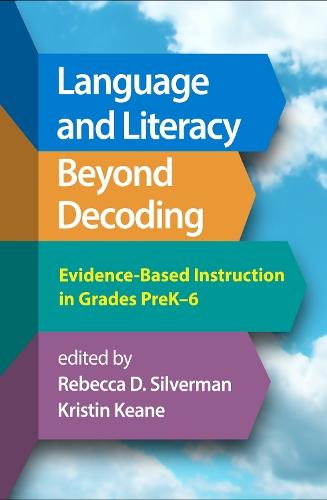
Successful reading comprehension requires readers to draw on a range of language comprehension abilities alongside decoding. This timely teacher reference and text explains how language comprehension develops throughout grades PreK-6 and presents evidence-based instructional strategies. The volume reviews innovative ways to conduct content-rich classroom conversations, deliver strategy and text structure instruction, target motivational aspects of comprehension, use assessment to guide comprehension-focused instruction, and more. Ways to support language and reading comprehension with multilingual and multidialectal learners are considered in depth. Ideal for professional learning within a science-of-reading perspective, each chapter provides guiding questions, research reviews, classroom applications, and reflection questions.
Full Product Details
Author: Rebecca D. Silverman (Stanford University, United States) , Kristin Keane (Stanford University, United States)
Publisher: Guilford Publications
Imprint: Guilford Press
ISBN: 9781462559596
ISBN 10: 146255959
Pages: 282
Publication Date: 06 April 2026
Audience:
Professional and scholarly
,
Professional & Vocational
Format: Paperback
Publisher's Status: Forthcoming
Availability: Not yet available 
This item is yet to be released. You can pre-order this item and we will dispatch it to you upon its release.
Table of Contents
1. Introduction: The Critical Role of Language Comprehension in Reading Comprehension, Rebecca D. Silverman & Kristin Keane 2. Content-Rich Classroom Conversations That Improve Language Comprehension in the Early Grades, Sonia Q. Cabell, C. J. Espittia, & Tricia A. Zucker 3. Gaps and Opportunities for Supporting Language and Comprehension in Early Childhood Classrooms, Shayne B. Piasta, Hyekin Kim, & Yeqing Liu 4. From Ears to Eyes: Supporting Reading Comprehension through Systematic Instruction on Listening Comprehension, Young-Suk Grace Kim 5. Improving Elementary Students’ Reading Comprehension through Structured and Systematic Translation of Research to Practice, Kausalai Kay Wijekumar, Kacee Lambright, Ashley Stack, Javier Garza, & Pilar Sierra 6. Best Practices for Supporting Motivation during Reading Comprehension Instruction, Eunsoo Cho, Sarah Reiley, & Philip Capin 7. Inferencing and Reading Comprehension, Gina Biancarosa 8. Effects of Language Components on Language and Reading Comprehension, Doris Luft Baker, Yixian Huang, Cinthia Berenice Herrera, & Sholeh Moradibavi 9. Hearing Themselves in Books: Using Authentic Children’s Literature to Support the Language of African American Students, Ramona T. Pittman, Endia Lindo, W. McCoy, & Jasmine Rogers 10. Language and Reading Assessment Practices for Multilingual Learners from Spanish-Speaking Homes, Jeannette Mancilla-Martinez, Bhabika Joshi, & Phoebe J. Ahn 11. The Role of Language in Reading Comprehension: Instructional Implications for Teachers of Multilingual Learners, C. Patrick Proctor & Rebecca D. Silverman 12. “What If I Don’t Speak Their Languages?”: Engaging Educators and Multilingual Learners in Collaborative Exploration of the Language for School Literacy, Emily Phillips Galloway Index
Reviews
“Every day, educators encounter many students who can sound out individual words on the page but struggle to comprehend the text they are reading. This timely, approachable volume brings together an extraordinary group of reading experts to share proven principles and techniques for teaching language comprehension. Topics range from promoting content-rich language instruction, to leveraging better assessments and new technologies, to integrating linguistic diversity as a central feature--not a special case--in today’s classrooms. This book addresses all of the elements most essential to improving our students’ literacy performance and life outcomes.”--Michael Kieffer, EdD, Department of Teaching and Learning, New York University “Providing a vital corrective to foundational skills mandates, this volume addresses the importance of rich language development occurring alongside--not after--phonics instruction. Contributors address the complex needs of diverse learners, including multilingual students and speakers of African American English, through culturally responsive approaches that honor students' linguistic assets while building academic success. Teachers, coaches, and teacher educators will find research-proven strategies and concrete solutions for fostering language's critical role in reading comprehension.”--Elfrieda H. Hiebert, PhD, President and CEO, TextProject ""Evidence based and teacher friendly, this book explores the 'whats' and 'how-tos' of implementing multi-component instructional strategies to support elementary students’ language and reading comprehension. Leading scholars describe cutting-edge research and give teachers tools they can start using immediately. Each chapter invites the reader in with guiding questions; reviews the literature; provides relatable vignettes and case studies; and asks teachers to reflect on their own current practices and how they might be improved to positively impact student learning.""--Stephanie Al Otaiba, PhD, Centennial Chair in Teaching and Learning, Simmons School of Education and Human Development, Southern Methodist University-
“Every day, educators encounter many students who can sound out individual words on the page but struggle to comprehend the text they are reading. This timely, approachable volume brings together an extraordinary group of reading experts to share proven principles and techniques for teaching language comprehension. Topics range from promoting content-rich language instruction, to leveraging better assessments and new technologies, to integrating linguistic diversity as a central feature--not a special case--in today’s classrooms. This book addresses all of the elements most essential to improving our students’ literacy performance and life outcomes.”--Michael Kieffer, EdD, Department of Teaching and Learning, New York University “Providing a vital corrective to foundational skills mandates, this volume addresses the importance of rich language development occurring alongside--not after--phonics instruction. Contributors address the complex needs of diverse learners, including multilingual students and speakers of African American English, through culturally responsive approaches that honor students' linguistic assets while building academic success. Teachers, coaches, and teacher educators will find research-proven strategies and concrete solutions for fostering language's critical role in reading comprehension.”--Elfrieda H. Hiebert, PhD, President and CEO, TextProject-
""Amazing! A master class from some of the top researchers and instructors in language and literacy research and instruction with clear, practical classroom ideas and materials. This is a much-needed resource for language and literacy instruction that I plan to use immediately in my reading methods courses for both preservice and practicing teachers.""--Jeanne Wanzek, PhD, Department of Special Education, Peabody College, Vanderbilt University ""Evidence based and teacher friendly, this book explores the 'whats' and 'how-tos' of implementing multi-component instructional strategies to support elementary students’ language and reading comprehension. Leading scholars describe cutting-edge research and give teachers tools they can start using immediately. Each chapter invites the reader in with guiding questions; reviews the literature; provides relatable vignettes and case studies; and asks teachers to reflect on their own current practices and how they might be improved to positively impact student learning.""--Stephanie Al Otaiba, PhD, Centennial Chair in Teaching and Learning, Simmons School of Education and Human Development, Southern Methodist University “Every day, educators encounter many students who can sound out individual words on the page but struggle to comprehend the text they are reading. This timely, approachable volume brings together an extraordinary group of reading experts to share proven principles and techniques for teaching language comprehension. Topics range from promoting content-rich language instruction, to leveraging better assessments and new technologies, to integrating linguistic diversity as a central feature--not a special case--in today’s classrooms. This book addresses all of the elements most essential to improving our students’ literacy performance and life outcomes.”--Michael Kieffer, EdD, Department of Teaching and Learning, New York University “Providing a vital corrective to foundational skills mandates, this volume addresses the importance of rich language development occurring alongside--not after--phonics instruction. Contributors address the complex needs of diverse learners, including multilingual students and speakers of African American English, through culturally responsive approaches that honor students' linguistic assets while building academic success. Teachers, coaches, and teacher educators will find research-proven strategies and concrete solutions for fostering language's critical role in reading comprehension.”--Elfrieda H. Hiebert, PhD, President and CEO, TextProject-
Author Information
Rebecca D. Silverman, EdD, is the Judy Koch Professor of Education in the Graduate School of Education at Stanford University. A former elementary school teacher, Dr. Silverman’s research focuses on language and literacy development and instruction in early childhood and elementary school. In particular, her work has contributed to the research base on supporting vocabulary and other aspects of language that are critical to reading and writing, and using multimedia and educational technology to facilitate literacy. At Stanford, Dr. Silverman leads the Language to Literacy Research Lab and teaches in the Stanford Teacher Education Program. She also engages in research–practice partnerships with school districts and provides professional development to teachers. Widely published in education journals, she has served on the board of directors of the International Literacy Association and is Editor-in-Chief of Elementary School Journal. Her website is https://langlitlab.stanford.edu. Kristin Keane, PhD, is Assistant Professor of Reading Development at the University of California, Berkeley. She uses mixed methods approaches to study literacy development and instruction in elementary schools, paying special attention to the ways multimodal and digital literacies--including technological approaches--can enhance engagement, comprehension, and dialogic discussion of varied types of text. Previously, Dr. Keane was Director of Research and Partnerships at the Language to Literacy Research Lab at Stanford University. Her school-based work has included leading a network of literacy coaches, serving as a literacy staff developer, and teaching in various contexts in California. She has published a number of articles on literacy practice and development in leading education journals.
Tab Content 6
Author Website:
Countries Available
All regions
|