Overview
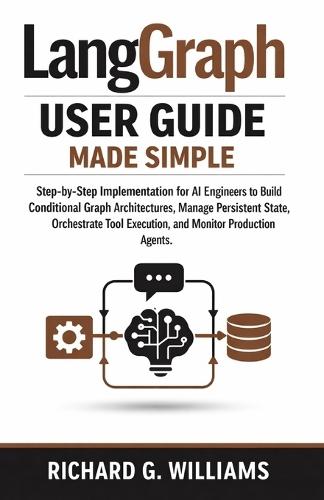
Artificial intelligence has evolved. Simple prompt-and-response systems are no longer enough. Today's real-world applications demand structured reasoning, intelligent decision flow, tool coordination, and persistent memory. Yet many engineers are still building systems that stop thinking the moment they generate a response. If you've ever struggled with: - Rigid workflows that break under complex logic - Agents that call tools but fail to complete reasoning - Systems that forget context at the wrong moment - Conditional routing that feels messy and unreliable - Deployments that lack monitoring and control Then this book was written for you. LangGraph User Guide Made Simple is not another surface-level explanation of AI concepts. It is a structured, implementation-focused manual designed specifically for AI engineers who are ready to move beyond basic chains and build production-ready autonomous systems. Inside this guide, you will learn how to: - Design conditional graph architectures that think in structured paths - Manage persistent state across multi-step executions - Coordinate tool invocation without breaking reasoning flow - Implement memory checkpoints for session continuity - Monitor runtime behavior, token usage, and execution trace - Transition from linear workflows to decision-driven architectures This book shows you not just how to build - but how to build correctly. You will understand the architectural principles that separate reactive chatbots from truly autonomous agents. You will learn how to balance flexibility with control. You will develop the mindset required to design systems that are reliable, observable, and scalable. This guide is for: - AI Engineers building intelligent systems - Backend Developers integrating LLM-based workflows - Software Engineers designing production-grade AI architectures - Technical Professionals moving beyond prompt engineering If you are experimenting with language models and wondering why your systems feel fragile, the time to rethink your structure is now. The shift from response generation to controlled autonomy is happening. Those who understand orchestration, state management, and structured execution will lead the next generation of AI deployment. You do not need hype. You need clarity. You need structure. You need implementation discipline. And that is exactly what this book delivers. If you are ready to design AI systems that do more than respond - systems that reason, decide, act, and recover with precision - then this guide belongs on your desk. Take the next step. Build with structure. Deploy with confidence. Design with intention. Get your copy today and start architecting intelligent systems the right way.
Full Product Details
Author: Richard G William
Publisher: Independently Published
Imprint: Independently Published
Dimensions:
Width: 14.00cm
, Height: 1.00cm
, Length: 21.60cm
Weight: 0.227kg
ISBN: 9798249668754
Pages: 192
Publication Date: 24 February 2026
Audience:
General/trade
,
General
Format: Paperback
Publisher's Status: Active
Availability: Available To Order

We have confirmation that this item is in stock with the supplier. It will be ordered in for you and dispatched immediately.