Overview
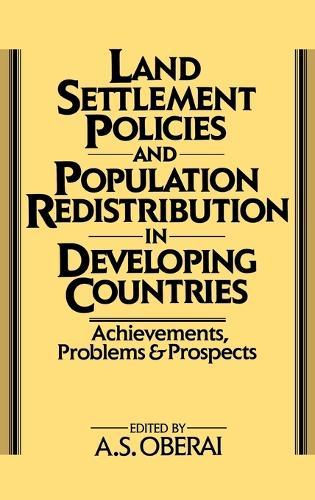
Land Settlement Policies and Population Redistribution in Developing Countries provides a comparative analysis, initiated by the International Labour Office, of land settlement policies and programs in developing countries under various socioeconomic conditions. It reports the findings of nine case studies conducted in countries which have established resettlement schemes. The major focus of the studies is the identification of the factors that have contributed to the success or failure of resettlement schemes from the point of view of the populations concerned--in relation to the original objectives of the policymakers--and with respect to development objectives other than population distribution.
Full Product Details
Author: A. S. Oberai
Publisher: Bloomsbury Publishing Plc
Imprint: Praeger Publishers Inc
Dimensions:
Width: 15.60cm
, Height: 2.30cm
, Length: 23.40cm
Weight: 0.752kg
ISBN: 9780275927998
ISBN 10: 0275927997
Pages: 409
Publication Date: 26 January 1988
Recommended Age: From 7 to 17 years
Audience:
College/higher education
,
Undergraduate
,
Postgraduate, Research & Scholarly
Format: Hardback
Publisher's Status: Active
Availability: Manufactured on demand

We will order this item for you from a manufactured on demand supplier.
Reviews
?The central issue of this anthology is the evaluation of resettlement schemes in several developing nations that were intended to exploit lands; alleviate poverty, landlessness, and underemployment; and achieve national security objectives. Contributions deal with land settlements in Indonesia, Malaysia, the Philippines, Ethiopia, Somalia, Tanzania, Brazil, Latin American frontier zones, and Peru. In the first two chapters, the editor provides the background and evaluation of settlement schemes and a general survey of the factors affecting success or failure of these programs. In his overall evaluation of the programs, Oberai concludes that their successes in improving population distribution and reducing unemployment and poverty were very modest. Only few projects achieved their objectives; the total impact on employment and production was limited, while the cost per settler was high. A major contribution of this symposium is the identification of major factors that have in the past contributed to the success of failure of resettlement policies. Among the problems confronting settlement programs, the contributors list migrants' abandonment of settlements, lack of nonfarm employment opportunities, large land holdings, ecological effects, high costs, and tensions between the newcomers and indigenous population.?-Choice
Author Information
A. S. OBERAI is a Senior Economist in the Employment Planning and Population Branch, Employment and Development Department of the International Labour Office, Geneva, Switzerland.