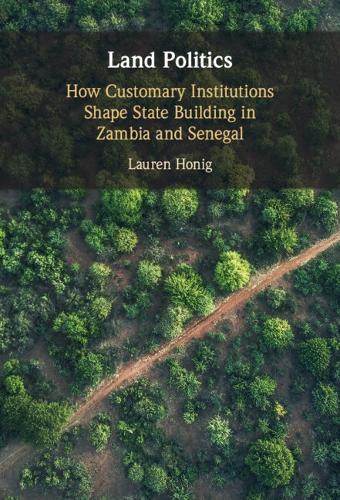
Full Product Details
Author: Lauren Honig (Boston College, Massachusetts)
Publisher: Cambridge University Press
Imprint: Cambridge University Press
Edition: New edition
Dimensions:
Width: 15.70cm
, Height: 2.50cm
, Length: 23.50cm
Weight: 0.690kg
ISBN: 9781009123402
ISBN 10: 1009123408
Pages: 382
Publication Date: 25 August 2022
Audience:
General/trade
,
General
Format: Hardback
Publisher's Status: Active
Availability: Manufactured on demand

We will order this item for you from a manufactured on demand supplier.
Reviews
'The drama of African politics is increasingly a story of fierce competition over land, especially as states attempt to wrest control from customary authorities. In this carefully-crafted book, Lauren Honig shows that even across divergent contexts, longstanding institutions continue to shape and to constrain the realization of such ambitions, with important distributional consequences for citizens. With a wealth of empirical evidence based on extensive original data collection, Land Politics details the ways in which institutions affect the balance of power, and the likelihood of citizens engaging the state or local chiefs to advance their interests. This ambitious volume is a must-read for understanding the political economy of land in Africa.' Evan S. Lieberman, Total Professor of Political Science and Contemporary Africa, Director, Global Diversity Lab, Massachusetts Institute of Technology 'Honig's superb book advances scholarship on land politics and customary leadership by theorizing and demonstrating how variation within traditional political institutions matters. Based on original qualitative and quantitative evidence from both Anglophone and Francophone Africa, the book is an exemplar of field research in comparative politics.' Kate Baldwin, Associate Professor of Political Science, Yale University 'Honig's book makes an innovative theoretical contribution to our understanding of how customary institutions shape state building from the ground up in very different ways. In a fascinating comparison of Zambia and Senegal, she investigates different pathways of accountability during the complex local-level negotiations over land titles. Her analysis and arguments are powerfully enriched by a rigorous case comparison and extensive, multi-method fieldwork.' Lauren M. MacLean, Department Chair, Political Science, Indiana University
Author Information
Lauren Honig is an assistant professor of political science at Boston College. Her research on property rights, citizen-state linkages, customary authority, and informal institutions in Africa has been published in numerous journals. She has received fellowships and grants from the National Science Foundation, Social Science Research Council, and Fulbright Association, among others.