Overview
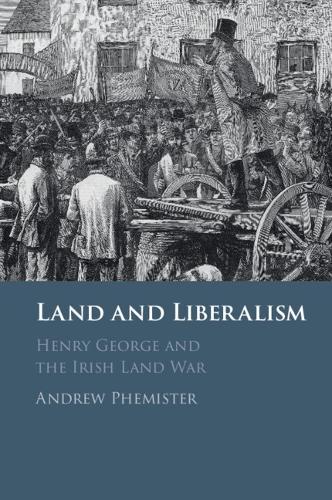
Irish land in the 1880s was a site of ideological conflict, with resonances for liberal politics far beyond Ireland itself. The Irish Land War, internationalised partly through the influence of Henry George, the American social reformer and political economist, came at a decisive juncture in Anglo-American political thought, and provided many radicals across the North Atlantic with a vision of a more just and morally coherent political economy. Looking at the discourses and practices of these agrarian radicals, alongside developments in liberal political thought, Andrew Phemister shows how they utilised the land question to articulate a natural and universal right to life that highlighted the contradictions between liberty and property. In response to this popular agrarian movement, liberal thinkers discarded many older individualistic assumptions, and their radical democratic implications, in the name of protecting social order, property, and economic progress. Land and Liberalism thus vividly demonstrates the centrality of Henry George and the Irish Land War to the transformation of liberal thought.
Full Product Details
Author: Andrew Phemister (Newcastle University)
Publisher: Cambridge University Press
Imprint: Cambridge University Press
Dimensions:
Width: 15.20cm
, Height: 1.50cm
, Length: 22.90cm
Weight: 0.423kg
ISBN: 9781009202923
ISBN 10: 1009202928
Pages: 289
Publication Date: 20 February 2025
Audience:
General/trade
,
General
Format: Paperback
Publisher's Status: Active
Availability: Manufactured on demand

We will order this item for you from a manufactured on demand supplier.
Reviews
'This is a well-researched and deeply original study of the American social and political reformer Henry George, who inspired both the first generation of British and Irish socialists - including James Keir Hardie and Michael Davitt - and liberal reformers and philosophers like Thomas Hill Green. The main question Andrew Phemister endeavours to answer is why Henry George was so influential, but the originality of his approach also relies on his placing the history of political ideas in their widest social context.' E. F. Biagini, University of Cambridge 'Andrew Phemister has contributed a serious illustration of what he calls the “social history of ideas”, which locates the American journalist Henry George at the centre of a transition to non-violent activism, the contribution of Catholic intellectuals, and the fractionation of social movements over the relationship of state and individual. The book will be of interest to historians of labour, identity, and liberalism on both sides of the Atlantic.' Jo Guldi, Southern Methodist University
Author Information
Andrew Phemister is a Research Associate at Newcastle University. He has previously held postdoctoral positions in History at NUI Galway, the University of Oxford, and Edinburgh's Institute for Advanced Studies in the Humanities.