Full Product Details
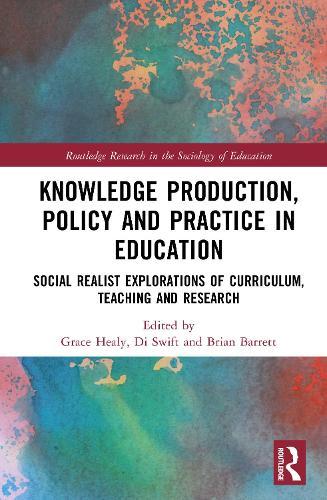
Author: Grace Healy ,
Di Swift ,
Brian Barrett (SUNY Cortland, USA)
Publisher: Taylor & Francis Ltd
Imprint: Routledge
ISBN: 9781041093947
ISBN 10: 1041093942
Pages: 190
Publication Date: 31 March 2026
Audience:
College/higher education
,
Professional and scholarly
,
Tertiary & Higher Education
,
Professional & Vocational
Format: Hardback
Publisher's Status: Forthcoming
Availability: Not yet available

This item is yet to be released. You can pre-order this item and we will dispatch it to you upon its release.
Reviews
‘This book is a significant contribution to contemporary debates about knowledge production, policy and practice in Education. It is structured around three themes: epistemic justice, the challenges presented by the rise of genericism and the role of Basil Bernstein’s ‘discursive gap’ for analysing these issues. The chapters comprise a set of rich accounts from scholars in social realism working in a range of contexts and from a diverse range of geographical regions. Regarding the first theme, the studies contained within this book aim toward an expanded understanding of epistemic injustice and the consideration of possibilities for enabling access to powerful knowledge. In relation to the rise of genericism, the editors draw on Bernstein’s term “trainability” which he described as an ‘ability’ to receive an instruction or direction that is then replicated or reproduced as a competency. As such they argue that it is empty of the educative means of powerful knowledge. With further reference to Bernstein, genericism is seen to result in untethered practices that are neither contextually nor conceptually coherent, producing professional identities described as “socially empty”. The impact of such practices on teacher and vocational education and on curriculum development are explored in detail through these chapters.’ - Professor Brian Hudson, Emeritus Professor of Education, University of Sussex and Guest Professor, Karlstad University, Sweden ‘I believe that the rise of populism and the resurgence of totalitarianism across the globe, based on the politics of denial, conspiracy theories, anti-science and the re-writing of history, requires a deeply informed educational response. The backdrop to these threats to open and democratic societies are the epochal challenges to human existence itself, including nuclear conflict and climate change. And this is before we imagine the world of ubiquitous and unregulated artificial intelligence. Bernstein provided some of the conceptual resources we need to grasp and embrace active and responsible citizenship in these times. The chapters of this book use Bernsteinian insight to explore the depth and ambition required to re-imagine teachers and teaching appropriately. The chapters of this book are wide ranging, but all take seriously notions of epistemic access and epistemic justice. Teachers are the key, the editors argue, and with that an elaborated concept of what it means to teach.’ - Professor David Lambert, Emeritus Professor of Geography Education, IOE UCL’s Faculty of Education and Society, London ‘Insightfully bringing together theory and practice, the book offers readers possibilities for how to enable epistemic justice and make knowledge structures visible to learners. Drawing on, and adding to, Bernsteinian and social realist theories, concepts such as the ‘pedagogic device’, ‘recontextualisation’ and ‘open concepts’ are clearly defined and then applied to different disciplines within a range of global educational settings. The book advances our understandings of knowledge in education through documenting innovative research into teaching practices, teacher agency, pedagogy and curriculum design. The drive towards ‘genericism’ with reduced specification of knowledge in curriculum, and the alternative impetus for ‘knowledge-rich’ curricula are explored which has ensured that a wide lens on possible approaches to curricula has been engaged with. The range and depth of the discussion makes the book a ‘must read’ for scholars, teachers, initial teacher educators and policy developers.’ - Dr Barbara Ormond, Director of Secondary Programmes, University of Auckland, New Zealand
Author Information
Grace Healy is Honorary Associate Professor, UCL Institute of Education, UK, Honorary Research Fellow, University of Oxford, UK, and Education Director (Secondary), David Ross Education Trust, UK. Di Swift is Associate Lecturer, Primary Education, The Open University, UK & Honorary Fellow, Institute for Social Inclusion, Keele University, UK. Brian Barrett is Professor in the Foundations and Social Advocacy Department, State University of New York at Cortland, USA.