Overview
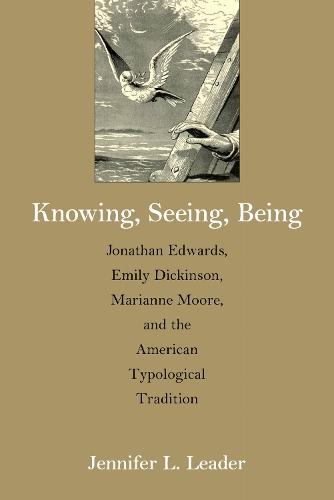
Scholars no longer see Jonathan Edwards as the fire-and-brimstone preacher who deemed his parishioners """"sinners in the hands of an angry god."""" Edwards now figures as caring and socially conscious and exerts increased influence as a philosopher of the American school of Protestantism. In this study, he becomes the progenitor of an alternative tradition in American letters. In Knowing, Seeing, Being, Jennifer Leader argues that Edwards, the nineteenth-century poet Emily Dickinson, and the twentieth-century poet Marianne Moore share a heretofore underrecognized set of religious and philosophical preoccupations. She contends that they represent an alternative tradition within American literature, one that differs from Transcendentalism and is grounded in Reformed Protestantism and its ways of reading and interpreting the King James Bible and the natural world. According to Leader, these three writers' most significant commonality is the Protestant tradition of typology, a rigorous mode of interpreting scripture and nature through which certain figures or phenomena are read as the fulfillment of prophecy and of God's work. Following from their similar ways of reading, they also share philosophical and spiritual questions about language, epistemology (knowing), perception (seeing), and physical and spiritual ontology (being). In connecting Edwards to these two poets, in exploring each writer's typological imagination, and through a series of insightful readings, this innovative book reevaluates three major figures in American intellectual and literary history and compels a reconsideration of these writers and their legacies.
Full Product Details
Author: Jennifer L. Leader
Publisher: University of Massachusetts Press
Imprint: University of Massachusetts Press
Dimensions:
Width: 15.20cm
, Height: 2.20cm
, Length: 22.80cm
Weight: 0.400kg
ISBN: 9781625341808
ISBN 10: 1625341806
Pages: 240
Publication Date: 10 February 2016
Audience:
College/higher education
,
Postgraduate, Research & Scholarly
Format: Paperback
Publisher's Status: Active
Availability: Temporarily unavailable

The supplier advises that this item is temporarily unavailable. It will be ordered for you and placed on backorder. Once it does come back in stock, we will ship it out to you.
Reviews
"""A ground-breaking contribution to scholarship on three major writers and their roles in American Protestant poetics. It will introduce typology into literary conversations in a fresh and illuminating way while deepening appreciation for poetry.""--Jane Donahue Eberwein, author of Dickinson: Strategies of Limitation and editor of An Emily Dickinson Encyclopedia ""This is a very important book. Not only does it revive scholarly interest in the literary legacies of Edwards, it clarifies those legacies by showing that they survived not merely in a diffuse way among the Transcendentalists, but in a more specific way among writers raised in Reformed and Edwardsean church contexts in which the typological interpretation of reality, informed by the interpretation of Scripture, remained alive and well into the late modern period.""--Jonathan Edwards Center ""This approach, then, suggests a new lens--a grounding in Reformed thought--through which to see not only Edwards but also the writings of Dickinson and Moore. This lens allows us to see in each their engagement with categories of beauty, being, and virtue. Having pointed us to such seemingly diverse figures in American literature, and finding these profound commonalities, we can only wonder what other figures might be brought into this conversation with as much profit and illumination.""--Jonathan Edwards Studies ""By uncovering the typological traditions of these three American authors, Leader is pushingback against the 'Perry Miller school of thought, ' which 'erased epistemological categories that might delineate and juxtapose currents of religious philosophy beyond the Transcendental.' She argues that Edwards's relational ontology provides an alternative American model to Emerson's Neoplatonic 'Correspondences, ' and uses the theories of Emmanuel Levinas and Jean-Luc Marion to make sense of the connections between these writers.""--American Literature ""Jennifer Leader has written a thoughtful and provocative account of Jonathan Edwards's influence on two major American poets, Emily Dickinson and Marianne Moore--one the more obvious, though reluctant, heir to Puritan orthodoxy, the other a modernist whose reading and inclination encouraged her continuing dialogue with American religious tradition and twentieth-century theology....In her treatment of Marianne Moore, Leader makes her most distinctive contribution.""""--New England Quarterly"
A ground-breaking contribution to scholarship on three major writers and their roles in American Protestant poetics. It will introduce typology into literary conversations in a fresh and illuminating way while deepening appreciation for poetry.--Jane Donahue Eberwein, author of Dickinson: Strategies of Limitation and editor of An Emily Dickinson Encyclopedia This is a very important book. Not only does it revive scholarly interest in the literary legacies of Edwards, it clarifies those legacies by showing that they survived not merely in a diffuse way among the Transcendentalists, but in a more specific way among writers raised in Reformed and Edwardsean church contexts in which the typological interpretation of reality, informed by the interpretation of Scripture, remained alive and well into the late modern period.--Jonathan Edwards Center This approach, then, suggests a new lens--a grounding in Reformed thought--through which to see not only Edwards but also the writings of Dickinson and Moore. This lens allows us to see in each their engagement with categories of beauty, being, and virtue. Having pointed us to such seemingly diverse figures in American literature, and finding these profound commonalities, we can only wonder what other figures might be brought into this conversation with as much profit and illumination.--Jonathan Edwards Studies By uncovering the typological traditions of these three American authors, Leader is pushingback against the 'Perry Miller school of thought, ' which 'erased epistemological categories that might delineate and juxtapose currents of religious philosophy beyond the Transcendental.' She argues that Edwards's relational ontology provides an alternative American model to Emerson's Neoplatonic 'Correspondences, ' and uses the theories of Emmanuel Levinas and Jean-Luc Marion to make sense of the connections between these writers.--American Literature Jennifer Leader has written a thoughtful and provocative account of Jonathan Edwards's influence on two major American poets, Emily Dickinson and Marianne Moore--one the more obvious, though reluctant, heir to Puritan orthodoxy, the other a modernist whose reading and inclination encouraged her continuing dialogue with American religious tradition and twentieth-century theology....In her treatment of Marianne Moore, Leader makes her most distinctive contribution.--New England Quarterly
Author Information
Jennifer L. Leader is a professor in the American Language Department at Mt. San Antonio College, USA.