Overview
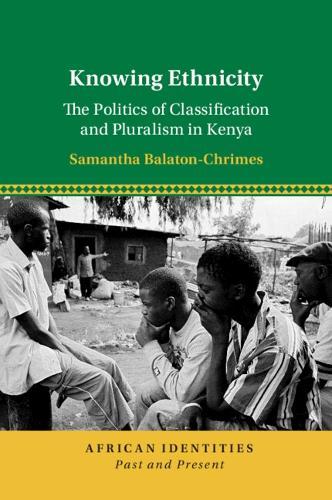
There is a widespread assumption that both ethnicity itself and ethnic conflict, are inevitable. Yet, we know very little about how ethnic identifications function in bureaucratic terms in Africa. The stakes of this problem are rapidly escalating in moves to digital identification and population knowledge systems. Focusing on Kenya, this study provides an urgently needed exploration of where ethnic classifications have come from, and where they might go. Through genealogies of tools of ethnic identification – maps, censuses, ID cards and legal categories for minorities and marginalised communities – Samantha Balaton-Chrimes challenges conventional understandings of classifications as legible. Instead, she shows them to be uncertain and vague in useful ways, opening up new modes of imagining how bureaucracy can be used to advance pluralism. Knowing Ethnicity holds important insights for policymakers and scholars of difference and governmentality in postcolonial societies, as well as African and ethnic politics.
Full Product Details
Author: Samantha Balaton-Chrimes (Deakin University, Victoria)
Publisher: Cambridge University Press
Imprint: Cambridge University Press
Weight: 0.390kg
ISBN: 9781009707800
ISBN 10: 1009707809
Pages: 266
Publication Date: 09 April 2026
Audience:
College/higher education
,
Postgraduate, Research & Scholarly
Format: Paperback
Publisher's Status: Active
Availability: Manufactured on demand

We will order this item for you from a manufactured on demand supplier.
Reviews
'Few researchers and fewer policy makers realise that the most serious danger lurking in African states' growing administrative capacity to identify and track their citizens is the development of a permanent architecture of ethnicised citizenship. Sam Balaton-Chimes' Knowing Ethnicity is the best account of why this happened and what is at stake in reproducing it.' Keith Breckenridge, Wits University 'This rich, detailed book offers important contributions to studies of governmentality, social sorting, and legal recognition; census, registration, and identification technologies; and the pre-history of datafication. Through her concept of 'cultivated vagueness' and with a sensitivity towards the diverse strategies of minoritized groups and their representatives, Samantha Balaton-Chrimes provides refreshingly new insights into long-standing debates about the making and politicization of ethnicity in Africa. In dispelling the myth that there has ever been a definitive list of Kenya's '42' ethnic groups, Balaton-Chrimes offers fine-grained analysis of the politics of 'code seeking,' 'the arts of government and of being governed,' and the risks and opportunities that emerge in the disconnect between law and practice, which has implications well beyond the field of African studies.' Keren Weitzberg, Queen Mary University of London
Author Information
Samantha Balaton-Chrimes is an associate professor in politics at Deakin University. She is a political sociologist with sixteen years' experience conducting research on ethnicity, marginalisation and politics in Kenya and other postcolonial societies. Balaton-Chrimes is the author of Ethnicity, Democracy and Citizenship in Africa (2015) and has published more than twenty articles and book chapters.