Overview
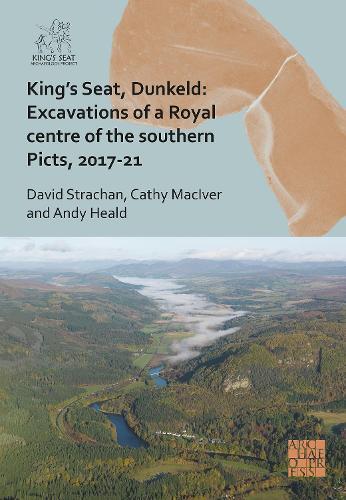
It is remarkable, given Dunkeld’s importance in medieval Scotland, that so little was known of King’s Seat fort until the 1950s. While proposed as a royal Pictish ‘nuclear’ fort in the 1980s, it was so heavily overgrown as to be effectively lost to archaeology until 2015, when the local history society instigated a programme of community archaeology to explore its story. Led by Perth and Kinross Heritage Trust, working with AOC Archaeology Group, this included excavation that revealed a high-status Pictish fort complex. Like the classic sites Dundurn and Clatchard Craig, it had a high-status summit citadel surrounded by a hierarchy of connected out-works on lower terraces. LiDAR data revealed a previously unknown south enclosure, more than doubling its total footprint and raising questions about the role of such sites and the nature of Pictish settlement. Controlling important routes from the north and west into the lower Tay region, King’s Seat was a Pictish ‘royal’ stronghold, estate, and production centre which was to attract an important early monastic foundation. While relatively short-lived, it produced evidence of elite metalworking and trade and was the venue for feasting that saw the consumption of exotic luxuries such as Continental imports and glass vessels from Anglo-Saxon England. It was abandoned, rather than destroyed, perhaps as power passed to a lower site in a new architectural form, associated with the increasing power of the church and as larger polities developed. The relics of Columba were brought to Dunkeld in the 9th century, probably as much a result of tensions between Pictish royalty and the Gaelic church as the threat of Viking raids, before its ecclesiastical importance was eclipsed by St Andrews. Dunkeld takes its name from the Gaelic dùn Cailleann or ‘fort of the Caledonians’ which undoubtedly refers to King’s Seat fort. It is apt that retention of this pre-Pictish name celebrates the link between later prehistory and medieval Scotland that is so well represented by the site itself.
Full Product Details
Author: David Strachan ,
Cathy MacIver ,
Andy Heald
Publisher: Archaeopress
Imprint: Archaeopress Archaeology
Weight: 1.308kg
ISBN: 9781805831174
ISBN 10: 1805831178
Pages: 246
Publication Date: 27 November 2025
Audience:
Professional and scholarly
,
Professional & Vocational
Format: Hardback
Publisher's Status: Active
Availability: Manufactured on demand

We will order this item for you from a manufactured on demand supplier.
Author Information
David Strachan has over 35 years’ experience of curatorial field archaeology in Wales, England, and Scotland, working at both national and county level. As ‘county archaeologist’ with Perth and Kinross Heritage Trust over the last 25 of these, he has led several research projects, often delivered through community archaeology. These include the recovery of the Late Bronze Age Carpow logboat, excavation of early medieval longhouses in the uplands of Glen Shee, and Iron Age forts around the Tay estuary, also published by Archaeopress. Cathy MacIver is a Project Manager at AOC Archaeology Group and has worked in commercial archaeology since 2009, having managed numerous fieldwork projects. Recent excavations include extensive Romano-British settlements in England, multiple Scottish Iron Age and early medieval hillforts and later prehistoric settlement at Meigle. In addition to working with developers, Cathy has worked closely with HES and the Universities of Glasgow and Aberdeen on research and field school projects with a particular focus on prehistoric to early medieval sites. Andy Heald is the Managing Director of AOC Archaeology and has worked in Scottish archaeology for over 20 years, previously as a Curator of Early Historic and Viking collections at National Museums Scotland. He has a PhD in Non-Ferrous Metalworking in Iron Age Scotland and has published widely on artefacts of the first millennium BC and AD in national and international journals. Recent publications include Caithness Archaeology: Aspects of Prehistory and artefact reports in Clachtoll Broch. Andy is also the Chair of the Scottish Strategic Archaeology Committee.