Overview
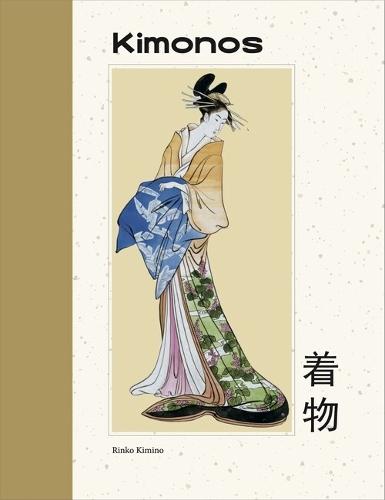
Kimonos reveals the intricacies of Japanese dress from the 3rd century to the present. Including garments for women, men and children, the details have been selected both for their exquisite beauty and craftsmanship, and for how much they impart about the wearer’s identity, be it age, status or taste. A comprehensive introduction, illuminating the main periods and key themes of Japanese fashion history, is followed by thematic chapters that cover all eras of clothing. Each garment or illustration is accompanied by text exploring its structure and the fascinating range of decorative techniques employed, including embroidery, weaving, lacquering, stencilling, dyeing and digital technology. The kimono has a rich history spanning hundreds of years, and is still worn today as fashionable clothing in Japan.
Full Product Details
Author: Rinko Kimino
Publisher: Amber Books Ltd
Imprint: Amber Books
Dimensions:
Width: 21.20cm
, Height: 2.20cm
, Length: 27.60cm
Weight: 1.000kg
ISBN: 9781838866129
ISBN 10: 1838866124
Pages: 224
Publication Date: 14 October 2025
Recommended Age: From 14 to 99 years
Audience:
General/trade
,
Professional and scholarly
,
General
,
Professional & Vocational
Format: Hardback
Publisher's Status: Active
Availability: In Print 
This item will be ordered in for you from one of our suppliers. Upon receipt, we will promptly dispatch it out to you. For in store availability, please contact us.
Table of Contents
1: Historical Context Samurai armour changed over time: in the Heian Period (794–1185), armour was designed to be light and flexible because samurai fought on horseback, often as mounted archers; by the Azuchi-Momoyama Period (1573–1603), gunpowder weapons had been introduced via Dutch traders, causing samurai to wear a European-style plate cuirass for protection against musket balls. In the later Edo Period (1603–1867), Japan’s longest stretch of peace, armour was worn more as an expression of culture and status. 2: Construction Japanese armour contained leather, iron, steel, wool, cotton, and sometimes silk in its construction; despite popular perceptions, wood and bamboo were not used for Japanese armour. The building blocks of samurai armour were the kozane, lacquered iron and leather scales of various sizes. These scales were often attached to a mail backing called a kusari, which in turn was stitched onto a leather or cloth surface. 3: Types of Armour Arranged chronologically: • Tanko – The first iron armour appeared in the 4th century and was called tanko. This was for infantry combat and featured a distinctive lamellar construction. The cuirass (do) consisted of a metal frame and lamellae. • Keiko – Without any doubt, the introduction of the keiko (or kake-yoroi), was connected with the importation of horses from continental Asia around the end of the 4th century or beginning of the 5th century. The Japanese quickly discovered that Korean armour, with scale construction, was much better than Japanese lamellar armour for fighting on horseback. • Kozane and Kebiki-odoshi – The basic type of scale was called o-arame. • O-yoroi – The o-yoroi (or ‘great armour’) appeared in the beginning of the 10thcentury. It was specially designed for mounted archery and for several centuries was considered to be the only armour suitable for the high-ranking warriors(bushi). • Do-maru – At the beginning of this period retainers and servants usually wore simpler armour (do-maru), which appeared approximately in the same time with the o-yoroi or even earlier. • Haraate and Haramaki – Beginning in the 15th century, the constantly-increasing light infantry (ashigaru) was equipped with a new type of armour called haraate (‘protection of the abdomen’). • Kusari – Japanese mail, appeared in the 14th century. It differed from European mail in both construction and use. • Mogami-do gusoku – The earlier variants of the mogami-do gusoku, which appeared in the late 15th/early 16th centuries were considered to be transitional types of armour. • Maru-do gusoku – The maru-do was a modern variant of the do-maru and usually was the armour of high-ranking warriors. It was opened under the right arm like classical armour but was of lamellar construction. • Ni-mai-do gusoku – Strictly speaking, the ni-mai-do was not a particular type of armour but was a term for a group of armours of different construction. The name means ‘cuirass of two sections’ and directly refers to their common feature. • Okegawa-do gusoku – Around 1550 a new type of armour appeared, and soon became extremely widespread due to all its advantages. This was the okegawa-do or the armour of riveted lamellae. The name means ‘tube-sided’, because the cuirass had a tube-like shape and construction. • Tosei-gusoku – in the beginning of the 16th century the Classical armours were replaced by tosei-gusoku (‘Modern armours’) of lamellar construction. These exhibited enormous variety but their common feature was minimal use or total absence of lacing (as in the riveted and full-plate cuirasses). The Modern armours offered better protection against firearms, introduced to Japan in 1543 and first used in battle in 1549. • Namban-do gusoku – The namban-do gusoku or ‘armour of the south barbarians’ was one of the results of contact with Europeans. Japanese armourers quickly learned how to produce local copies of European plate armour, and starting around 1560 the namban-do ‘Made in Japan’ appeared. Although the quality varied widely, these always were associated with the high-ranking samurai. Feature: Famous Samurai Takeda Shingen (1521–73) – wore yoroi armour, including white Yak haired helmet with beaten gold Shikami headerboard Oda Nobunaga (1534–82) – fabled to have worn a Portuguese inspired Nanban gusoku with metal breastplate Tokugawa Ieyasu (1543–1616) – the first Shogun wore Daikoku-Zukin helmet with the beaten gold fern fronds kabuto 4: Parts of Armour • Dou or dō, a chest armour made up of iron and or leather plates of various sizes and shapes with pendants • Kusazuri made from iron or leather plates hanging from the front and back of the dou (dō) to protect the lower body and upper leg. • Sode, large rectangular shoulder protection made from iron and or leather plates. • Kote, armoured glove like sleeves which extended to the shoulder or hankote (kote gauntlets) which covered the forearms. • Kabuto, a helmet made from iron or leather plates (from three to over 100 plates) riveted together. • Mengu, various types of lacquered metal and or leather facial armour designed ina way that the top heavy helmet could be tied and secured to them by various metal posts. • Haidate, thigh guards which tied around the waist and covered the thighs. • Suneate, shin guards made from iron splints connected together by chain armour(kusari) and sewn to cloth and tied around the calf. • Guruwa, throat protector. • Nodowa, a type of throat and neck guard. • Tate-eri, the tate-eri is a small padded pillow like piece with a standing armoured collar that sits on the shoulder to protect from the weight of the dou (dō) • Manju no wa, the manju no wa, (also manjunowa or manju nowa) is a combination of shoulder pads, collar and armpit guards in one that protected the upper chest area. • Manchira, the manchira is a type of armoured-vest covered with kusari (chain armour), karuta (small armour plates) or kikko (brigandine) • Wakibiki, the wakibiki is a simple rectangle of cloth covered with kusari (chain armour), karuta (small iron plates), or kikko (brigandine) • Yoroi zukin, cloth hoods with various types of armour sewn to the cloth. 5: Heraldry Samurai in battle would wear a banner with their lord’s crest on it, attached to the back of their armour. The motifs could be abstract patterns, simple shapes, or representations of nature like flowers, or they could be kanji representing a motto. For example, the mon of the Hojo family is an arrangement of three triangles forming a larger triangle. Some mon survive as company logos today: the Mitsubishi logo is the most recognizable.
Reviews
Author Information
Rinko Kimino has written 20 books on kimonos, Japanese folk craft and kabuki and her work has appeared in several books, magazines and newspaper articles. Her works are geared toward the youth of Japan, and promote Japanese traditions such as kimonos and Japanese traditional crafts with a modern sensibility. As a curator of Japanese culture, she wants to share with and educate others on the beauty and healing/calming benefits the classic Japanese ritual of kimonos, kabuki, Japanese calligraphy, traditional art & craft and tea ceremonies can provide. She is also a curator for the development of new kimonos and Japanese accessories to appeal to a contemporary audience. She lives in Tokyo, Japan.
Tab Content 6
Author Website:
Countries Available
All regions
|