Overview
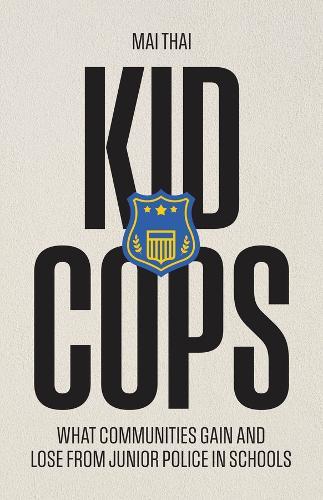
An on-the-ground study of junior police academies—contentious school-police partnerships that provide educational resources, career opportunities, and hope for social mobility. Some might see police officers as benevolent sources of protection, but in many communities, they are often perceived as a threat due to a legacy of violent interactions and arrests for arbitrary offenses. How, then, do police sustain their presence in places where people might distrust them? In Kid Cops, sociologist Mai Thai offers one answer: junior police academies, high school programs in which police officers provide courses, mentorship, and job training to students in communities with high rates of juvenile delinquency and poverty. These school-police partnerships have expanded rapidly in the United States over the last few decades, largely in response to political unrest and police violence in the 1990s. Programs vary in their offerings, but they generally aim to ease tensions between communities and law enforcement, while also providing needed resources in neighborhoods where education and job opportunities are scarce. Kid Cops draws on years of observations and interviews with educators, police officers, and, of course, kids. The junior police programs at each high school may have different emphases, but their common goal is for students to graduate from high school and enter college or the workforce. A second goal of the program is to cultivate a positive image of the police. Ultimately, however, Thai finds that these programs tighten the relationship between marginalized youth, schools, and the criminal justice system and strain the students' relationships with their peers, families, and each other. These programs also distract residents from systemic issues of policing and suppress opportunities for meaningful change. Written in an accessible tone that balances the seriousness of inequality with the playfulness of the study's youth, Kid Cops moves beyond the narrative of detentions, suspensions, and arrests to tell a less conventional story about police in schools. It asks, does good, friendly policing exist—especially if it continues to tether low-income communities of color to the criminal justice system?
Full Product Details
Author: Mai Thai
Publisher: The University of Chicago Press
Imprint: University of Chicago Press
Weight: 0.454kg
ISBN: 9780226847689
ISBN 10: 0226847683
Pages: 240
Publication Date: 22 April 2026
Audience:
College/higher education
,
Postgraduate, Research & Scholarly
Format: Paperback
Publisher's Status: Forthcoming
Availability: Awaiting stock

Reviews
""Thai shows the power of high-quality ethnography to explore the contradictions at the heart of junior police academies and the larger endeavor of community policing. Throughout, she centers the struggles, compromises, and uncertainties of young people trying to make their way through life in a challenging social environment."" -- Alex S. Vitale, Brooklyn College
""Thai shows the power of high-quality ethnography to explore the contradictions at the heart of junior police academies and the larger endeavor of community policing. Throughout, she centers the struggles, compromises, and uncertainties of young people trying to make their way through life in a challenging social environment."" -- Alex S. Vitale, Brooklyn College ""Through a powerful ethnographic study, Thai shows us the insidious ways that schools and community policing intersect. In doing so, Thai takes on an urgent question: how do young people--whose communities are brutalized by police violence--become invested in policing as an institution? Thai—an excellent sociological storyteller--tells us some of the answers through the urgent voices of the young people."" -- Ranita Ray, author of 'Slow Violence: Confronting Dark Truths in the American Classroom' ""At a time when debates over policing are sharply polarized, Kid Cops offers a deeply original and nuanced look at how junior police academies attract schools and students through promises of mentorship and mobility. Thai’s study reorients how we think about police–youth relationships in schools, moving beyond arrests and suspensions to reveal how programs meant to inspire opportunity can still reinforce new forms of social control."" -- Tony Cheng, author of 'The Policing Machine: Enforcement, Endorsements, and the Illusion of Public Input'
Author Information
Mai Thai is assistant professor of sociology at Occidental College.