Overview
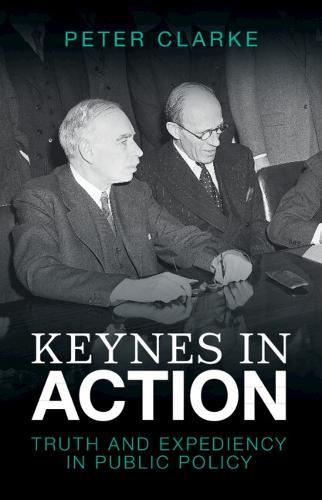
John Maynard Keynes died in 1946 but his ideas and his example remain relevant today. In this distinctive new account, Peter Clarke shows how Keynes's own career was not simply that of an academic economist, nor that of a modern policy advisor. Though rightly credited for reshaping economic theory, Keynes's influence was more broadly based and is assessed here in a rounded historical, political and cultural context. Peter Clarke re-examines the full trajectory of Keynes's public career from his role in Paris over the Versailles Treaty to Bretton Woods. He reveals how Keynes's insights as an economic theorist were rooted in his wider intellectual and cultural milieu including Bloomsbury and his friendship with Virginia Woolf as well as his involvement in government business. Keynes in Action uncovers a much more pragmatic Keynes whose concept of 'truth' needs to be interpreted in tension with an acknowledgement of 'expediency' in implementing public policy.
Full Product Details
Author: Peter Clarke (University of Cambridge)
Publisher: Cambridge University Press
Imprint: Cambridge University Press
Dimensions:
Width: 14.70cm
, Height: 2.00cm
, Length: 22.30cm
Weight: 0.470kg
ISBN: 9781009255011
ISBN 10: 1009255010
Pages: 274
Publication Date: 24 November 2022
Audience:
College/higher education
,
Postgraduate, Research & Scholarly
Format: Hardback
Publisher's Status: Active
Availability: Available To Order

We have confirmation that this item is in stock with the supplier. It will be ordered in for you and dispatched immediately.
Reviews
'This readable and lively book by the eminent modern historian and Keynes scholar Peter Clarke provides an important insight into 'the historical Keynes,' both academic theorist and public intellectual, by examining the complex relation between truth and expediency in policy advising from Versailles to Bretton Woods and in probability theory.' Robert Dimand, Brock University 'A sparkling and learned exploration of Keynes's beliefs about probability, truth, and expediency.' Richard Toye, University of Exeter
'This readable and lively book by the eminent modern historian and Keynes scholar Peter Clarke provides an important insight into 'the historical Keynes,' both academic theorist and public intellectual, by examining the complex relation between truth and expediency in policy advising from Versailles to Bretton Woods and in probability theory.' Robert Dimand, Brock University 'A sparkling and learned exploration of Keynes's beliefs about probability, truth, and expediency.' Richard Toye, University of Exeter
'This readable and lively book by the eminent modern historian and Keynes scholar Peter Clarke provides an important insight into 'the historical Keynes,' both academic theorist and public intellectual, by examining the complex relation between truth and expediency in policy advising from Versailles to Bretton Woods and in probability theory.' Robert Dimand, Brock University 'A sparkling and learned exploration of Keynes's beliefs about probability, truth, and expediency.' Richard Toye, University of Exeter 'By presenting material in a new way Clarke manages to shed new light on a subject on whom a vast literature has emerged. … Clarke has successfully performed the difficult task of saying enough that is new to interest specialists in a book that should be accessible to a wide readership.' Roger E. Backhouse, Journal of British Studies
Author Information
Peter Clarke was elected a Fellow of the British Academy in 1989. His previous publications include Hope and Glory: Britain 1900-2000 (2004), The Locomotive of War: Money, Empire, Power, and Guilt (2017) and studies on John Maynard Keynes including The Keynesian Revolution in the Making, 1924–1936 (1988) and Keynes (2009).