Overview
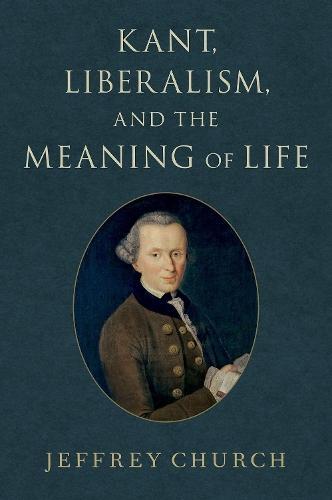
In the wake of populist challenges throughout the past decade in the U.S. and Europe, liberalism has been described as elitist and out of touch, concerned with protecting and promoting material interests with an orientation that is pragmatic, legalistic, and technocratic. Simultaneously, liberal governments have become increasingly detached from the middle class and its moral needs for purpose and belonging. If liberalism cannot provide spiritual sustenance, individuals will look elsewhere for it, especially in illiberal forms of populism. In Kant, Liberalism, and the Meaning of Life, Jeffrey Church addresses the ""meaning deficit"" in contemporary liberal societies. Focusing on Immanuel Kant's largely neglected early lectures on anthropology from the 1760s and 1770s, Church argues that Kant's work can serve as a basis for a more meaningful liberalism, one that conceives of freedom and equality for all as a moral vocation of citizens and institutions. Church also asserts that Kant's early view of the meaning of life has important implications for understanding his political theory. Kant saw liberal community as something that helps us realize our destiny on earth as the distinctively free creatures we are. Liberalism, then, is not elitist but a participatory project of all members of society. It is not concerned primarily with material things but with our moral destiny. It is not pragmatic but principled. Church holds that Kant's liberalism rests on a view of the meaning of human existence, and so analyzes Kant's view of the meaning of life and its application to his politics. In particular, Church contends that a fundamental concern included in Kant's liberalism, largely unrecognized by scholars, is to foster the meaning of life for citizens of liberal republican orders. At the same time, Church applies Kant's views of the meaning of life to contemporary problems in liberalism. In particular, he argues that Kant's view of a meaningful liberalism can provide a counterweight to the recent rise of illiberal nationalist or religious forms of community that seem attractive to liberal citizens hungering for meaning in a disenchanted world. Compelling and ambitious, Jeffrey Church provides the first extended treatment of Kant's understanding of the meaning of life and a powerful alternative to procedural liberalism.
Full Product Details
Author: Jeffrey Church (Professor of Political Science, Professor of Political Science, University of Houston)
Publisher: Oxford University Press Inc
Imprint: Oxford University Press Inc
Dimensions:
Width: 23.80cm
, Height: 2.90cm
, Length: 16.20cm
Weight: 0.617kg
ISBN: 9780197633182
ISBN 10: 0197633188
Pages: 352
Publication Date: 28 September 2022
Audience:
General/trade
,
General
Format: Hardback
Publisher's Status: Active
Availability: Available To Order

We have confirmation that this item is in stock with the supplier. It will be ordered in for you and dispatched immediately.
Reviews
Kant's anthropology has long been treated as an afterthought or an embarrassment to his monumental critical philosophy. Jeffrey Church audaciously argues that Kantian anthropology can not only be salvaged, but can anchor a liberalism as ambitious in its scope as it is capacious in its vision. This book brilliantly reconstructs a Kantian liberalism for our contemporary fractured political reality, centered on an ideal of independence that speaks to human purposes without determining them. Rigorous in its exegesis and normatively sharp, Church extracts an embodied and humanized liberalism from unlikely territory. Rich, provocative, and utterly original, Kant, Liberalism, and the Meaning of Life shows that Rawls by no means exhausted the liberalisms that we might draw out of Kant, and may himself not have drawn the right one out at all. -- Inder S. Marwah, author of Liberalism, Diversity and Domination: Kant, Mill and the Government of Difference A brilliant and original analysis of Kant's politics broadly conceived. Church's careful and compelling consideration of contemporary 'liberalisms' through a Kantian lens is especially valuable and should be of interest not only to specialists but also to the broader educated public. In short: a 'public use of reason' in the true Kantian sense. -- Susan Shell, Professor of Political Science, Boston College In this book, Jeffrey Church explores the substantive, rather than merely formal, elements of Kant's pre-critical writings on ethics, and traces the resonance of those elements in the critical philosophy itself. The analysis is deeply informed and brilliantly argued. Indeed, what we have here is nothing less than a major and bracingly provocative intervention in the ongoing conversation concerning not only Kantian thought but, more broadly, the very idea of liberal politics. -- Peter J. Steinberger, Robert H. and Blanche Day Ellis Professor of Political Science and Humanities, Reed College Church breathes new life into familiar debates about Kantian liberalism by mining the pre-critical writings that most liberal theorists leave behind. -- Bernard Yack, Lerman Neubauer Professor of Democracy and Public Policy, Brandeis University
Author Information
Jeffrey Church is Chair and Professor of Political Science at the University of Houston. His research focuses on the history of modern political thought, and he is the author of three books, including Infinite Autonomy: the Divided Individual in the Political Thought of G.W.F. Hegel and Friedrich Nietzsche; Nietzsche's Culture of Humanity: Beyond Aristocracy and Democracy in the Early Period; and Nietzsche's Unfashionable Observations: A Critical Introduction and Guide.