Overview
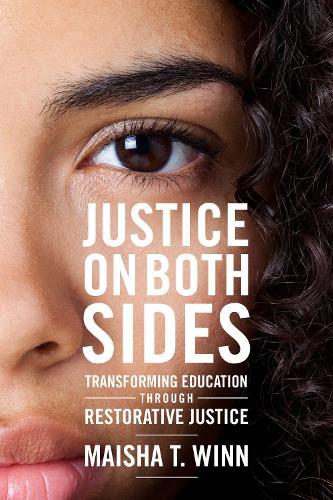
Restorative justice represents “a paradigm shift in the way Americans conceptualize and administer punishment,” says author Maisha T. Winn, from a focus on crime to a focus on harm, including the needs of both those who were harmed and those who caused it. Her book, Justice on Both Sides, provides an urgently needed, comprehensive account of the value of restorative justice and how contemporary schools can implement effective practices to address inequalities associated with race, class, and gender. Winn, a restorative justice practitioner and scholar, draws on her extensive experience as a coach to school leaders and teachers to show how indispensable restorative justice is in understanding and addressing the educational needs of students, particularly disadvantaged youth. Justice on Both Sides makes a major contribution by demonstrating how this actually works in schools and how it can be integrated into a range of educational settings. It also emphasizes how language and labeling must be addressed in any fruitful restorative effort. Ultimately, Winn makes the case for restorative justice as a crucial answer, at least in part, to the unequal practices and opportunities in American schools.
Full Product Details
Author: Maisha T. Winn
Publisher: Harvard Educational Publishing Group
Imprint: Harvard Educational Publishing Group
Dimensions:
Width: 14.90cm
, Height: 1.50cm
, Length: 22.60cm
Weight: 0.308kg
ISBN: 9781682531822
ISBN 10: 1682531821
Pages: 216
Publication Date: 30 May 2018
Audience:
Professional and scholarly
,
Professional & Vocational
Format: Paperback
Publisher's Status: Active
Availability: In Print

This item will be ordered in for you from one of our suppliers. Upon receipt, we will promptly dispatch it out to you. For in store availability, please contact us.
Reviews
Winn makes a compelling case for the use of restorative justice practices in schools as ... as a way to disrupt the school-to-prison pipeline that has destroyed the lives of too many young people of color. --Zahra Bokhari, Philanthropy News Digest In a nation that is hyper-socialized to preserve the concepts of law, order, and punishment, especially with regard to Black and Brown bodies, shifting one's mindset is no simple undertaking. However, Justice on Both Sides is an accessible guide that serves as both a 'compass' and a 'map' for PreK-12 educators, administrators, policymakers, and all others whose work has implications for education. --Darius O. Johnson and Dorinda J. Carter Andrews, Teachers College Record
Winn makes a compelling case for the use of restorative justice practices in schools as ... as a way to disrupt the school-to-prison pipeline that has destroyed the lives of too many young people of color. --Zahra Bokhari, Philanthropy News Digest In a nation that is hyper-socialized to preserve the concepts of law, order, and punishment, especially with regard to Black and Brown bodies, shifting one's mindset is no simple undertaking. However, Justice on Both Sides is an accessible guide that serves as both a 'compass' and a 'map' for PreK-12 educators, administrators, policymakers, and all others whose work has implications for education. --Darius O. Johnson and Dorinda J. Carter Andrews, Teachers College Record Winn shares the insights of teachers, students, administrators, support staff and parents who each look at restorative justice through their own lenses. --Bob Schultz, School Administrator This book serves as a compass for educators committed to justice and transformation. It compels us to resolve the inequities in school while we seek to support all students. --Nadira Baksh, Professionally Speaking [Justice on Both Sides] bridges the theory of restorative justice with teacher practice while highlighting tensions that practitioners are likely to encounter. For researchers, Winn's book provides plenty of inspiration for future studies that examine the link between teachers' perspectives on restorative justice and their enactment of it across school sites. --Education Review
In a nation that is hyper-socialized to preserve the concepts of law, order, and punishment, especially with regard to Black and Brown bodies, shifting one's mindset is no simple undertaking. However, Justice on Both Sides is an accessible guide that serves as both a 'compass' and a 'map' for PreK-12 educators, administrators, policymakers, and all others whose work has implications for education. --Darius O. Johnson and Dorinda J. Carter Andrews, Teachers College Record Winn makes a compelling case for the use of restorative justice practices in schools as ... as a way to disrupt the school-to-prison pipeline that has destroyed the lives of too many young people of color. --Zahra Bokhari, Philanthropy News Digest
"""[Justice on Both Sides] bridges the theory of restorative justice with teacher practice while highlighting tensions that practitioners are likely to encounter. For researchers, Winn's book provides plenty of inspiration for future studies that examine the link between teachers' perspectives on restorative justice and their enactment of it across school sites."" --Education Review ""This book serves as a compass for educators committed to justice and transformation. It compels us to resolve the inequities in school while we seek to support all students."" --Nadira Baksh, Professionally Speaking ""Winn shares the insights of teachers, students, administrators, support staff and parents who each look at restorative justice through their own lenses."" --Bob Schultz, School Administrator ""In a nation that is hyper-socialized to preserve the concepts of law, order, and punishment, especially with regard to Black and Brown bodies, shifting one's mindset is no simple undertaking. However, Justice on Both Sides is an accessible guide that serves as both a 'compass' and a 'map' for PreK-12 educators, administrators, policymakers, and all others whose work has implications for education."" --Darius O. Johnson and Dorinda J. Carter Andrews, Teachers College Record ""Winn makes a compelling case for the use of restorative justice practices in schools as ... as a way to disrupt the school-to-prison pipeline that has destroyed the lives of too many young people of color."" --Zahra Bokhari, Philanthropy News Digest"
Author Information
Maisha T. Winn is the Chancellor’s Leadership Professor in the School of Education at the University of California, Davis, and codirector of the Transformative Justice in Education Center.