Overview
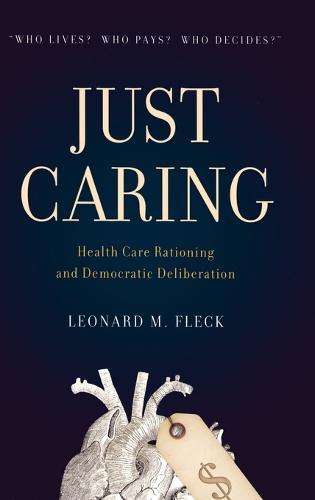
What does it mean to be a ""just"" and ""caring"" society when we have only limited resources to meet unlimited health care needs? Do we believe that all lives are of equal value? Is human life priceless? Should a ""just"" and ""caring"" society refuse to put limits on health care spending? In Just Caring, Leonard Fleck reflects on the central moral and political challenges of health reform today. He cites the millions of Americans who go without health insurance, thousands of whom die prematurely, unable to afford the health care needed to save their lives. Fleck considers these deaths as contrary to our deepest social values, and makes a case for the necessity of health care rationing decisions. The core argument of this book is that no one has a moral right to impose rationing decisions on others if they are unwilling to impose those same rationing decisions on themselves in the same medical circumstances. Fleck argues we can make health care rationing fair, in ways that are mutually respectful, if we engage in honest rational democratic deliberation. Such civic engagement is rare in our society, but the alternative is endless destructive social controversy that is neither just nor caring.
Full Product Details
Author: Leonard M. Fleck (Professor of Philosophy and Medical Ethics, Professor of Philosophy and Medical Ethics, Michigan State University)
Publisher: Oxford University Press Inc
Imprint: Oxford University Press Inc
Dimensions:
Width: 23.40cm
, Height: 3.60cm
, Length: 15.70cm
Weight: 0.805kg
ISBN: 9780195128048
ISBN 10: 0195128044
Pages: 480
Publication Date: 23 April 2009
Audience:
College/higher education
,
Professional and scholarly
,
Postgraduate, Research & Scholarly
,
Professional & Vocational
Format: Hardback
Publisher's Status: Active
Availability: To order

Stock availability from the supplier is unknown. We will order it for you and ship this item to you once it is received by us.
Reviews
<br> Justice is a slippery concept. It becomes especially complex and controversial when we try to conceive what justice entails in the allocation of health care. This bold volume explains the need for rationing health care and provides the reader with clear and accessible accounts of the medical science, economics, demographics, and philosophic concepts involved in the decisions that have to be made. Fleck also offers his own process of rational democratic deliberation as the means for achieving a just system of health care distribution based upon priorities that are publicly acknowledged and broadly accepted. Just Caring is a remarkably well-researched, scholarly achievement. It is a valuable resource and required reading for anyone who wants to grapple with the problems of allocating health care in today's world. --Rosamund Rhodes, PhD, Professor: Medical Education, Director: Bioethics Education, Mount Sinai School of Medicine, New York<p><br> Americans like to think that our society is both just and decent. Leonard Fleck challenges us to think about what health care choices would live up to the description. He shows us that the answer will lie in all of us having a special sort of conversation. He has here written a well-reasoned and comprehensive guide to getting that conversation up and running. --Howard Brody, MD, PhD, Institute for the Medical Humanities, University of Texas Medical Branch-Galveston, and author of The Future of Bioethics<p><br> This should prove a very useful and important contribution to the field of healthcare reform, though since the book may reward only the meticulous and sophisticated reader, the form may undercut its populist function. However, the inherent messiness of the subject is probably too often ill-served by books and articles that reduce it to a tidy zero-sum game and thus this may be one of the few honest books dedicated to healthcare rationing in the United States. --Doody's Health Sciences Review<p><br> Just Caring: Health
Justice is a slippery concept. It becomes especially complex and controversial when we try to conceive what justice entails in the allocation of health care. This bold volume explains the need for rationing health care and provides the reader with clear and accessible accounts of the medical science, economics, demographics, and philosophic concepts involved in the decisions that have to be made. Fleck also offers his own process of rational democratic deliberation as the means for achieving a just system of health care distribution based upon priorities that are publicly acknowledged and broadly accepted. Just Caring is a remarkably well-researched, scholarly achievement. It is a valuable resource and required reading for anyone who wants to grapple with the problems of allocating health care in today's world. --Rosamund Rhodes, PhD, Professor: Medical Education, Director: Bioethics Education, Mount Sinai School of Medicine, New York Americans like to think that our society is both just and decent. Leonard Fleck challenges us to think about what health care choices would live up to the description. He shows us that the answer will lie in all of us having a special sort of conversation. He has here written a well-reasoned and comprehensive guide to getting that conversation up and running. --Howard Brody, MD, PhD, Institute for the Medical Humanities, University of Texas Medical Branch-Galveston, and author of The Future of Bioethics This should prove a very useful and important contribution to the field of healthcare reform, though since the book may reward only the meticulous and sophisticated reader, the form may undercut its populist function. However, the inherent messiness of the subject is probably too often ill-served by books and articles that reduce it to a tidy zero-sum game and thus this may be one of the few honest books dedicated to healthcare rationing in the United States. --Doody's Health Sciences Review Just Caring: Health
<br> Justice is a slippery concept. It becomes especially complex and controversial when we try to conceive what justice entails in the allocation of health care. This bold volume explains the need for rationing health care and provides the reader with clear and accessible accounts of the medical science, economics, demographics, and philosophic concepts involved in the decisions that have to be made. Fleck also offers his own process of rational democratic deliberation as the means for achieving a just system of health care distribution based upon priorities that are publicly acknowledged and broadly accepted. Just Caring is a remarkably well-researched, scholarly achievement. It is a valuable resource and required reading for anyone who wants to grapple with the problems of allocating health care in today's world. --Rosamund Rhodes, PhD, Professor: Medical Education, Director: Bioethics Education, Mount Sinai School of Medicine, New York<br> Americans like to think that our society i