Overview
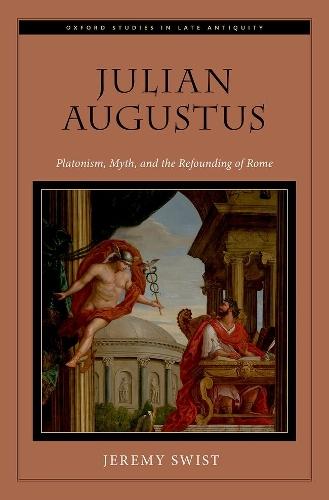
The Roman emperor Julian (r. 361-363 CE) was a man of action and of letters, which he employed in an effort to return the Empire to the light of the pagan gods, and reverse the Christianization of the empire advanced by his uncle Constantine and the sons of Constantine. This enterprise was inspired and guided by his conversion to the Neoplatonic philosophy and radical pagan Hellenism of Iamblichus and his disciples, and promoted by his production of Greek orations, letters, and satires. These works present a coherent vision of the providentially guided history and destiny of Rome as a series of foundations and refoundations enacted by rulers such as Romulus, Numa, and Caesar Augustus. As this book demonstrates, Julian offers an Iamblichean approach to the exegesis of the legends of Rome's founding, the allegories of Plato's dialogues, and myths of his own creation in order to articulate his own role in the refounding of the Empire. Furthermore, argues Jeremy Swist, approaching the wider examination of Julian's imperial self-image on these terms ends up nuancing and challenging common assumptions influenced by the rhetoric of his contemporary proponents. In his reverence for the gods and for philosophy, the emperor's self-construction embraces the identities of a statesman and soldier more than of a philosopher, of a Roman more than a Greek, and of a mere human rather than a semi-divine being. While distancing himself from the ideal models of philosophical virtue and imperial founding that inspire his own actions, he adopts a different set of exemplary figures as mirrors of himself.
Full Product Details
Author: Jeremy Swist (Visiting Assistant Professor of Classics, Visiting Assistant Professor of Classics, Grand Valley State University)
Publisher: Oxford University Press Inc
Imprint: Oxford University Press Inc
Dimensions:
Width: 16.50cm
, Height: 3.40cm
, Length: 23.80cm
Weight: 0.640kg
ISBN: 9780197787519
ISBN 10: 0197787517
Pages: 376
Publication Date: 20 October 2025
Audience:
College/higher education
,
Postgraduate, Research & Scholarly
Format: Hardback
Publisher's Status: Active
Availability: To order

Stock availability from the supplier is unknown. We will order it for you and ship this item to you once it is received by us.
Author Information
Jeremy Swist is a native of Boston, Massachusetts. He earned his BA in History and Latin from the University of Maine, and MA and PhD. in Classics from the University of Iowa. He has taught Greek and Roman language and civilization at Miami University, Xavier University, and Brandeis University. He now resides in Grand Rapids, Michigan, working as a Visiting Assistant Professor of Classics at Grand Valley State University. He has published several articles and chapters on pagan prose literature under the later Roman Empire, as well as on the reception of ancient Greece, Rome, and Byzantium in heavy metal music. Jeremy Swist is Visiting Assistant Professor at Grand Valley State University. A native of Boston, Massachusetts, he earned his BA in History and Latin from the University of Maine, and MA and PhD. in Classics from the University of Iowa. He has taught Greek and Roman language and civilization at Miami University, Xavier University, and Brandeis University. He has published several articles and chapters on pagan prose literature under the later Roman Empire, as well as on the reception of ancient Greece, Rome, and Byzantium in heavy metal music.