Overview
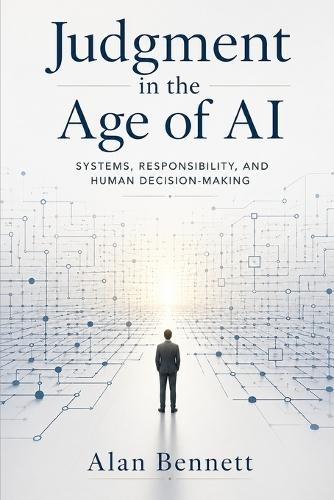
Judgment in the Age of AI examines one of the defining questions of the modern age: what remains distinctively human when artificial intelligence, administrative systems, compliance frameworks, digital platforms, and organisational processes increasingly shape the decisions by which we live. This book is a careful and accessible inquiry into judgment, responsibility, authority, and human decision making in a world increasingly governed by systems. Across government, business, law, education, health, finance, regulation, and public administration, decisions are now more often mediated by structured processes. These systems promise consistency, speed, fairness, efficiency, and scale. In many settings, they are valuable and necessary. Yet their expansion raises a deeper question. Do they support human judgment, or do they gradually displace it? Alan Bennett argues that the central issue is not whether systems should exist, but whether they remain subordinate to responsible human judgment. Artificial intelligence has made this question more urgent, but it did not create the underlying problem. Long before AI, modern institutions had already begun to rely heavily on processes, procedures, risk models, compliance structures, metrics, and administrative systems. AI intensifies this development by making system outputs faster, more persuasive, and more difficult to question. The book explores the distinction between capability and understanding. AI systems can process information, identify patterns, generate language, assist decision making, and operate at a scale beyond ordinary human capacity. Yet these capacities do not amount to human understanding. They do not provide moral awareness, intention, responsibility, practical wisdom, or the ability to judge whether the framework itself is adequate. This matters because systems often appear neutral. Their outputs may look objective because they are produced through process. But the choices embedded in design, data, classification, priorities, and institutional use do not disappear. They are merely relocated. Judgment is not abolished. It is often hidden. For readers in the United Kingdom and the United States, the book speaks directly to current anxieties about AI, institutional authority, public trust, governance, regulation, professional responsibility, and the future of human agency. It will be of particular interest to lawyers, policy makers, business leaders, academics, regulators, professionals, students, and serious general readers concerned with the direction of modern institutional life. At its heart, the book asks whether responsibility can survive when decisions are increasingly produced, shaped, or justified by systems whose assumptions are not always visible. If no one fully understands the process, who is answerable for the outcome? If a system recommends a course of action, when does assistance become substitution? If a decision is efficient but unintelligible, can it still be legitimate? The book does not call for a rejection of systems or a retreat from technology. It recognises that modern societies cannot function without structure, coordination, and technical assistance. Its argument is more measured and more important. Systems must be designed and governed so that they support judgment rather than replace it. Human beings must remain capable of asking whether a decision is right, not merely whether it follows a process. Judgment in the Age of AI invites readers to look beyond excitement and fear, and to consider what kind of society will emerge if responsibility, judgment, and human agency are allowed to become secondary to system performance. As systems become more capable, the central question is no longer simply what they can do. It is what human beings must still refuse to surrender.
Full Product Details
Author: Alan Bennett
Publisher: Independently Published
Imprint: Independently Published
Dimensions:
Width: 15.20cm
, Height: 1.30cm
, Length: 22.90cm
Weight: 0.327kg
ISBN: 9798197970831
Pages: 242
Publication Date: 21 May 2026
Audience:
General/trade
,
General
Format: Paperback
Publisher's Status: Active
Availability: Available To Order

We have confirmation that this item is in stock with the supplier. It will be ordered in for you and dispatched immediately.