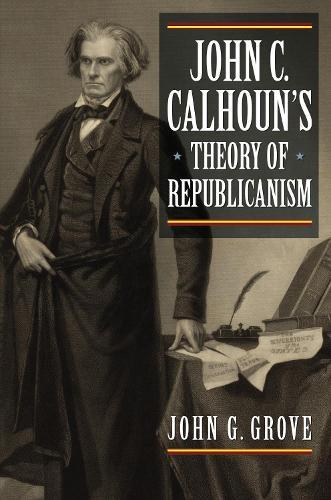
Full Product Details
Author: John Grove
Publisher: University Press of Kansas
Imprint: University Press of Kansas
Dimensions:
Width: 16.00cm
, Height: 2.20cm
, Length: 23.30cm
Weight: 0.480kg
ISBN: 9780700623341
ISBN 10: 0700623345
Pages: 256
Publication Date: 16 December 2016
Audience:
College/higher education
,
Undergraduate
,
Postgraduate, Research & Scholarly
Format: Hardback
Publisher's Status: Active
Availability: Temporarily unavailable

The supplier advises that this item is temporarily unavailable. It will be ordered for you and placed on backorder. Once it does come back in stock, we will ship it out to you.
Reviews
Grove brings fresh coherence to the political thought of one of the South's most vexing figures. Historians will appreciate this work on political theory for its creative and nuanced presentation of a complex figure who has often been either caricatured or deemed inaccessible. --Journal of Southern History This book is the best available survey of Calhoun's thought. --American Political Thought Grove presents a new interpretation of Calhoun, an interpretation more sympathetic to Calhoun than most of the recent literature and differing from most in placing Calhoun squarely in the tradition of classical republicanism. Grove's Calhoun is a post-liberal republican, for we see Calhoun here as a conscious critic of the liberal individualistic theory so common in 18th and 19th century America. And unlike most writing on Calhoun Grove is very concerned to show that Calhoun's theory of republicanism is not indissolubly wedded to his defense of slavery and thus of value and relevance to us today. --Michael P. Zuckert, coauthor of Leo Strauss and the Problem of Political Philosophy This provocative book seeks to locate Calhoun squarely in the tradition of classical republicanism. Students of ante bellum political thought will have much to learn from Grove's analysis. --Daniel Farber, author of Lincoln's Constitution John Grove argues persuasively that Calhoun's critique of corruption, political parties, and executive power was rooted in a classically republican conception of politics. He also maintains that Calhoun's commitment to slavery contradicted what was best in his republican vision. John C. Calhoun's Theory of Republicanism sheds fresh light on Calhoun's thought and invites renewed debate on his defense of slavery. --James H. Read, author of Majority Rule versus Consensus: The Political Thought of John C. Calhoun
Grove presents a new interpretation of Calhoun, an interpretation more sympathetic to Calhoun than most of the recent literature and differing from most in placing Calhoun squarely in the tradition of classical republicanism. Grove's Calhoun is a post-liberal republican, for we see Calhoun here as a conscious critic of the liberal individualistic theory so common in 18th and 19th century America. And unlike most writing on Calhoun Grove is very concerned to show that Calhoun's theory of republicanism is not indissolubly wedded to his defense of slavery and thus of value and relevance to us today. --<b>Michael P. Zuckert</b>, coauthor of <i>Leo Strauss and the Problem of Political Philosophy</i>
Grove presents a new interpretation of Calhoun, an interpretation more sympathetic to Calhoun than most of the recent literature and differing from most in placing Calhoun squarely in the tradition of classical republicanism. Grove's Calhoun is a post-liberal republican, for we see Calhoun here as a conscious critic of the liberal individualistic theory so common in 18th and 19th century America. And unlike most writing on Calhoun Grove is very concerned to show that Calhoun's theory of republicanism is not indissolubly wedded to his defense of slavery and thus of value and relevance to us today. --Michael P. Zuckert, coauthor of Leo Strauss and the Problem of Political Philosophy
Grove presents a new interpretation of Calhoun, an interpretation more sympathetic to Calhoun than most of the recent literature and differing from most in placing Calhoun squarely in the tradition of classical republicanism. Grove's Calhoun is a post-liberal republican, for we see Calhoun here as a conscious critic of the liberal individualistic theory so common in 18th and 19th century America. And unlike most writing on Calhoun Grove is very concerned to show that Calhoun's theory of republicanism is not indissolubly wedded to his defense of slavery and thus of value and relevance to us today. --Michael P. Zuckert, coauthor of Leo Strauss and the Problem of Political Philosophy This provocative book seeks to locate Calhoun squarely in the tradition of classical republicanism. Students of ante bellum political thought will have much to learn from Grove's analysis. --Daniel Farber, author of Lincoln's Constitution -Grove presents a new interpretation of Calhoun, an interpretation more sympathetic to Calhoun than most of the recent literature and differing from most in placing Calhoun squarely in the tradition of classical republicanism. Grove's Calhoun is a -post-liberal- republican, for we see Calhoun here as a conscious critic of the liberal individualistic theory so common in 18th and 19th century America. And unlike most writing on Calhoun Grove is very concerned to show that Calhoun's theory of republicanism is not indissolubly wedded to his defense of slavery and thus of value and relevance to us today.---Michael P. Zuckert, coauthor of Leo Strauss and the Problem of Political Philosophy -This provocative book seeks to locate Calhoun squarely in the tradition of classical republicanism. Students of ante bellum political thought will have much to learn from Grove's analysis.---Daniel Farber, author of Lincoln's Constitution John Grove argues persuasively that Calhoun's critique of corruption, political parties, and executive power was rooted in a classically republican conception of politics. He also maintains that Calhoun's commitment to slavery contradicted what was best in his republican vision. John C. Calhoun's Theory of Republicanism sheds fresh light on Calhoun's thought and invites renewed debate on his defense of slavery. --James H. Read, author of Majority Rule versus Consensus: The Political Thought of John C. Calhoun John Grove argues persuasively that Calhoun s critique of corruption, political parties, and executive power was rooted in a classically republican conception of politics. He also maintains that Calhoun s commitment to slavery contradicted what was best in his republican vision. John C. Calhoun s Theory of Republicanism sheds fresh light on Calhoun s thought and invites renewed debate on his defense of slavery. James H. Read, author of Majority Rule versus Consensus: The Political Thought of John C. Calhoun
Grove presents a new interpretation of Calhoun, an interpretation more sympathetic to Calhoun than most of the recent literature and differing from most in placing Calhoun squarely in the tradition of classical republicanism. Grove s Calhoun is a post-liberal republican, for we see Calhoun here as a conscious critic of the liberal individualistic theory so common in 18th and 19th century America. And unlike most writing on Calhoun Grove is very concerned to show that Calhoun s theory of republicanism is not indissolubly wedded to his defense of slavery and thus of value and relevance to us today. <b>Michael P. Zuckert</b>, coauthor of <i>Leo Strauss and the Problem of Political Philosophy</i>
Grove presents a new interpretation of Calhoun, an interpretation more sympathetic to Calhoun than most of the recent literature and differing from most in placing Calhoun squarely in the tradition of classical republicanism. Grove's Calhoun is a post-liberal republican, for we see Calhoun here as a conscious critic of the liberal individualistic theory so common in 18th and 19th century America. And unlike most writing on Calhoun Grove is very concerned to show that Calhoun's theory of republicanism is not indissolubly wedded to his defense of slavery and thus of value and relevance to us today. --Michael P. Zuckert, coauthor of Leo Strauss and the Problem of Political Philosophy -Grove presents a new interpretation of Calhoun, an interpretation more sympathetic to Calhoun than most of the recent literature and differing from most in placing Calhoun squarely in the tradition of classical republicanism. Grove's Calhoun is a -post-liberal- republican, for we see Calhoun here as a conscious critic of the liberal individualistic theory so common in 18th and 19th century America. And unlike most writing on Calhoun Grove is very concerned to show that Calhoun's theory of republicanism is not indissolubly wedded to his defense of slavery and thus of value and relevance to us today.---Michael P. Zuckert, coauthor of Leo Strauss and the Problem of Political Philosophy -This provocative book seeks to locate Calhoun squarely in the tradition of classical republicanism. Students of ante bellum political thought will have much to learn from Grove's analysis.---Daniel Farber, author of Lincoln's Constitution This provocative book seeks to locate Calhoun squarely in the tradition of classical republicanism. Students of ante bellum political thought will have much to learn from Grove's analysis. --Daniel Farber, author of Lincoln's Constitution John Grove argues persuasively that Calhoun's critique of corruption, political parties, and executive power was rooted in a classically republican conception of politics. He also maintains that Calhoun's commitment to slavery contradicted what was best in his republican vision. John C. Calhoun's Theory of Republicanism sheds fresh light on Calhoun's thought and invites renewed debate on his defense of slavery. --James H. Read, author of Majority Rule versus Consensus: The Political Thought of John C. Calhoun John Grove argues persuasively that Calhoun s critique of corruption, political parties, and executive power was rooted in a classically republican conception of politics. He also maintains that Calhoun s commitment to slavery contradicted what was best in his republican vision. John C. Calhoun s Theory of Republicanism sheds fresh light on Calhoun s thought and invites renewed debate on his defense of slavery. James H. Read, author of Majority Rule versus Consensus: The Political Thought of John C. Calhoun
Author Information
John G. Grove is assistant professor of political science at Lincoln Memorial University in Harrogate, Tennessee, USA.