Overview
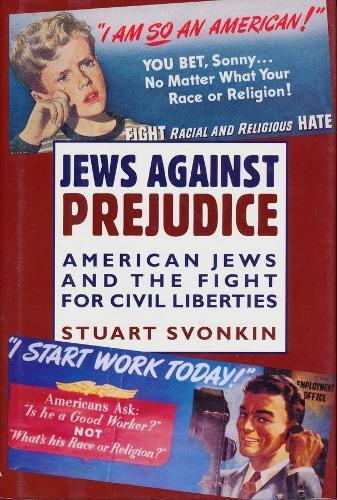
America's dark history of anti-Semitism, racism, and ethnic bigotry-and many of the efforts to combat such prejudice-has received growing attention in recent years. Yet one of the most important stories in America's struggle to overcome ethnic and religious hatred has gone largely untold. From the Depression to the late 1960s Jewish organizations-working as the leaders in a broadly based social and political movement-waged a determined campaign to eliminate all forms of discrimination and prejudice from American society. Stuart Svonkin delves into the archival records of America's three major Jewish defense groups-the American Jewish Committee, the Anti-Defamation League of B'nai B'rith, and the American Jewish Congress-to offer the first comprehensive account of organized Jewish political activism against bigotry and for human rights. Jews Against Prejudice chronicles American Jewry's political ascendance, from the era before World War II, when Jewish defense groups first organized to fight mass anti-Semitism, to their emergence as the leaders of a liberal movement determined to address the nation's most pressing political and social problems. Svonkin explores the impact that these Jewish groups had in the fight against racial and ethnic stereotypes. Beginning in World War II Jewish social scientists and other intellectuals began a concentrated effort to investigate the social and psychological bases of prejudicial attitudes, outlooks, and behavior. By the end of the war these social scientists became convinced that all forms of prejudice, including anti-Semitism, shared the same social and psychological causes, which, if discovered, could be successfully treated and eliminated. For over twenty years Jewish intellectuals and activists worked hand in hand to formulate practical programs to combat prejudice. They pioneered tactics-including educational programs in the schools, appeals for tolerance broadcast through the mass media, and legal challenges in the courts-that remain among the principal weapons of today's civil rights activists. Svonkin shows how ideology and the shifting models of prejudice greatly influenced the means that each Jewish group used in its fight against bigotry and racism. He considers the far-reaching effects of anticommunism in the 1950s and early 1960s, when Jewish political groups moved to support liberal anticommunism as well as to oppose the demagoguery of such figures as Senator Joseph McCarthy and the leaders of the John Birch Society. Exploring the tensions between American and Jewish identities, Svonkin argues that the revelations of the Eichmann Trial, the growing concern over Israel's security, and the persistence of anti-Semitism all shaped Jewish activism- driving the shift from the universalistic liberalism of the 1940s and 1950s to the cultural assertion and political neoconservatism of the late 1960s.
Full Product Details
Author: Stuart Svonkin (Torys LLP)
Publisher: Columbia University Press
Imprint: Columbia University Press
Dimensions:
Width: 16.20cm
, Height: 2.70cm
, Length: 23.40cm
Weight: 0.694kg
ISBN: 9780231106382
ISBN 10: 0231106386
Pages: 472
Publication Date: 01 October 1997
Audience:
Professional and scholarly
,
Professional & Vocational
Format: Hardback
Publisher's Status: Active
Availability: Out of stock

The supplier is temporarily out of stock of this item. It will be ordered for you on backorder and shipped when it becomes available.
Language: English
Reviews
An extravagantly-researched, tightly-focused survey of the internal development of three important Jewish organizations fighting discrimination at a crucial time.... There is a fascinating story behind the bureaucratic history Svonkin has recounted. -- Boston Book Review
A detailed study of how, during the 1940s and '50s, three major American Jewish organizations - the American Jewish Committee (AJC), American Jewish Congress, and Anti-Defamation League (ADL) - fundamentally broadened their mission and then partly subverted it by becoming caught up in the era's anti-communist hysteria. Historian Svonkin traces how all three national agencies shifted their focus from defense against anti-Semitic groups to opposing prejudice of all types and promoting the new ideal of intergroup relations. They did so using a broad and often innovative strategy involving research, radio and TV ads, curricular materials, and human-relations workshops. In the process, their staffs and the social scientists associated with them played down the socioeconomic causes of discrimination; influenced by Freudianism, they tended to see prejudice in terms of individual pathology. Svonkin also demonstrates how the agencies' intergroup-relations agenda was undercut when they embraced (though very reluctantly in the case of the AJ Congress) a constrained and defensive cold war liberalism that denied civil liberties to avowed communists, and even some suspected communists. In a concluding chapter Svonkin analyzes how, beginning during the 1960s, a reassertion of ethnoreligious particularism characterized Jewish leaders, who were already coming to view assimilation as at least as much of a threat to Jewish life as anti-Semitism. Clearly written and extremely well documented, Svonkin's book could have benefited from more exploration of the American historical and sociological context. A bit dry and targeted toward the specialist, this is, however, an informative and at times absorbing exploration of the roots of both the human-relations movement that characterized the civil-rights era and of current Jewish communal ideologies and policies. (Kirkus Reviews)
Author Information
Stuart Svonkin received his Ph.D. in History from Columbia University and will complete his J.D. from Harvard Law School in the Spring of 1999. He has taught American History and Jewish History at Columbia University and the New School for Social Research.