Overview
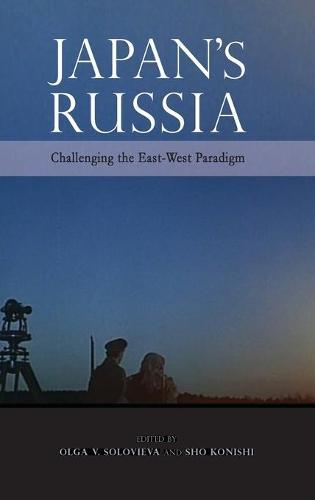
*Includes 29 images. The Russian cultural presence in Japan after the Meiji Revolution was immense. Indeed, Japanese cultural negotiations with Russian intellectuals and Russian literature, art, theology and political thought, formed an important basis for modern Japanese transnational intellectual, cultural, literary, and artistic production. And yet, despite the depth and range of ""Japan's Russia,"" this historical phenomenon has been markedly neglected in our studies of modern Japanese intellectual life. This absence may be attributed to the fact that ""Japan's Russia"" as idea and cultural expression developed outside the logic of Western modernity. There has been an interconnected logic behind this ignorance, a systematic lacuna in our historiography that tied method to historical actors, concept to theory. This volume seeks to depart from this logic in order to identify thoughts and practices that helped produce a dynamic transnational cultural phenomenon that we identify as ""Japan's Russia."" It does so by orchestrating case studies from cutting-edge scholarship originating in multiple disciplines, each with its own methodological and theoretical implications. Japan's Russia contributes to the uprooting of the temporal-spatial order of Western modernity and its territorial utopia. It departs from such habits of thinking to make sense of the magnitude and distinctiveness of Russia-related cultural and intellectual expressions and manifestations in Japan. It offers fresh insights into Japanese-Russian transnational intellectual history, a life that was polyvalent, multidirectional, mutually enabling and constructive, linking Japan with the wider world in alternative ways. Precisely because the global history of modernity has had no way of recognizing such non-imperial encounters, their theoretical implications and historical significance are immense. Indeed, they offer to transform our understanding of modern transnational cultural life at large. By redirecting the flow of transnational cultural production to defy the dichotomies of East and West, civilized and uncivilized, nature and culture/civilization, colonizer and colonized, and associated conceptual vocabularies and approaches, the volume transcends our ways of knowing. By shifting our lens from international to transnational, state to non-state, center to periphery, territorial to non-territorial, imperial to non-imperial, this volume discerns fresh imaginations of the future in the past that have so far been concealed. Japan's Russia is not just a historical phenomenon, then. ""Japan's Russia,"" as it is conceived in this volume, is a methodology of reading cultural production beyond East and West through its diverse medial transmissions and temporal and spatial displacements in a global setting. The circulations of knowledge introduced in this volume were facilitated by unofficial networks, elusive personal encounters, and biographical contingencies of actors on the non-state and even underground level, who often found themselves at odds with the geopolitical schemes of their times.
Full Product Details
Author: Olga V Solovieva ,
Sho Konishi
Publisher: Cambria Press
Imprint: Cambria Press
Dimensions:
Width: 15.20cm
, Height: 3.50cm
, Length: 22.90cm
Weight: 0.984kg
ISBN: 9781621965534
ISBN 10: 1621965538
Pages: 560
Publication Date: 26 January 2021
Audience:
General/trade
,
General
Format: Hardback
Publisher's Status: Active
Availability: Available To Order

We have confirmation that this item is in stock with the supplier. It will be ordered in for you and dispatched immediately.
Reviews
Japan's Russia is a valuable resource in the field of modern Japanese history because it provides a critical narrative that challenges the dominant 'East-West-binary-based paradigm, ' which sees only Western Europe and the United States as the determinant 'Other' of Japanese modernity. The authors present a wide range of case studies that bring forth the longue duree of interaction between Russia and Japan, particularly via the profound influence of the Narodniks, the late nineteenth-century Russian intelligentsia who promoted progressive cosmopolitanism and search for democracy. A major underlying theme of many chapters is the Japanese deep appreciation for and adaptation of Tolstoy's anti-statist anarchist cosmopolitanism, which inspired the rediscovery/invention of the Japanese turn to the countryside to establish the modern culture of mutual help and cooperative organizations. This book is a significant contribution to the new trend in the study of modern Japanese history that brings together geographies, peoples, and cultures and in so doing constructs a transnational and global historical narrative for modern Japan. -Selcuk Esenbel, Professor of History and Director of the Asian Studies Center, Bogazici University Japan's Russia presents a reinterpretation of modern Japanese culture and society by focusing on the Russia-Japan relationship. Building on Sho Konishi's earlier and important rethinking of visions of modernity in the early twentieth-century Russia-Japan relationship, this book expands the horizons by exploring a range of literary, artistic, intellectual, and political encounters. It also extends the timeframe from the late nineteenth century to the present day, offering fascinating and important insights. -Tessa Morris-Suzuki, Professor Emerita of Japanese History, Australian National University Premised on the multidirectionality of influence, Japan's Russia introduces readers to myriad currents in intellectual and cultural interactions between Japan and Russia, from literature to religion, ethnography to anti-nuclear activism. Solovieva and Konishi have made a space for topics and issues that have no home in fields defined by states and traditional disciplines. Their proposition of 'Japan's Russia' as not just a theme but a method will be provocative for anyone investigating culture and thought across borders. The chapters are impressive in their range and together create a multilayered, fine-grained history of interactions between artists, intellectuals, religious leaders, and other figures from Russia, Japan, China, and several more countries in the twentieth century, extending briefly into the twenty-first. -Christopher Hill, Associate Professor of Asian Languages and Cultures, University of Michigan
"""Japan's Russia is a valuable resource in the field of modern Japanese history because it provides a critical narrative that challenges the dominant 'East-West-binary-based paradigm, ' which sees only Western Europe and the United States as the determinant 'Other' of Japanese modernity. The authors present a wide range of case studies that bring forth the longue dur�e of interaction between Russia and Japan, particularly via the profound influence of the Narodniks, the late nineteenth-century Russian intelligentsia who promoted progressive cosmopolitanism and search for democracy. A major underlying theme of many chapters is the Japanese deep appreciation for and adaptation of Tolstoy's anti-statist anarchist cosmopolitanism, which inspired the rediscovery/invention of the Japanese turn to the countryside to establish the modern culture of mutual help and cooperative organizations. This book is a significant contribution to the new trend in the study of modern Japanese history that brings together geographies, peoples, and cultures and in so doing constructs a transnational and global historical narrative for modern Japan."" -Selcuk Esenbel, Professor of History and Director of the Asian Studies Center, Bogazici University ""Japan's Russia presents a reinterpretation of modern Japanese culture and society by focusing on the Russia-Japan relationship. Building on Sho Konishi's earlier and important rethinking of visions of modernity in the early twentieth-century Russia-Japan relationship, this book expands the horizons by exploring a range of literary, artistic, intellectual, and political encounters. It also extends the timeframe from the late nineteenth century to the present day, offering fascinating and important insights."" -Tessa Morris-Suzuki, Professor Emerita of Japanese History, Australian National University ""Premised on the multidirectionality of influence, Japan's Russia introduces readers to myriad currents in intellectual and cultural interactions between Japan and Russia, from literature to religion, ethnography to anti-nuclear activism. Solovieva and Konishi have made a space for topics and issues that have no home in fields defined by states and traditional disciplines. Their proposition of 'Japan's Russia' as not just a theme but a method will be provocative for anyone investigating culture and thought across borders. The chapters are impressive in their range and together create a multilayered, fine-grained history of interactions between artists, intellectuals, religious leaders, and other figures from Russia, Japan, China, and several more countries in the twentieth century, extending briefly into the twenty-first."" -Christopher Hill, Associate Professor of Asian Languages and Cultures, University of Michigan"
Author Information
Olga V. Solovieva is Assistant Professor in Comparative Literature at the University of Chicago. Sho Konishi is Associate Professor in Modern Japanese History at the University of Oxford.