Overview
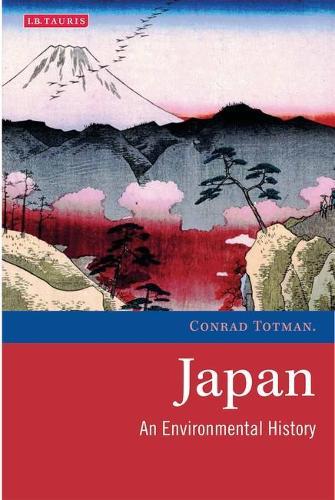
The lush green mountainous archipelago of today supports a population of over 127 million people and one of the most advanced economies in the world. How has this come about? At what environmental cost? Conrad Totman, one of the world's foremost scholars on Japan, explores the country's environmental history, from its beginnings to the present day. From Japan's unique borders, to the external influences exerted on its rich history, Totman demonstrates how the Japanese experience, yields important insights into the processes of environmental history, with important lessons for the wider environmental history of the planet.
Full Product Details
Author: Conrad Totman
Publisher: Bloomsbury Publishing PLC
Imprint: I.B. Tauris
Edition: 2nd edition
Dimensions:
Width: 15.60cm
, Height: 3.00cm
, Length: 23.40cm
Weight: 1.701kg
ISBN: 9781784537432
ISBN 10: 1784537438
Pages: 384
Publication Date: 30 September 2016
Audience:
College/higher education
,
Postgraduate, Research & Scholarly
Format: Paperback
Publisher's Status: Active
Availability: Manufactured on demand 
We will order this item for you from a manufactured on demand supplier.
Table of Contents
Preface Illustrations Maps Introduction Chapter 1 Japan the Place Japan today; Geological process: geological pre-history, archipelagic history; Global Location: Japan's position in Eurasia, ambient ocean currents, north-south length, some human consequences. Chapter 2 Forager Society Environmental context: sea level, temperature and precipitation; Early arrivals (pre-pottery); Jomon culture (pottery): perplexities of the onset, Jomon overall, regarding ambiguities of society and culture. Chapter 3 Early agricultural society to 600 CE Regarding agriculture: forager-agriculture comparison, early-later agriculture comparison, paddy culture - the technique, paddy culture - its extent; Agriculture: Early manifestations: general observations, Jomon agricultural practices; Yayoi: the beginning of fully developed agriculture in Japan: background and beginnings, some socio-cultural conundrums: Yayoi and beyond c. 200- 600CE: Later Yayoi society, Kofun, environmental ramifications to 600 CE. Chapter 4 Early agricultural society, 600-1250 Regarding deforestation: logging, agricultural land clearance; Formation of a central elite, 600- 850: capital cities, the new architecture, control and exploitation of the hinterland; consolidation of the margins; Environmental ramifications of the Ritsuryo order: regarding the center, regarding the realm; The later Ritsuryo centuries, 850-1250: intra-elite changes, changes in elite- producer relations, changes in producer organization and practice; Environmental ramifications of later Ritsuryo developments: renewal of agricultural growth, changing center periphery relations, urbanism. Chapter 5 Intensive agricultural society, 1250-1650 Geography; The elite: politics of disorder and reconsolidation, 1250-1650: the final decades of diarchy (1250-1330), the era of disarray and disorder (1330-1550), the period of reconsolidation (1550-1650); The producer populace: growth in scale and complexity: human-pathogen relations, elite-producer relations, producer organization and practice; Trends in agricultural technique: regarding fertilizer, water management, noteworthy new crops; Social and environmental effects of technological change: effects of deforestation, effects of agricultural intensification, other matters; Recapitulation Chapter 6 Intensive agricultural society, 1650-1890 The elite: politics of stability, rupture and reorientation: Bakuhan structure and limitations, the foreign menace (1790-1860), political restructuring (1860-90): The producer-populace: growth, stasis and change: human pathogen relations, elite-producer relations, producer organization and practice; Trends in technology: mining, forestry, fisheries, agriculture. Chapter 7 Imperial industrialism, 1890-1945 Some preliminaries: on the global resource, on 'packing and stacking', on 1890 as starting date, on 'imperial industrialism' as a temporary category, on 'state' vs. 'elite'; Affairs of state: domestic politics, foreign relations; Society and economy: demographics.
Reviews
This is the premier book for readers in and outside academia to gain a comprehensive view of human interaction with the environment on the Japanese archipelago, and a perspective that is beyond the anthropocentric historiography. --Canadian Journal of History/Annales canadiennes d'histoire
This is the premier book for readers in and outside academia to gain a comprehensive view of human interaction with the environment on the Japanese archipelago, and a perspective that is beyond the anthropocentric historiography. * Canadian Journal of History/Annales canadiennes d’histoire *
This is the premier book for readers in and outside academia to gain a comprehensive view of human interaction with the environment on the Japanese archipelago, and a perspective that is beyond the anthropocentric historiography. * Canadian Journal of History/Annales canadiennes d'histoire *
Author Information
Conrad Totman is Professor Emeritus in Japanese History, Yale University. Acknowledged as the leading western authority on Japanese environmental history, his books include Japan before Perry, The Green Archipelago, Early Modern Japan, and A History of Japan (3rd edition, 2010).
Tab Content 6
Author Website:
Countries Available
All regions
|