Overview
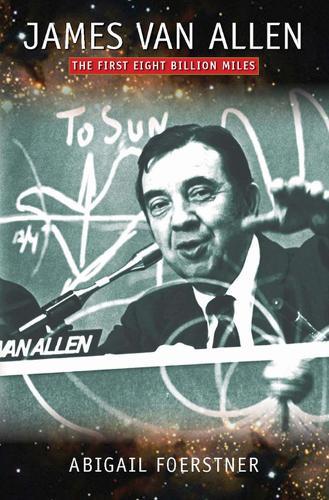
Astrophysicist and space pioneer James Van Allen (1914-2006), for whom the Van Allen radiation belts were named, was among the principal scientific investigators for twenty-four space missions, including Explorer 1 in 1958, the first successful U.S. satellite; Mariner 2's 1962 flyby of Venus, the first successful mission to another planet; and the 1970s Pioneer 10 and Pioneer 11, missions that surveyed Jupiter and Saturn. Although he retired as a University of Iowa professor of physics and astronomy in 1985, he remained an active researcher, using his campus office to monitor data from Pioneer 10 - on course to reach the edge of the solar system when its signal was lost in 2003 - until a short time before his death at the age of ninety-one. Now Abigail Foerstner blends space science drama, military agendas, cold war politics, and the events of Van Allen's lengthy career to create the first biography of this highly influential physicist. Drawing on Van Allen's correspondence and publications, years of interviews with him as well as with more than a hundred other scientists, and declassified documents from such archives as the Jet Propulsion Laboratory, the Kennedy Space Center, and the Applied Physics Laboratory, Foerstner describes Van Allen's life from his Iowa childhood to his first experiments at White Sands to the years of Explorer 1 until his death in 2006. Often called the father of space science, James Van Allen led the way to mapping a new solar system based on the solar wind, massive solar storms, and cosmic rays. Pioneer 10 alone sent him more than thirty years of readings that helped push our recognition of the boundary of the solar system billions of miles past Pluto. Abigail Foerstner's compelling biography charts the eventful life and time of this trailblazing physicist.
Full Product Details
Author: Abigail Foerstner
Publisher: University of Iowa Press
Imprint: University of Iowa Press
Dimensions:
Width: 15.20cm
, Height: 2.90cm
, Length: 22.90cm
Weight: 0.695kg
ISBN: 9780877459996
ISBN 10: 0877459991
Pages: 396
Publication Date: 15 November 2007
Audience:
General/trade
,
General
Format: Hardback
Publisher's Status: Out of Print
Availability: Out of stock

Reviews
A distinct contribution, long overdue, this most satisfying biography sets the subject within the context of his time, place, and profession. It not only illuminates the early history of space science but addresses the larger history of the scientific enterprise and even American history. The scientific basics and the open questions and controversies with which Van Allen was involved are well articulated, and the contextual look at the birth of space science will be useful to scientists. --Tom Crouch, senior curator, Aeronautics, National Air and Space Museum, Smithsonian Institution
Abigail Foerstner's life of James Van Allen reads like an exciting novel as we participate in Van Allen's growth in the field of space science, using rocketry to explore the rich structure of our planet in and above the layer of our atmosphere. It is crammed with very literate expositions of the dramatic years following World War II, years of epochal events: scientific, technological, political, and academic. James Van Allen was a superb figure upon which to trace this important era in the history of the nation. --Leon M. Lederman, Nobel Laureate, Physics A distinct contribution, long overdue, this most satisfying biography sets the subject within the context of his time, place, and profession. It not only illuminates the early history of space science but addresses the larger history of the scientific enterprise and even American history. The scientific basics and the open questions and controversies with which Van Allen was involved are well articulated, and the contextual look at the birth of space science will be useful to scientists. - Tom Crouch, senior curator, Aeronautics, National Air and Space Museum, Smithsonian Institution Abigail Foerstner's life of James Van Allen reads like an exciting novel as we participate in Van Allen's growth in the field of space science, using rocketry to explore the rich structure of our planet in and above the layer of our atmosphere. It is crammed with very literate expositions of the dramatic years following World War II, years of epochal events: scientific, technological, political, and academic. James Van Allen was a superb figure upon which to trace this important era in the history of the nation. --Leon M. Lederman, Nobel Laureate, Physics A distinct contribution, long overdue, this most satisfying biography sets the subject within the context of his time, place, and profession. It not only illuminates the early history of space science but addresses the larger history of the scientific enterprise and even American history. The scientific basics and the open questions and controversies with which Van Allen was involved are well articulated, and the contextual look at the birth of space science will be useful to scientists. Tom Crouch, senior curator, Aeronautics, National Air and Space Museum, Smithsonian Institution
A distinct contribution, long overdue, this most satisfying biography sets the subject within the context of his time, place, and profession. It not only illuminates the early history of space science but addresses the larger history of the scientific enterprise and even American history. The scientific basics and the open questions and controversies with which Van Allen was involved are well articulated, and the contextual look at the birth of space science will be useful to scientists. --Tom Crouch, senior curator, Aeronautics, National Air and Space Museum, Smithsonian Institution Abigail Foerstner's life of James Van Allen reads like an exciting novel as we participate in Van Allen's growth in the field of space science, using rocketry to explore the rich structure of our planet in and above the layer of our atmosphere. It is crammed with very literate expositions of the dramatic years following World War II, years of epochal events: scientific, technological, political, and academic. James Van Allen was a superb figure upon which to trace this important era in the history of the nation. --Leon M. Lederman, Nobel Laureate, Physics
A wholly inclusive biography of the famed physicist, often called the father of space science, from Foerstner (Science and News Writing/Northwestern Univ.; Picturing Utopia: Bertha Shambaugh and the Amana Photographers, 2000).Son of a small-town Iowa lawyer, Van Allen (1914 - 2006) grew up enthralled by high-tech devices of the 1920s - crystal radios, automotive engines, etc. - and he maintained this interest throughout college. World War II and his Ph.D. arrived simultaneously, and he played a central role in developing the proximity fuse, a critically important wartime invention. Success designing an instrument that could survive being shot from a cannon proved useful when he pioneered upper-atmosphere research firing captured German V2 rockets after the war. He continued working with balloons and smaller rockets, developing skills that vaulted him into headlines after Russia launched Sputnik in 1957. When the United States hastily launched its own satellite four months later, choosing the payload was easy because only Van Allen had an instrument ready to fly, which provided the first picture of the eponymous Van Allen radiation belts surrounding Earth. Over the next 30 years, he served as a principal investigator for two-dozen space missions that mapped the turbulent space of our solar system, with its solar wind, massive solar storms and cosmic rays. His probes - in addition to those of his students - continue to transmit from the edge of our solar system, eight billion miles away. Although a leading scientific figure, Van Allen's rather staid personal life creates difficulties for the biographer. He was popular with colleagues and students and a good husband, and he made few enemies and avoided politics. Foerstner does a fine job explaining Van Allen's work, but readers outside academia may wish for less of her exhaustive research, which includes biographies of his and his wife's ancestors, domestic details (including what the bride wore at his wedding) and details of innumerable committees on which he served.A sturdy account of an important if uncontroversial figure in American space research. (Kirkus Reviews)
A distinct contribution, long overdue, this most satisfying biography sets the subject within the context of his time, place, and profession. It not only illuminates the early history of space science but addresses the larger history of the scientific enterprise and even American history. The scientific basics and the open questions and controversies with which Van Allen was involved are well articulated, and the contextual look at the birth of space science will be useful to scientists. Tom Crouch, senior curator, Aeronautics, National Air and Space Museum, Smithsonian Institution
Author Information
Abigail Foerstner teaches science writing and news writing in the graduate program at Northwestern University's Medill School of Journalism; she is the author of Picturing Utopia: Bertha Shambaugh and the Amana Photographers (IOWA 2000) and of hundreds of articles on science, history, and the visual arts. As a staff reporter for the suburban sections of the Chicago Tribune, she covered science and the environment for nearly ten years. She spent seven years researching and writing James Van Allen: The First Eight Billion Miles.