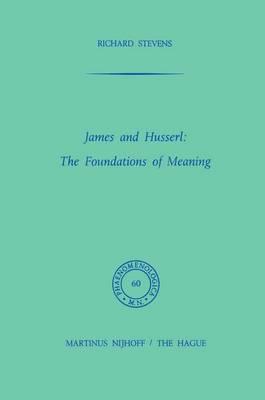
James and Husserl: The Foundations of Meaning

Author:   R. Stevens
Publisher:   Springer
Edition:   1974 ed.
Volume:   60
ISBN:  

9789024716319


Pages:   192
Publication Date:   31 August 1974
Format:   Hardback
Availability:   In Print   Availability explained
This item will be ordered in for you from one of our suppliers. Upon receipt, we will promptly dispatch it out to you. For in store availability, please contact us.

Our Price $472.56 Quantity:  
Add to Cart

Share |

James and Husserl: The Foundations of Meaning


Overview

"" ... a universe unfinished, with doors and windows open to possibilities uncontrollable in advance."" 1 A possibility which William James would certainly not have envisaged is a phenomenological reading of his philosophy. Given James's personality, one can easily imagine the explosive commen­ tary he would make on any attempt to situate his deliberately unsystematic writings within anyone philosophical mainstream. Yet, in recent years, the most fruitful scholarship on William James has resulted from a confrontation between his philosophy and the phe­ nomenology of Husserl. The very unlikelihood of such a comparison renders all the more fascinating the remarkable convergence of perspectives that comes to light when the fundamental projects of James and HusserI are juxtaposed. At first view, nothing could be more alien to the pragmatic mentality with its constant mistrust of any global system than a philosophy whose basic drive is to discover absolute knowledge and whose goal is to establish itself as a certain and universal science.

Full Product Details

Author:   R. Stevens
Publisher:   Springer
Imprint:   Kluwer Academic Publishers
Edition:   1974 ed.
Volume:   60
Dimensions:   Width: 15.50cm , Height: 1.20cm , Length: 23.50cm
Weight:   1.030kg
ISBN:  

9789024716319


ISBN 10:   9024716314
Pages:   192
Publication Date:   31 August 1974
Audience:   College/higher education ,  Professional and scholarly ,  Postgraduate, Research & Scholarly ,  Professional & Vocational
Format:   Hardback
Publisher's Status:   Active
Availability:   In Print   Availability explained
This item will be ordered in for you from one of our suppliers. Upon receipt, we will promptly dispatch it out to you. For in store availability, please contact us.

Table of Contents

I. The World of Pure Experience.- 1. The fundamental tenets of Radical Empiricism.- 2. The absolute sphere of pure experience.- 3. A comparison with Bergson.- II. Sensation, Perception, Conception.- 1. Knowledge by acquaintance and “knowledge about”.- 2. The recognition of sameness.- 3. The fringe structure of the stream of consciousness.- 4. The complementarity of perception and conception.- 5. Comparison between Husserl’s epoché and James’s return to pure experience.- III. The Genesis of Space and Time.- 1. The pre-reflective givenness of spatiality.- 2. The elaboration of spatial coordinates.- 3. Husserl’s theory of horizons and James’s fringes.- 4. The temporal structure of the stream of consciousness.- 5. The theory of the specious present.- 6. Primary and secondary remembrance.- 7. Husserl’s analysis of the now-phase.- 8. Active and passive genesis.- IV. The Structure of the Self: A Theory of Personal Identity.- 1. A functional view of consciousness.- 2. The empirical self.- 3. The pure ego.- 4. Husserl’s distinction between the human ego and the pure phenomenological ego.- 5. The auto-constitution of the ego in temporality.- 6. The ambiguous situation of the body.- V. Intersubjectivity.- 1. Two inadequate solutions to the impasse of solipsism.- 2. Reference to a common spatial horizon.- 3. The problem of solipsism in the context of transcendental subjectivity.- 4. The coordination of alien spatial perspectives through imaginative variation.- VI. The Thing and its Relations: A Theory of the Constitution of the Physical World.- 1. The positing of thing-patterns within the stream of consciousness.- 2. The sense of reality.- 3. The various sub-universes of reality.- 4. The region of the “thing” as a guiding clue for phenomenological inquiry.- 5.The return to the concrete fullness of the life-world.- VII. Attention and Freedom.- 1. The correlation between the focus-fringe structure of the object and the subjective modalities of attention and inattention.- 2. James’s dependence upon the “reflex-arc” theory of human activity.- 3. The relationship between attention and freedom.- 4. Husserl’s study of attention as an index of intentionality.- 5. The spontaneity of the ego’s glance.- 6. James’s pragmatic justification of the possibility of freedom.- VIII. The Pragmatic Theory of Truth.- 1. Pragmatism as a method and as a genetic theory of truth.- 2. Four different types of truth and of verification.- 3. Husserl’s definition of truth as the ideal adequation between meaning-intention and meaning fulfillment.- 4. The retrogression from the self-evidence of judgment to the original founding evidences of the life-world.- Conclusion — Action: the Final Synthesis.

Reviews

Author Information

Tab Content 6

Author Website:  

Countries Available

All regions
Latest Reading Guide

NOV RG 20252


Shopping Cart
Your cart is empty
Shopping cart
Mailing List