|
|
|||
|
||||
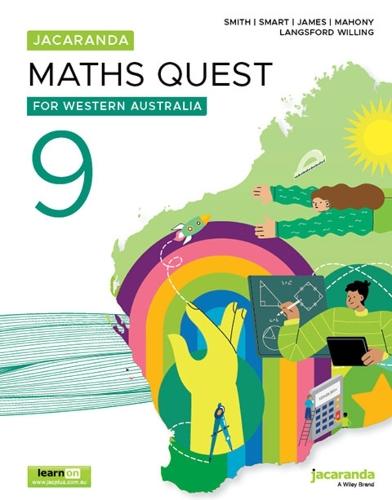
OverviewJACARANDA MATHS QUEST FOR WESTERN AUSTRALIA Developed by expert Australian teachers for ALL students Tried, tested and trusted. The Maths Quest series focuses on helping teachers achieve learning success for every student — ensuring no student is left behind and no student is held back. Because both what and how students learn matter. Series features: The digital Supercourse provides free Pre-Primary to Year 10 questions to support students in areas of weakness. Every lesson includes a teaching video that can be used in many ways, such as pre-and post-learning, flipped classrooms, class discussions, and revisiting key concepts. Quick quizzes with auto-marked questions for each topic give you a quick snapshot of each student’s progress. Learning intentions and success criteria are provided for every subtopic so students know what they need to learn and can track their progress. Visual summary maps at the end of each chapter help summarise and consolidate understanding. Worked examples featuring THINK/WRITE columns in every lesson provide exemplary solutions and explanations. eWorkbook with additional downloadable activities supports deeper learning. Full Product DetailsAuthor: Catherine Smith , James Smart , Geetha James , Caitlin MahonyPublisher: John Wiley & Sons Australia Ltd Imprint: Jacaranda Wiley, Australia Dimensions: Width: 2.20cm , Height: 0.30cm , Length: 2.80cm Weight: 1.588kg ISBN: 9781394363438ISBN 10: 1394363435 Pages: 736 Publication Date: 10 October 2025 Recommended Age: From 14 to 15 years Audience: Primary & secondary/elementary & high school , Educational: Primary & Secondary Format: Paperback Publisher's Status: Active Availability: Available To Order We have confirmation that this item is in stock with the supplier. It will be ordered in for you and dispatched immediately. Table of ContentsAbout this resource vii The new jacTUTOR xiv Acknowledgements xv NAPLAN practice Set A Calculator allowed Set B Non-calculator Set C Calculator allowed Set D Non-calculator Set E Calculator allowed Set F Non-calculator STRAND Number and algebra 1 1 Number skills and index laws 1 Sub-strands Understanding number | Calculating with number | Algebraic techniques 1.1 Overview 2 1.2 Real numbers 4 1.3 Rounding numbers and significant figures 11 1.4 Review of index laws 16 1.5 Raising powers 24 1.6 Negative indices 28 1.7 Scientific notation 34 1.8 Square roots and cube roots 41 1.9 Surds (extending) 44 1.10 Review 56 2 Algebra 71 Sub-strand Algebraic techniques 2.1 Overview 72 2.2 Using variables 74 2.3 Algebra in worded problems 83 2.4 Simplification of algebraic expressions 88 2.5 Expanding brackets 96 2.6 Difference of two squares and perfect squares 105 2.7 Further expansions 110 2.8 The highest common factor 113 2.9 The highest common binomial factor (extending) 118 2.10 Solving worded problems 122 2.11 Review 130 3 Linear equations 145 Sub-strand Linear and non-linear equations and inequalities 3.1 Overview 146 3.2 Solving multi-step linear equations 148 3.3 Solving linear equations with brackets 156 3.4 Solving linear equations with variables on both sides 160 3.5 Solving problems with linear equations 164 3.6 Rearranging formulas 170 3.7 Review 175 4 Linear graphs 185 Sub-strand Linear and non-linear patterns and relationships 4.1 Overview 186 4.2 Plotting linear graphs 189 4.3 Features of linear graphs 195 4.4 The equation of a straight line 203 4.5 Sketching linear graphs 211 4.6 Technology and linear graphs 219 4.7 Practical applications of linear graphs 223 4.8 Midpoint of a line segment and distance between two points 228 4.9 Review 235 5 Proportions 257 Sub-strand Linear and non-linear patterns and relationships 5.1 Overview 258 5.2 Direct proportion 260 5.3 Proportionality 265 5.4 Indirect proportion (optional) 270 5.5 Review 275 6 Quadratic equations and graphs 283 Sub-strands Linear and non-linear equations and inequalities | Linear and non-linear patterns and relationships 6.1 Overview 284 6.2 Quadratic equations 286 6.3 The Null Factor Law (optional) 290 6.4 Graphing quadratic functions of the form 294 6.5 Review 300 7 Financial mathematics 309 Sub-strand Financial mathematics 7.1 Overview 310 7.2 Salaries and wages 313 7.3 Penalty rates 318 7.4 Piecework, commission and royalties 323 7.5 Simple interest 330 7.6 Review 338 Modelling with number and algebra 347 STRAND Measurement and geometry 351 8 Pythagoras and trigonometry 351 Sub-strand Two-dimensional space and structures 8.1 Overview 352 8.2 Pythagoras’ theorem 356 8.3 Applications of Pythagoras’ theorem 365 8.4 Trigonometric ratios 373 8.5 Calculating unknown side lengths 382 8.6 Calculating unknown angles 391 8.7 The unit circle (optional) 399 8.8 Review 406 9 Measurement 421 Sub-strands Two-dimensional space and structures | Three-dimensional space and structures 9.1 Overview 422 9.2 Perimeter and circumference 426 9.3 Area 433 9.4 Area and perimeter of a sector 443 9.5 Surface area of rectangular and triangular prisms 450 9.6 Surface area of a cylinder 456 9.7 Volume of prisms and cylinders 461 9.8 Review 474 10 Congruence and similarity 487 Sub-strand Two-dimensional space and structures 10.1 Overview 488 10.2 Ratio and scale 491 10.3 Congruent figures 502 10.4 Similar figures 510 10.5 Area and volume of similar figures (extending) 522 10.6 Review 531 Modelling with measurement and geometry 545 STRAND Probability and statistics 549 11 Probability 549 Sub-strand Probability and statistics 11.1 Overview 550 11.2 Theoretical probability 556 11.3 Experimental probability 563 11.4 Venn diagrams and two-way tables 572 11.5 Compound events 589 11.6 Review 602 12 Statistics 617 Sub-strand Probability and statistics 12.1 Overview 618 12.2 Collecting data 622 12.3 Organising data 634 12.4 Displaying data 644 12.5 Measures of centre 659 12.6 Comparing multiple data sets 675 12.7 Review 689 Modelling with probability and statistics 711 GlossaryReviewsAuthor InformationTab Content 6Author Website:Countries AvailableAll regions |
||||