Awards
- Winner of Shortlisted, 2024 Elizabeth Longford Prize for Historical Biography.
Overview
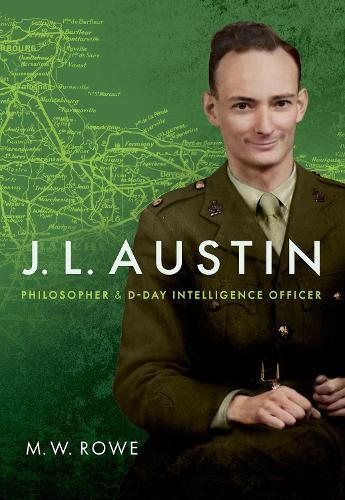
The first biography of the philosopher who became a mastermind of Allied intelligence in World War Two.Austere, witty, and formidable, J. L. Austin (1911-1960) was the leader of Oxford Ordinary Language Philosophy and the founder of speech-act theory. This book--the first full-length biography of Austin--enhances our understanding of his dominance in 1950s Oxford, examining the significance of his famous Saturday morning seminars, and his sometimes tense relationships with Gilbert Ryle, Isaiah Berlin, A. J. Ayer, and Elizabeth Anscombe. Throwing new light on Austin's own intellectual development, it probes the strengths and weaknesses of his mature philosophy, and reconstructs his late unpublished work on sound symbolism.Austin's philosophical work remains highly influential, but much less well known is his outstanding contribution to British Intelligence in World War Two. The twelve central chapters thus investigate Austin's part in the North African campaign, the search for the V-weapons, the preparations for D-Day, the Battle of Arnhem, and the Ardennes Offensive, and show that, in the case of D-Day, he played a major role in the ultimate Allied victory.While exploring Austin's dramatic and romantic personal history, Rowe pays close attention to his harsh schooling and pre-war affair with a married Frenchwoman; his wartime marriage, bomb injury, and response to a colleague's murder; and his post-war family life, the growing influence of America, and his tragically premature death. Adding considerably to our knowledge of World War Two, and Austin's diverse and enduring influence, this biography reveals the true complexity of his character, and the full range and significance of his achievements.
Full Product Details
Author: M. W. Rowe (Honorary Researcher in Philosophy, Honorary Researcher in Philosophy, University of East Anglia)
Publisher: Oxford University Press
Imprint: Oxford University Press
Dimensions:
Width: 18.00cm
, Height: 3.50cm
, Length: 25.20cm
Weight: 1.502kg
ISBN: 9780198707585
ISBN 10: 0198707584
Pages: 682
Publication Date: 11 May 2023
Audience:
Professional and scholarly
,
Professional & Vocational
Format: Hardback
Publisher's Status: Active
Availability: To order 
Stock availability from the supplier is unknown. We will order it for you and ship this item to you once it is received by us.
Table of Contents
Part I: Pre-War 1: Origins: c. 1670-1911 2: Childhood: 1911-1924 3: Shrewsbury: 1924-1929 4: Balliol: 1929-1933 5: Philosophy in Oxford: 1918-1933 6: All Souls: 1933-1935 7: Collingwood, C. I. Lewis, and Aristotle: 1935-1938 8: The Brethren, Politics, and Wittgenstein: 1937-1940 Part II: War 9: Jean and the Army: 1939-1941 10: MI14, Marriage, and North African Intelligence: 1941 11: Injury, Scotland, and the Desert War: 1941-1942 12: The Coming of the Martians: 1942 13: Norfolk House, Dieppe, and Torch: 1942 14: Skyscraper, Invade Mecum, and Exile: 1943 15: The Hunt for the V-Weapons: 1943-1944 16: At Peter Robinson's: 1943-1944 17: Towards D-Day: 1944 18: D-Day and the Battle of Normandy: 1944 19: Arnhem and the Ardennes: 1944-1945 20: War's End: 1945 Part III: Post-War 21: Post-War Britain and Oxford: 1945-1947 22: 'Other Minds': 1946-1947 23: Ordinary Language Philosophy: 1947-1959 24: The Oral and the Written: 1947-1959 25: Sense and Sensibilia: 1947-1959 26: Truth and Logic: 1950-1952 27: White's Professor: 1952-1954 28: Domestic Life and the Americans: 1952-1954 29: Harvard and Speech-Acts: 1955 30: Abilities and Excuses: 1956-1957 31: Royaumont and Anscombe: 1958 32: California, Semantics, and Sound Symbolism: 1958-1959 33: Ayer, Scandinavia, and the Gellner Controversy: 1959 34: Final Illness: 1959-1960
Reviews
Meticulously researched yet uncluttered ... philosophically illuminating. * Jane O'Grady, Times Literary Supplement *
Scrupulous and engrossing * Best Books of the Year 2023, The Economist * A revelatory work of intelligence history, ingeniously built from scattered and skimpy materials. * Richard Davenport-Hines, Books of the Year 2023, Times Literary Supplement * A superb biography...dense and readable. * Tom Stoppard, Books of the Year 2023, Times Literary Supplement * Meticulously researched yet uncluttered ... philosophically illuminating. * Jane O'Grady, Times Literary Supplement * [ Rowe's] research is so thorough, his exposition so meticulous and his presentation so clear that even the digressions are a delight * Jonathan Ree, Literary Review * a marvellous book . . . thoroughly absorbing... First, it gives a detailed account of Austin's philosophical development, his background, his works and his academic career and influence, accompanied at each stage by interpretations and criticisms that are judicious and insightful. Rowe shows himself to be an excellent philosopher in his own right. Second, the book presents the results of Rowe's painstaking archival research on Austin's intelligence career, placing it in the context of British and Allied intelligence concerning Western Europe and North Africa. It gives a fascinating account of the way military intelligence is generated and the crucial role it plays in every military operation... Third, Rowe offers a perceptive analysis of Austin's personal qualities and their part in his academic and military engagements. * Thomas Nagel, London Review of Books * well-researched, and admirably written intellectual biography. * Stephen Mulhall, Society * This is a magnificent biography, balanced, comprehensive, and meticulously researched. It reconstructs the life of a scholar whose analyses helped shape mid-twentieth-century British philosophy; and it traces the work of an intelligence officer whose analyses helped save tens of thousands of lives. * SANDER VERHAEGH, Tilburg University * M. W. Rowe's compendious biography of J. L. Austin (1911-60), at least a decade in the making, can justifiably be described as long-awaited. Its more than 600 pages contain more than enough in the way of fact and interpretation to vindicate handsomely the time and labour that have gone into it. The book contains a wealth of biographical detail, extended quotations from correspondence and archival material that are not widely known and efficient synopses of Austin's philosophical writings. These elements alone render the book indispensable to any philosopher or historian interested in Austin's life, his times and, of course, his philosophical themes - among other things, perception, the theory of 'speech acts' and the role of language in philosophy. * NIKHIL KRISHNAN, MIND * Rowe has written a superb historical and intellectual biographyof Austin. It is a marvellous achievement, and everyone should read the book. * Alex Moran, Université de Fribourg * This is a terrific, massively impressive work. The text is an extremely well-judged and exhaustively detailed (potentially exhaustingly detailed for some readers) treatment of Austin's philosophical and military contributions. I recommend J.L. Austin in the highest possible terms. * Robert J. Stainton, Philosophy in Review *
Meticulously researched yet uncluttered ... philosophically illuminating. * Jane O'Grady, Times Literary Supplement * Meticulously researched yet uncluttered... philosophically illuminating. * Jane O'Grady, TLS * a marvellous book . . . thoroughly absorbing... First, it gives a detailed account of Austin's philosophical development, his background, his works and his academic career and influence, accompanied at each stage by interpretations and criticisms that are judicious and insightful. Rowe shows himself to be an excellent philosopher in his own right. Second, the book presents the results of Rowe's painstaking archival research on Austin's intelligence career, placing it in the context of British and Allied intelligence concerning Western Europe and North Africa. It gives a fascinating account of the way military intelligence is generated and the crucial role it plays in every military operation... Third, Rowe offers a perceptive analysis of Austin's personal qualities and their part in his academic and military engagements. * Thomas Nagel, London Review of Books *
Meticulously researched yet uncluttered ... philosophically illuminating. * Jane O'Grady, Times Literary Supplement * Meticulously researched yet uncluttered... philosophically illuminating. * Jane O'Grady, TLS *
Author Information
M. W. Rowe is an Honorary Researcher in Philosophy at the University of East Anglia (UEA). He was educated at Cranbrook School and Cambridge and York Universities. He was formerly Head of English at Pocklington School, Yorkshire, Lecturer in Aesthetics at Birkbeck College, London, and Senior Lecturer in Philosophy at UEA. He is particularly interested in military history, linguistic philosophy, classical music, nineteenth- and twentieth-century literature, and the intersections between philosophy and literature. In addition to his work on J. L. Austin, he is currently supervising a recording of the complete works of Heinrich Wilhelm Ernst (1812-65).
Tab Content 6
Author Website:
Countries Available
All regions
|