Overview
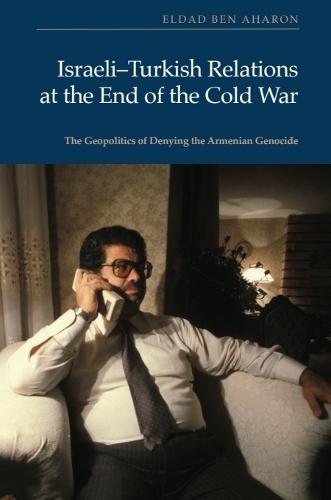
This book is the first to explore IsraeliTurkish relations during the 1980s, a decade often overlooked due to the absence of formal diplomatic ties. Although Turkey appeared to distance itself from Israel, this book examines how Cold War-era ontological security concerns played a key role in improving bilateral relations behind the scenes. These ontological fears included Turkey's potential departure from NATO and its increasing efforts to combat international terrorism. Divided into three sections, the book attributes the strengthening of AnkaraJerusalem ties in the 1980s to the Israeli MFA's efforts to support the denial of the 1915 Armenian Genocide in international forums. It presents case studies of four distinct episodes and examines the diplomatic manoeuvring involved. Drawing on declassified records from Israeli and American archives, along with 30 oral interviews with Israeli, Turkish and Armenian officials, the book demonstrates that IsraeliTurkish relations during the late Cold War were shaped not only by the 1979 Islamic Revolution in Iran but also by Turkey's September 1980 military coup, Turgut zal's leadership, Turkey's 1987 application to the European Economic Community and other key developments in Turkish politics and foreign policy. Taking an interdisciplinary approach, Eldad Ben Aharon also reveals how the 1980s marked the establishment of international norms on genocide recognition and memory, with the Holocaust emerging as the gold standard for understanding human-rights violations, while the Armenian Genocide remained contested and relegated to a weaker, secondary norm.
Full Product Details
Author: Eldad Ben Aharon (Postdoctoral Fellow and Senior Researcher, Peace Research Institute Frankfurt)
Publisher: Edinburgh University Press
Imprint: Edinburgh University Press
ISBN: 9781399507356
ISBN 10: 1399507354
Pages: 304
Publication Date: 30 November 2025
Audience:
Professional and scholarly
,
Professional & Vocational
Format: Hardback
Publisher's Status: Active
Availability: Not yet available

This item is yet to be released. You can pre-order this item and we will dispatch it to you upon its release.
Reviews
Dr Eldad Ben Aharon's book provides original and important insights into the first ""global war on terror"" under the Reagan administration in the 1980s. Drawing upon extensive archival research and interviews, this book examines how Cold War-era ontological fears of international terrorism shaped liaison efforts amongst the U.S., Israel and Turkey. This notably led to delays in the recognition of the Armenian Genocide of 1915 for several decades. This compelling work highlights the deep interconnections between security policy and historical memory.--Sarah Léonard, Dublin City University
This ground-breaking study examines the evolution of the Israeli-Turkish alliance in the late Cold War era, laying the foundation for a decades-long partnership. It meticulously explores how Israel seized Turkey's denial of the Armenian Genocide in the 1970s as a launching point to build trust in a country that viewed Israel's close ties with Washington as a means to shape policy. To the surprise of many, the foundations of the alliance endured major political shifts, with the rise of Erdogan and Netanyahu. It is essential reading for anyone interested in Israel-Turkish relations and their impact on the geopolitical dynamics of the Middle East. Unequivocally, this work positions Eldad Ben-Aharon as a leading authority on Israeli-Turkish ties, just as relations between the two countries have hit rock bottom in the wake of the events of Oct 7th. In short, few can match Ben-Aharon's ability to manoeuvre the political world of Israel, Turkey, the United States and the Middle East, crafting a compelling and very readable analysis.--Louis Fishman, City University of New York Dr Eldad Ben Aharon's book provides original and important insights into the first ""global war on terror"" under the Reagan administration in the 1980s. Drawing upon extensive archival research and interviews, this book examines how Cold War-era ontological fears of international terrorism shaped liaison efforts amongst the U.S., Israel and Turkey. This notably led to delays in the recognition of the Armenian Genocide of 1915 for several decades. This compelling work highlights the deep interconnections between security policy and historical memory.--Sarah Léonard, Dublin City University
Author Information
Eldad Ben Aharon is a Senior Researcher at the Peace Research Institute Frankfurt and was previously an Irish Research Council (IRC) Postdoctoral Fellow in International Security at Dublin City University. His work explores the nexus of security, identity, and memory, drawing on insights from securitisation theory, foreign policy analysis, and oral history. Ben Aharon has published widely on Israeli foreign policy and its intersections with broader regional conflict dynamics, with his research appearing in leading academic journals, including the European Journal of International Security, Intelligence and National Security, Studies in Conflict & Terrorism, Oral History Review, British Journal of Middle Eastern Studies, Journal of Genocide Research and Cold War History.