Overview
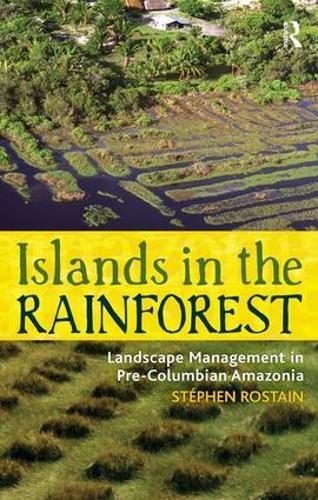
Stéphen Rostain’s book is a culmination of 25 years of research on the extensive human modification of the wetlands environment of Guiana and how it reshapes our thinking of ancient settlement in lowland South America and other tropical zones. Rostain demonstrates that populations were capable of developing intensive raised-field agriculture, which supported significant human density, and construct causeways, habitation mounds, canals, and reservoirs to meet their needs. The work is comparative in every sense, drawing on ethnology, ethnohistory, ecology, and geography; contrasting island Guiana with other wetland regions around the world; and examining millennia of pre-Columbian settlement and colonial occupation alike. Rostain’s work demands a radical rethinking of conventional wisdom about settlement in tropical lowlands and landscape management by its inhabitants over the course of millennia.
Full Product Details
Author: Stéphen Rostain ,
Philippe Descola ,
Philippe Descola (Ecole des Hautes Etudes en Sciences Sociales, Paris)
Publisher: Left Coast Press Inc
Imprint: Left Coast Press Inc
Dimensions:
Width: 15.20cm
, Height: 2.30cm
, Length: 22.90cm
Weight: 0.589kg
ISBN: 9781598746341
ISBN 10: 1598746340
Pages: 278
Publication Date: 15 November 2012
Audience:
General/trade
,
General
Format: Hardback
Publisher's Status: Active
Availability: In Print

This item will be ordered in for you from one of our suppliers. Upon receipt, we will promptly dispatch it out to you. For in store availability, please contact us.
Reviews
Stephen Rostain is not only a remarkable field archaeologist, he is also a comparativist with broad perspectives and a solid erudition which have made him an authority in the still embryonic field of Amazonian archaeology, and more widely on the theme of sustainable development in tropical-forest environments. --From the Foreword by Philippe Descola
Stephen Rostain is not only a remarkable field archaeologist, he is also a comparativist with broad perspectives and a solid erudition which have made him an authority in the still embryonic field of Amazonian archaeology, and more widely on the theme of sustainable development in tropical-forest environments. --From the Foreword by Philippe Descola
Stephen Rostain is not only a remarkable field archaeologist, he is also a comparativist with broad perspectives and a solid erudition which have made him an authority in the still embryonic field of Amazonian archaeology, and more widely on the theme of sustainable development in tropical-forest environments. --From the Foreword by Philippe Descola Collaborative autoethnography (CAE) is a relatively new qualitative social inquiry method that utilizes ethnography, autobiography, and researcher collaboration. CAE goes beyond autoethnography, a methodology in which researchers collect data from their own life stories and examine it within sociocultural contexts. Chang previously wrote Autoethnography as Method (CH, Mar'09, 46-3928). Multi-researcher CAE takes place collectively and cooperatively within teams ranging from two to a dozen, allowing for self- and collective analysis. The authors (all, Eastern Univ.) here present a cogent and practical guide to the collaborative process. Clearly delineated chapters explain CAE and its benefits and challenges; project typologies; project preparation, including team formation and determining researcher roles and research focus; data collection and interpretation; writing; and applications. Diagrams, extensive references, and a sample list of writing prompts for self-reflective data collection contribute to the volume's usefulness. In the epilogue, the authors describe their recent CAE research project. The appendix includes a reprint of a 2010 article by seven authors who examined mothering, using CAE methodology. As a relatively recent field of social inquiry, CAE previously was the subject of articles only. This volume provides a clearly articulated explanation of CAE and step-by-step guide to conducting research. Summing Up: Highly recommended. Upper-division undergraduates and above. --CHOICE This book is part of a new phase in Amazonian cultural geography and anthropology, and shows that the field is branching and spreading...As landscape archaeology and geography of the Amazon develops, this book can serve as a key text on raised field agriculture in a particular geographic context, and as an introduction to pre-Columbian agricultural systems more generally. - John Walker, University of Central Florida, AAG Review of Books
""This book is part of a new phase in Amazonian cultural geography and anthropology, and shows that the field is branching and spreading...As landscape archaeology and geography of the Amazon develops, this book can serve as a key text on raised field agriculture in a particular geographic context, and as an introduction to pre-Columbian agricultural systems more generally."" - John Walker, University of Central Florida, AAG Review of Books
Stephen Rostain is not only a remarkable field archaeologist, he is also a comparativist with broad perspectives and a solid erudition which have made him an authority in the still embryonic field of Amazonian archaeology, and more widely on the theme of sustainable development in tropical-forest environments. From the Foreword by Philippe Descola
Author Information
Stephen Rostain is Director of Investigation at the National Centre for Scientific Research (CNRS) in France. He received his Ph.D. on the archaeology of French Guiana in 1994 from the Sorbonne University in Paris. He has conducted archaeological excavations in France, Mexico, Guatemala, Aruba and Brazil, but his main investigations have been conducted in Amazonia, especially in the Guianas and in Ecuador. Rostain has published more than 100 articles, book chapters and books. In 2008, he received in Paris the Clio award for archaeological projects in foreign countries. The distinguished anthropologist Philippe Descola is chair of anthropology of nature at the College de France and author of numerous books, including In the Society of Nature and The Spears of Twilight .