Overview
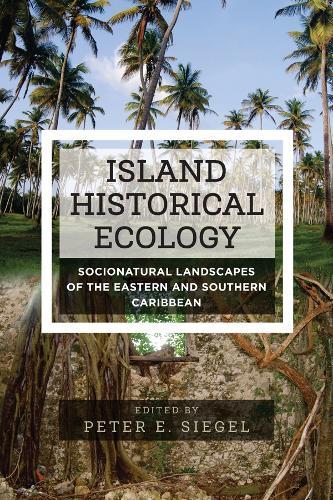
In the first book-length treatise on historical ecology of the West Indies, Island Historical Ecology addresses Caribbean island ecologies from the perspective of social and cultural interventions over approximately eight millennia of human occupations. Environmental coring carried out in carefully selected wetlands allowed for the reconstruction of pre-colonial and colonial landscapes on islands between Venezuela and Puerto Rico. Comparisons with well-documented patterns in the Mediterranean and Pacific islands place this case study into a larger context of island historical ecology.
Full Product Details
Author: Peter E. Siegel
Publisher: Berghahn Books
Imprint: Berghahn Books
ISBN: 9781836950585
ISBN 10: 1836950586
Pages: 450
Publication Date: 01 April 2025
Audience:
Professional and scholarly
,
Professional & Vocational
Format: Paperback
Publisher's Status: Active
Availability: In Print 
This item will be ordered in for you from one of our suppliers. Upon receipt, we will promptly dispatch it out to you. For in store availability, please contact us.
Table of Contents
Figures Tables Acknowledgments Foreword: A Prelude to Island Historical Ecology William Balée Preface Peter E. Siegel PART I: METHOD, THEORY, AND APPLICATIONS OF ISLAND HISTORICAL ECOLOGY Chapter 1. Migrations, Colonization Processes, and Landscape Learning Peter E. Siegel Chapter 2. Unique Challenges in Archipelagoes:
Examples from the Mediterranean and Pacific Islands Thomas P. Leppard Chapter 3. A Cultural Framework for Caribbean Island Historical Ecology Corinne L. Hofman and Menno L. P. Hoogland Chapter 4. Methods for Addressing Island Historical Ecology Deborah M. Pearsall, John G. Jones, Nicholas P. Dunning, Peter E. Siegel, Pat Farrell, Jason H. Curtis, and Neil A. Duncan PART II: WEST INDIAN ISLAND HISTORICAL ECOLOGY Chapter 5. Trinidad Pat Farrell, Neil A. Duncan, John G. Jones, Nicholas P. Dunning, Deborah M. Pearsall, and Peter E. Siegel Chapter 6. Grenada John G. Jones, Deborah M. Pearsall, Pat Farrell, Nicholas P. Dunning, Jason H. Curtis, Neil A. Duncan, and Peter E. Siegel Chapter 7. Curaçao Nicholas P. Dunning, John G. Jones, Neil A. Duncan, Deborah M. Pearsall, and Peter E. Siegel Chapter 8. Barbados Nicholas P. Dunning, John G. Jones, Deborah M. Pearsall, and Peter E. Siegel Chapter 9. Martinique Neil A. Duncan, Nicholas P. Dunning, John G. Jones, Deborah M. Pearsall, and Peter E. Siegel Chapter 10. Marie-Galante John G. Jones, Nicholas P. Dunning, Deborah M. Pearsall, and Peter E. Siegel Chapter 11. Antigua John G. Jones, Nicholas P. Dunning, Deborah M. Pearsall, Neil A. Duncan, and Peter E. Siegel Chapter 12. Barbuda John G. Jones, Nicholas P. Dunning, Neil A. Duncan, Deborah M. Pearsall, and Peter E. Siegel Chapter 13. St. Croix Deborah M. Pearsall, Nicholas P. Dunning, John G. Jones, Neil A. Duncan, and Peter E. Siegel PART III: SYNTHESIS AND FUTURE DIRECTIONS IN ISLAND HISTORICAL ECOLOGY Chapter 14. Assessing Colonization, Landscape Learning, and Socionatural Changes in the Caribbean Peter E. Siegel, Deborah M. Pearsall, Nicholas P. Dunning, John G. Jones, Pat Farrell, Neil A. Duncan, and Jason H. Curtis Chapter 15. Insights from the Outside:
Some Wider Perspectives and Future Directions in Caribbean Island Historical Ecology John F. Cherry References Glossary Notes on Contributors Index
Reviews
“It is hard to overstate the importance of successfully accomplishing a project of this magnitude. There have been limited coring projects on individual islands, but nothing on a regional scale like this. As such, Island Historical Ecology offers our best evidence yet of human-environmental interactions in the prehistoric (and historic) Lesser Antilles. We will all be referencing this volume for many decades to come.” • JRAI (Journal of the Royal Anthropological Institute) “This timely publication, … is probably the first to assiduously apply the science and rigour of …’historical Ecology’ to multiple small islands in the Southern and Eastern Caribbean.” • European Review of Latin American and Caribbean Studies “This highly important and most interesting book represents a valuable source of primary data on the historical ecology of the West Indies.” • Andrzej Antczak, Leiden University “I am much impressed with the ground-breaking work involved in this project, and with its presentation. I believe it is a very valuable and novel addition to the scientific literature on the Lesser Antilles.” • Peter G. Roe, University of Delaware
Author Information
Peter E. Siegel is Professor of Anthropology at Montclair State University. His articles have appeared in Current Anthropology, Journal of Anthropological Archaeology, and Journal of Field Archaeology, among others. Siegel’s research has been supported by the Heinz Family Foundation for Latin American Archaeology, National Geographic Society, National Science Foundation, the Wenner-Gren Foundation for Anthropological Research, and the School for Advanced Research, Santa Fe.
Tab Content 6
Author Website:
Countries Available
All regions
|