Overview
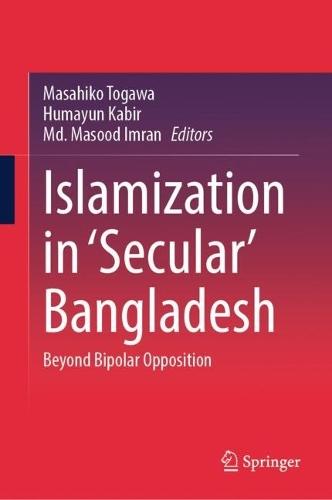
This volume adds to the increasingly important debate on religion and modernity and their complex interplay in Muslim-majority societies. Taking up the case of Bangladesh, the discussions are highly topical given the recent upsurges in the country. The volume offers a comprehensive perspective on the changing dynamics of Islamization and secularization processes in Bangladeshi society and deconstructs the binary opposition between religion and secular modernity as inapplicable not just to Bangladesh but also to Muslim societies elsewhere. The contributors mostly apply anthropological approaches to cover four broad themes: transformation of identity beyond Islamization and secularization; Islamic movements in democratic arena; Islamic culture in public sphere; and beyond polarization of women’s liberation and Islamization. They cast light on religion and modernity, identity politics, development, globalization, the digital space, Islamic movements, and gender identity and patriarchal structure in Bangladesh. The incisive analyses of the cases and themes presented here will help readers understand how Islamization intersects with secularization/modernity in Bangladesh, within the broader South Asian sociopolitical context. The volume is of interest to scholars of Bangladesh studies, and historians, anthropologists, feminists, political scientists, and researchers of South Asia. Policy makers and development and non-governmental professionals will also benefit from the issues, cases, and myriad examples incorporated in this volume.
Full Product Details
Author: Masahiko Togawa ,
Humayun Kabir ,
Md. Masood Imran
Publisher: Springer Nature Switzerland AG
Imprint: Springer Nature Switzerland AG
ISBN: 9783032160843
ISBN 10: 3032160847
Pages: 301
Publication Date: 08 May 2026
Audience:
Professional and scholarly
,
Professional & Vocational
Format: Hardback
Publisher's Status: Forthcoming
Availability: Not yet available

This item is yet to be released. You can pre-order this item and we will dispatch it to you upon its release.
Author Information
Masahiko Togawa is Professor at the Research Institute for Languages & Cultures of Asia & Africa, Tokyo University of Foreign Studies (TUFS), Japan. As a cultural anthropologist, he specializes in religion and society of Bangladesh and West Bengal, India. He has published several books and many journal articles on kinship, family, religion, minority communities, etc. Professor Togawa has authored Abode of the Goddess: Kinsgship, Caste, and Sacrificial Organization in a Bengali Village (2006, Manohar). He has also co-edited Kinship and Family among Muslims in Bengal (2021, Manohar) and Minorities and the State: Changing Social and Political Landscape of Bengal (2011, SAGE). Humayun Kabir is Assistant Teaching Professor of anthropology at the Department of Environment, Culture & Society, Thompson Rivers University, British Columbia, Canada. Recently, he served as a Visiting Research Fellow at the Research Institute for Languages and Cultures of Asia and Africa (ILCAA), Tokyo University of Foreign Studies. His research focuses on Islamic education and identity politics, Islamism and democracy, religious minority communities, etc. with a particular focus on Bangladeshi, but broadly modern South Asian, context. Dr. Kabir’s contributions have appeared as encyclopedia entries, book chapters, and journal articles. Md. Masood Imran is Professor at the Department of Archaeology, Jahangirnagar University, Dhaka, Bangladesh. He earned a PhD from Hiroshima University, Japan. At national and international levels, Professor Imran has published numerous journal articles, and several book chapters and books. His research specialization is on critical theory, identity and representation politics of the past, spatial patterns of cultural heritage sites, predictive 3D modelling of monuments, and generating VR versions of cultural heritage sites. His latest book, Safeguarding-Governmentality of Cultural Heritage: Democratising, Conserving, and Representing the Past(s) of Global South was published in 2024 by University Press Dhaka.